
How to Calibrate Calipers: Digital and Dial
How to Calibrate Calipers: Digital and Dial
David Bentley
Quality Assurance Engineer
8 min read
How to Calibrate Calipers: Digital and Dial
Calipers are among the most frequently used precision measuring instruments in manufacturing, quality control, and laboratory environments. Whether you're measuring the outer diameter of a machined shaft, the inner diameter of a bearing race, or the depth of a threaded hole, proper caliper calibration is essential for maintaining measurement accuracy and ensuring product quality. This comprehensive guide covers everything quality managers and technicians need to know about calibrating both digital and dial calipers to maintain traceability and meet industry standards.
Understanding Calipers and Their Critical Measurements
Calipers are versatile measuring instruments capable of taking four basic types of measurements: external dimensions (outside diameter, length, width), internal dimensions (inside diameter, slot width), depth measurements, and step height measurements. Modern calipers come in three primary types:
Digital calipers with LCD displays showing measurements in decimal format
Dial calipers featuring analog dial faces with pointer indicators
Vernier calipers using graduated scales for manual reading
Most precision calipers used in manufacturing environments have measuring ranges from 0-6 inches (0-150mm) or 0-8 inches (0-200mm), with resolutions of 0.0005 inches (0.01mm) for digital models and 0.001 inches (0.02mm) for dial versions. Higher-end models can achieve resolutions down to 0.0001 inches (0.002mm).
These instruments typically measure components with tolerances ranging from ±0.001 inches for precision machined parts to ±0.010 inches for general manufacturing applications. In automotive applications, calipers might measure brake rotor thickness with tolerances of ±0.0005 inches, while in aerospace manufacturing, critical dimensions often require tolerances of ±0.0002 inches or tighter.
Why Caliper Calibration Is Critical for Quality Control
Calipers are subject to measurement drift due to several factors that make regular calibration essential. Mechanical wear occurs at contact points between the measuring jaws and workpieces, gradually affecting accuracy over time. Digital calipers can experience electronic drift in their measurement circuits, while dial calipers may develop backlash in their gear mechanisms.
Environmental factors significantly impact caliper performance. Temperature variations cause thermal expansion in both the instrument and measured parts - a steel caliper measuring a steel part at 80°F versus 70°F can introduce errors of several tenths of thousands of an inch. Humidity affects electronic components in digital models, while contamination from coolants, chips, and handling can interfere with smooth jaw movement.
Consider a real-world scenario: A machine shop using uncalibrated calipers to measure bearing journal diameters discovers during a customer audit that their "precision" measurements were off by 0.003 inches. This error resulted in 200 rejected parts, a $15,000 scrap cost, and temporary loss of preferred supplier status. Regular caliper calibration prevents such costly quality failures.
From a compliance perspective, industries like aerospace (AS9100), automotive (IATF 16949), and medical devices (ISO 13485) require documented calibration programs for all measuring equipment. Modern calibration management systems help organizations maintain the detailed records necessary for these audit requirements.
Step-by-Step Caliper Calibration Procedure
Environmental Conditions and Setup
Before beginning caliper calibration, establish proper environmental conditions. The calibration area should maintain 68°F ± 2°F (20°C ± 1°C) with relative humidity between 40-60%. Allow both the caliper and reference standards to reach thermal equilibrium for at least 2 hours in the calibration environment.
Clean the caliper thoroughly using isopropyl alcohol and lint-free wipes. Inspect measuring surfaces for nicks, scratches, or wear that could affect accuracy. Check that jaws close completely with no light visible between them and that movement is smooth throughout the full range.
Reference Standards Required
Caliper calibration requires traceable reference standards with accuracy at least 4:1 better than the caliper being calibrated. For a caliper with ±0.001 inch accuracy, use standards accurate to ±0.00025 inches or better. Typical reference standards include:
Gage blocks: Grade 2 or better for external measurements (0.100", 1.000", 2.000", 4.000", 6.000")
Ring gages: Class X or XX for internal measurements (0.250", 1.000", 2.000")
Step height standards: For depth measurement verification (0.100", 0.500", 1.000")
Digital Caliper Calibration Steps
Step 1: Zero Setting Verification
Close the caliper jaws completely and press the zero/origin button. The display should read 0.000 (or 0.00mm). If the display shows any value other than zero after zeroing, note this as a pre-calibration finding.
Step 2: External Measurement Calibration
Place a 1.0000-inch gage block between the external jaws. Apply consistent, light pressure (approximately 2-3 pounds force). Record the displayed reading. The acceptance criteria is typically ±0.001 inches for standard 6-inch calipers. Repeat this process with 2.0000", 4.0000", and 6.0000" gage blocks.
Step 3: Internal Measurement Calibration
Using precision ring gages, carefully insert the caliper's internal measuring jaws. Start with a 1.0000" ring gage, ensuring the jaws are properly seated and perpendicular to the gage surface. Record readings and compare against the ring gage's certified dimension. Test additional sizes (2.0000", 3.0000") as required by your calibration procedure.
Step 4: Depth Measurement Verification
Position the caliper's depth probe against step height standards. Ensure the main body sits flat against the reference surface. Test multiple depths (0.1000", 0.5000", 1.0000") and record readings.
Dial Caliper Calibration Steps
Dial calipers follow similar procedures but require additional attention to pointer position and dial face alignment. Zero the dial when jaws are closed, then verify that the pointer moves smoothly without sticking or jumping as you open and close the jaws.
When measuring with gage blocks, watch for pointer oscillation or instability, which indicates worn mechanisms. Record both the main scale reading and dial position, calculating the total measurement. Acceptance criteria remain the same as digital calipers for equivalent accuracy grades.
Organizations using comprehensive calibration software can streamline this process by following guided procedures and automatically calculating measurement errors against acceptance criteria.
Relevant Calibration Standards and Requirements
Several standards govern caliper calibration procedures and acceptance criteria:
ISO 13385-1:2011 specifies geometrical product specifications for dimensional measuring equipment, including calipers. This standard defines maximum permissible errors based on measuring range and resolution.
ASME B89.1.14-2018 provides detailed procedures for calibrating calipers and similar measuring instruments. It establishes environmental requirements, reference standard specifications, and measurement uncertainty calculations.
NIST Special Publication 960-12 offers guidance on implementing dimensional calibration programs, including statistical analysis methods for calibration data.
Manufacturer specifications also play a crucial role. Mitutoyo specifies their 6-inch digital calipers should maintain ±0.001 inch accuracy, while Starrett's dial calipers carry ±0.001 inch specifications for similar ranges. Always consult manufacturer documentation for specific acceptance criteria.
For laboratories requiring ISO 17025 compliance, additional requirements apply for measurement uncertainty calculations, environmental monitoring, and calibration certificate content.
Optimal Caliper Calibration Intervals
Determining appropriate calibration intervals requires balancing measurement risk against calibration costs. Most organizations start with manufacturer recommendations - typically 12 months for precision calipers in normal use - then adjust based on actual performance data.
Several factors influence optimal intervals:
Usage frequency: Calipers used 40+ hours per week may require 6-month intervals
Measurement criticality: Instruments measuring safety-critical dimensions need more frequent calibration
Environmental conditions: Shop floor environments with temperature swings, coolants, and contamination accelerate drift
Historical performance: Instruments consistently passing calibration may qualify for extended intervals
A aerospace supplier found that calipers measuring critical flight control components required 6-month intervals to maintain required measurement uncertainty ratios, while the same caliper models used for non-critical dimensions could extend to 18-month intervals based on historical data.
Implement interval optimization programs by tracking calibration results over time. If a caliper consistently shows minimal drift (less than 25% of tolerance), consider extending the interval. Conversely, instruments frequently requiring adjustment should move to shorter intervals.
Common Caliper Calibration Mistakes and Prevention
Several recurring mistakes can compromise caliper calibration accuracy and validity:
Inadequate Temperature Stabilization
Rushing calibration without allowing thermal equilibrium leads to measurement errors. A caliper brought from a 60°F storage area to a 72°F calibration lab will show apparent dimensional changes as it warms up. Always allow 2+ hours for stabilization.
Improper Measuring Force
Excessive pressure when measuring with gage blocks or ring gages can cause elastic deformation, leading to false readings. Use consistent, light pressure - approximately 2-3 pounds force. Some technicians use torque-limiting devices to ensure repeatability.
Contaminated Reference Standards
Fingerprints, dust, or residue on gage blocks affects their dimensional accuracy. Clean all reference standards with appropriate solvents and handle with cotton gloves. Store in protective cases when not in use.
Ignoring Jaw Parallelism
Worn or damaged jaws may not close parallel, causing measurement errors that vary with jaw opening. Always verify zero setting and inspect jaw condition before calibration. Replace calipers showing significant jaw wear.
Inadequate Documentation
Recording only final "pass/fail" results without capturing as-found and as-left data limits your ability to analyze trends and optimize intervals. Document all measurements, environmental conditions, and any adjustments made.
Modern calibration management systems help prevent these mistakes by providing guided procedures, automatic calculations, and comprehensive data recording capabilities.
Streamlining Caliper Calibration Management with Gaugify
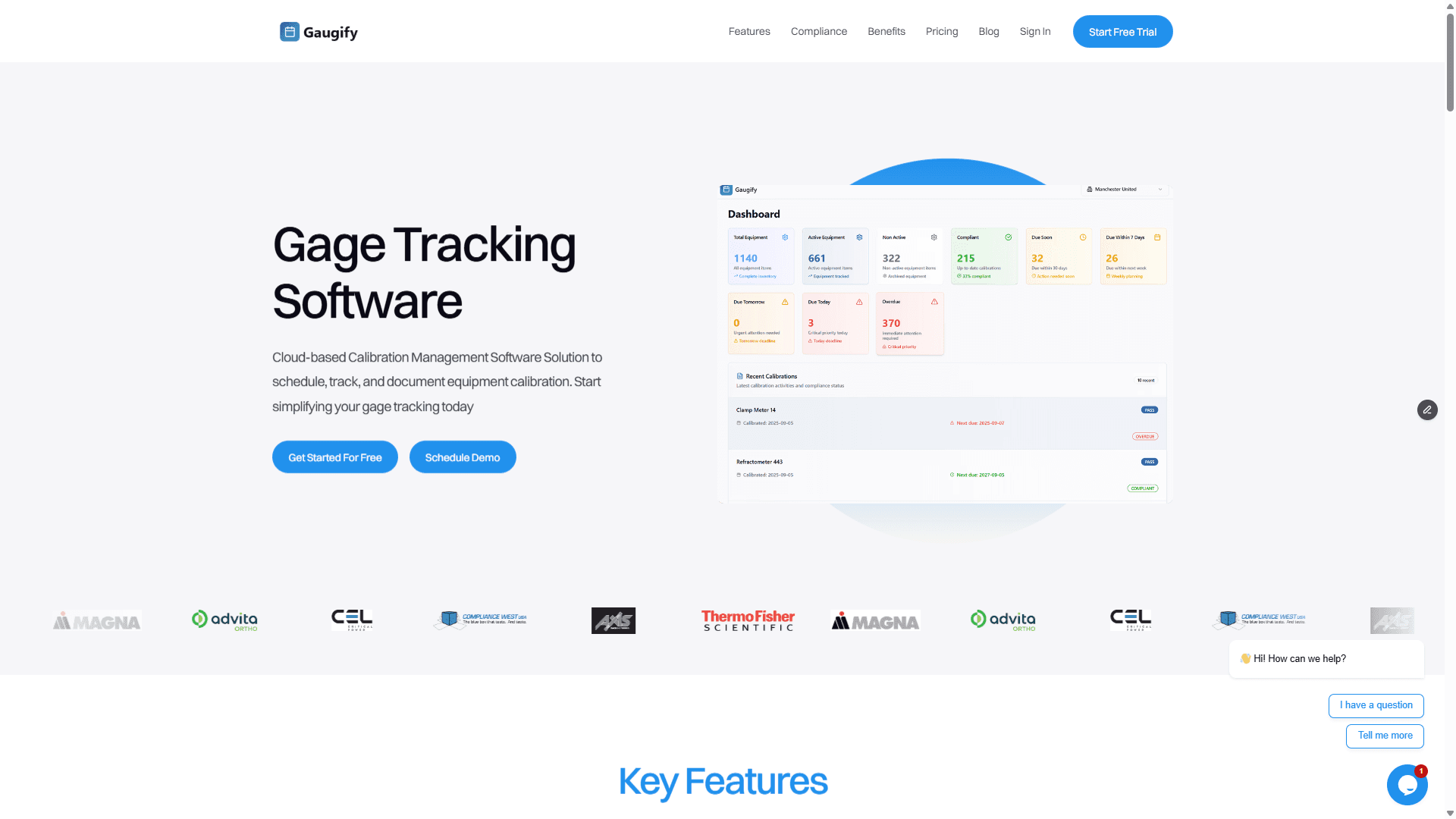
Managing caliper calibration across multiple locations and hundreds of instruments presents significant administrative challenges. Gaugify's cloud-based calibration management platform transforms this complex process into a streamlined, automated system.
The platform maintains detailed records for each caliper, including manufacturer, model, serial number, range, resolution, and accuracy specifications. Custom calibration procedures guide technicians through proper steps, ensuring consistency across different personnel and locations.
As-found and as-left data entry captures complete measurement results, automatically calculating errors and determining pass/fail status against defined acceptance criteria. The system flags instruments requiring adjustment or repair, preventing their return to service until properly corrected.
Certificate generation produces professional, detailed calibration certificates meeting customer and audit requirements. Digital certificates include measurement data, reference standard information, environmental conditions, and measurement uncertainty calculations.
Automated scheduling prevents missed calibrations through email and dashboard reminders. The system tracks calibration history, enabling interval optimization based on actual performance data. Quality managers receive executive dashboards showing calibration status, overdue instruments, and compliance metrics across their entire organization.
Consider how this streamlines operations: Instead of maintaining spreadsheets, chasing overdue calibrations, and manually creating certificates, your team focuses on value-added measurement activities while Gaugify handles administrative tasks automatically.
Start your free trial today to experience how modern calibration management transforms your quality system efficiency and compliance confidence.
Take Control of Your Caliper Calibration Program
Proper caliper calibration requires technical knowledge, appropriate reference standards, and systematic management processes. By following established procedures, maintaining proper environmental conditions, and avoiding common mistakes, organizations ensure measurement accuracy supporting quality objectives.
The administrative burden of tracking hundreds or thousands of calipers across multiple locations doesn't have to consume your quality team's time. Cloud-based calibration management provides the automation and visibility necessary for efficient, compliant programs.
Ready to modernize your calibration management approach? Schedule a personalized demo to see how Gaugify helps quality professionals like you maintain measurement traceability while reducing administrative overhead. Experience the confidence that comes from knowing your calibration program runs automatically, accurately, and in full compliance with industry requirements.
How to Calibrate Calipers: Digital and Dial
Calipers are among the most frequently used precision measuring instruments in manufacturing, quality control, and laboratory environments. Whether you're measuring the outer diameter of a machined shaft, the inner diameter of a bearing race, or the depth of a threaded hole, proper caliper calibration is essential for maintaining measurement accuracy and ensuring product quality. This comprehensive guide covers everything quality managers and technicians need to know about calibrating both digital and dial calipers to maintain traceability and meet industry standards.
Understanding Calipers and Their Critical Measurements
Calipers are versatile measuring instruments capable of taking four basic types of measurements: external dimensions (outside diameter, length, width), internal dimensions (inside diameter, slot width), depth measurements, and step height measurements. Modern calipers come in three primary types:
Digital calipers with LCD displays showing measurements in decimal format
Dial calipers featuring analog dial faces with pointer indicators
Vernier calipers using graduated scales for manual reading
Most precision calipers used in manufacturing environments have measuring ranges from 0-6 inches (0-150mm) or 0-8 inches (0-200mm), with resolutions of 0.0005 inches (0.01mm) for digital models and 0.001 inches (0.02mm) for dial versions. Higher-end models can achieve resolutions down to 0.0001 inches (0.002mm).
These instruments typically measure components with tolerances ranging from ±0.001 inches for precision machined parts to ±0.010 inches for general manufacturing applications. In automotive applications, calipers might measure brake rotor thickness with tolerances of ±0.0005 inches, while in aerospace manufacturing, critical dimensions often require tolerances of ±0.0002 inches or tighter.
Why Caliper Calibration Is Critical for Quality Control
Calipers are subject to measurement drift due to several factors that make regular calibration essential. Mechanical wear occurs at contact points between the measuring jaws and workpieces, gradually affecting accuracy over time. Digital calipers can experience electronic drift in their measurement circuits, while dial calipers may develop backlash in their gear mechanisms.
Environmental factors significantly impact caliper performance. Temperature variations cause thermal expansion in both the instrument and measured parts - a steel caliper measuring a steel part at 80°F versus 70°F can introduce errors of several tenths of thousands of an inch. Humidity affects electronic components in digital models, while contamination from coolants, chips, and handling can interfere with smooth jaw movement.
Consider a real-world scenario: A machine shop using uncalibrated calipers to measure bearing journal diameters discovers during a customer audit that their "precision" measurements were off by 0.003 inches. This error resulted in 200 rejected parts, a $15,000 scrap cost, and temporary loss of preferred supplier status. Regular caliper calibration prevents such costly quality failures.
From a compliance perspective, industries like aerospace (AS9100), automotive (IATF 16949), and medical devices (ISO 13485) require documented calibration programs for all measuring equipment. Modern calibration management systems help organizations maintain the detailed records necessary for these audit requirements.
Step-by-Step Caliper Calibration Procedure
Environmental Conditions and Setup
Before beginning caliper calibration, establish proper environmental conditions. The calibration area should maintain 68°F ± 2°F (20°C ± 1°C) with relative humidity between 40-60%. Allow both the caliper and reference standards to reach thermal equilibrium for at least 2 hours in the calibration environment.
Clean the caliper thoroughly using isopropyl alcohol and lint-free wipes. Inspect measuring surfaces for nicks, scratches, or wear that could affect accuracy. Check that jaws close completely with no light visible between them and that movement is smooth throughout the full range.
Reference Standards Required
Caliper calibration requires traceable reference standards with accuracy at least 4:1 better than the caliper being calibrated. For a caliper with ±0.001 inch accuracy, use standards accurate to ±0.00025 inches or better. Typical reference standards include:
Gage blocks: Grade 2 or better for external measurements (0.100", 1.000", 2.000", 4.000", 6.000")
Ring gages: Class X or XX for internal measurements (0.250", 1.000", 2.000")
Step height standards: For depth measurement verification (0.100", 0.500", 1.000")
Digital Caliper Calibration Steps
Step 1: Zero Setting Verification
Close the caliper jaws completely and press the zero/origin button. The display should read 0.000 (or 0.00mm). If the display shows any value other than zero after zeroing, note this as a pre-calibration finding.
Step 2: External Measurement Calibration
Place a 1.0000-inch gage block between the external jaws. Apply consistent, light pressure (approximately 2-3 pounds force). Record the displayed reading. The acceptance criteria is typically ±0.001 inches for standard 6-inch calipers. Repeat this process with 2.0000", 4.0000", and 6.0000" gage blocks.
Step 3: Internal Measurement Calibration
Using precision ring gages, carefully insert the caliper's internal measuring jaws. Start with a 1.0000" ring gage, ensuring the jaws are properly seated and perpendicular to the gage surface. Record readings and compare against the ring gage's certified dimension. Test additional sizes (2.0000", 3.0000") as required by your calibration procedure.
Step 4: Depth Measurement Verification
Position the caliper's depth probe against step height standards. Ensure the main body sits flat against the reference surface. Test multiple depths (0.1000", 0.5000", 1.0000") and record readings.
Dial Caliper Calibration Steps
Dial calipers follow similar procedures but require additional attention to pointer position and dial face alignment. Zero the dial when jaws are closed, then verify that the pointer moves smoothly without sticking or jumping as you open and close the jaws.
When measuring with gage blocks, watch for pointer oscillation or instability, which indicates worn mechanisms. Record both the main scale reading and dial position, calculating the total measurement. Acceptance criteria remain the same as digital calipers for equivalent accuracy grades.
Organizations using comprehensive calibration software can streamline this process by following guided procedures and automatically calculating measurement errors against acceptance criteria.
Relevant Calibration Standards and Requirements
Several standards govern caliper calibration procedures and acceptance criteria:
ISO 13385-1:2011 specifies geometrical product specifications for dimensional measuring equipment, including calipers. This standard defines maximum permissible errors based on measuring range and resolution.
ASME B89.1.14-2018 provides detailed procedures for calibrating calipers and similar measuring instruments. It establishes environmental requirements, reference standard specifications, and measurement uncertainty calculations.
NIST Special Publication 960-12 offers guidance on implementing dimensional calibration programs, including statistical analysis methods for calibration data.
Manufacturer specifications also play a crucial role. Mitutoyo specifies their 6-inch digital calipers should maintain ±0.001 inch accuracy, while Starrett's dial calipers carry ±0.001 inch specifications for similar ranges. Always consult manufacturer documentation for specific acceptance criteria.
For laboratories requiring ISO 17025 compliance, additional requirements apply for measurement uncertainty calculations, environmental monitoring, and calibration certificate content.
Optimal Caliper Calibration Intervals
Determining appropriate calibration intervals requires balancing measurement risk against calibration costs. Most organizations start with manufacturer recommendations - typically 12 months for precision calipers in normal use - then adjust based on actual performance data.
Several factors influence optimal intervals:
Usage frequency: Calipers used 40+ hours per week may require 6-month intervals
Measurement criticality: Instruments measuring safety-critical dimensions need more frequent calibration
Environmental conditions: Shop floor environments with temperature swings, coolants, and contamination accelerate drift
Historical performance: Instruments consistently passing calibration may qualify for extended intervals
A aerospace supplier found that calipers measuring critical flight control components required 6-month intervals to maintain required measurement uncertainty ratios, while the same caliper models used for non-critical dimensions could extend to 18-month intervals based on historical data.
Implement interval optimization programs by tracking calibration results over time. If a caliper consistently shows minimal drift (less than 25% of tolerance), consider extending the interval. Conversely, instruments frequently requiring adjustment should move to shorter intervals.
Common Caliper Calibration Mistakes and Prevention
Several recurring mistakes can compromise caliper calibration accuracy and validity:
Inadequate Temperature Stabilization
Rushing calibration without allowing thermal equilibrium leads to measurement errors. A caliper brought from a 60°F storage area to a 72°F calibration lab will show apparent dimensional changes as it warms up. Always allow 2+ hours for stabilization.
Improper Measuring Force
Excessive pressure when measuring with gage blocks or ring gages can cause elastic deformation, leading to false readings. Use consistent, light pressure - approximately 2-3 pounds force. Some technicians use torque-limiting devices to ensure repeatability.
Contaminated Reference Standards
Fingerprints, dust, or residue on gage blocks affects their dimensional accuracy. Clean all reference standards with appropriate solvents and handle with cotton gloves. Store in protective cases when not in use.
Ignoring Jaw Parallelism
Worn or damaged jaws may not close parallel, causing measurement errors that vary with jaw opening. Always verify zero setting and inspect jaw condition before calibration. Replace calipers showing significant jaw wear.
Inadequate Documentation
Recording only final "pass/fail" results without capturing as-found and as-left data limits your ability to analyze trends and optimize intervals. Document all measurements, environmental conditions, and any adjustments made.
Modern calibration management systems help prevent these mistakes by providing guided procedures, automatic calculations, and comprehensive data recording capabilities.
Streamlining Caliper Calibration Management with Gaugify
Managing caliper calibration across multiple locations and hundreds of instruments presents significant administrative challenges. Gaugify's cloud-based calibration management platform transforms this complex process into a streamlined, automated system.
The platform maintains detailed records for each caliper, including manufacturer, model, serial number, range, resolution, and accuracy specifications. Custom calibration procedures guide technicians through proper steps, ensuring consistency across different personnel and locations.
As-found and as-left data entry captures complete measurement results, automatically calculating errors and determining pass/fail status against defined acceptance criteria. The system flags instruments requiring adjustment or repair, preventing their return to service until properly corrected.
Certificate generation produces professional, detailed calibration certificates meeting customer and audit requirements. Digital certificates include measurement data, reference standard information, environmental conditions, and measurement uncertainty calculations.
Automated scheduling prevents missed calibrations through email and dashboard reminders. The system tracks calibration history, enabling interval optimization based on actual performance data. Quality managers receive executive dashboards showing calibration status, overdue instruments, and compliance metrics across their entire organization.
Consider how this streamlines operations: Instead of maintaining spreadsheets, chasing overdue calibrations, and manually creating certificates, your team focuses on value-added measurement activities while Gaugify handles administrative tasks automatically.
Start your free trial today to experience how modern calibration management transforms your quality system efficiency and compliance confidence.
Take Control of Your Caliper Calibration Program
Proper caliper calibration requires technical knowledge, appropriate reference standards, and systematic management processes. By following established procedures, maintaining proper environmental conditions, and avoiding common mistakes, organizations ensure measurement accuracy supporting quality objectives.
The administrative burden of tracking hundreds or thousands of calipers across multiple locations doesn't have to consume your quality team's time. Cloud-based calibration management provides the automation and visibility necessary for efficient, compliant programs.
Ready to modernize your calibration management approach? Schedule a personalized demo to see how Gaugify helps quality professionals like you maintain measurement traceability while reducing administrative overhead. Experience the confidence that comes from knowing your calibration program runs automatically, accurately, and in full compliance with industry requirements.