
How to Calibrate Dimensional Air Gages
How to Calibrate Dimensional Air Gages
David Bentley
Quality Assurance Engineer
12 min read
How to Calibrate Dimensional Air Gages
Dimensional air gages are precision measurement instruments that use compressed air flow to determine the size and geometric characteristics of machined parts with exceptional accuracy. Understanding proper air gage calibration procedures is essential for maintaining measurement reliability in manufacturing and quality control environments. These instruments require meticulous calibration protocols to ensure they deliver the micron-level precision that modern manufacturing demands.
Air gages operate on the principle that air flow through a restriction varies predictably with the size of that restriction. When measuring a part, the instrument forces air through a small gap between the gage head and the workpiece surface. Changes in this gap dimension directly affect the air flow rate or back pressure, which the system converts into dimensional readings. This elegant measurement principle makes air gages ideal for high-volume production environments where speed and repeatability are critical.
Understanding Dimensional Air Gages and Their Measurement Capabilities
Dimensional air gages excel at measuring internal and external diameters, tapers, roundness, and surface finish characteristics. Common applications include measuring cylinder bore diameters in automotive engines, hydraulic valve tolerances, and precision bearing races. These instruments typically achieve measurement uncertainties of ±0.1 to ±0.5 micrometers, making them indispensable for parts with tight tolerances like ±2.5 μm on critical engine components.
The measurement range of air gages varies significantly based on their design. Plug gages for internal measurements might cover ranges from 10mm to 150mm diameter, while snap gages for external measurements can handle parts from 5mm to 300mm. The key advantage lies in their ability to provide continuous dimensional feedback during machining operations, enabling real-time process control that traditional contact measurement methods cannot match.
Air gage systems consist of several critical components: the air supply unit with pressure regulation, the amplification unit that converts air flow changes to dimensional readings, the gage head containing the measurement jets, and the display unit. Each component contributes to overall measurement uncertainty and requires consideration during calibration planning.
Types of Air Gage Configurations
Back pressure systems maintain constant air flow while measuring pressure changes caused by gap variations. These systems work well for measuring internal dimensions like cylinder bores where the gage head fits inside the part. Flow systems maintain constant pressure while measuring air flow changes, making them suitable for external measurements and applications requiring multiple measurement points simultaneously.
Differential air gages compare the measurement point against a master reference, automatically compensating for air supply variations and temperature fluctuations. This configuration provides enhanced stability for critical measurements but requires careful selection and maintenance of the reference masters used during operation.
Critical Importance of Air Gage Calibration
Air gage calibration ensures measurement traceability and reliability in production environments where dimensional quality directly impacts product performance. Unlike many measurement instruments, air gages are highly sensitive to environmental conditions, air supply quality, and component wear, making regular calibration essential for maintaining measurement integrity.
Manufacturing environments subject air gages to contamination from machining fluids, temperature variations, and mechanical wear that gradually degrades measurement accuracy. A cylinder bore measurement system used in engine manufacturing might experience drift of 0.5 μm per month due to jet wear and contamination buildup. Without proper calibration tracking, this drift could result in accepting out-of-specification parts or rejecting good parts, both costly outcomes in high-volume production.
Regulatory compliance adds another layer of importance to air gage calibration. ISO/TS 16949 automotive quality standards require documented measurement system analysis and calibration for all gages used in production acceptance decisions. Similarly, aerospace manufacturers following AS9100 standards must maintain calibration records demonstrating measurement traceability to national standards.
The economic impact of uncalibrated air gages extends beyond immediate quality costs. Consider a transmission manufacturing line where bore measurement uncertainty increases from ±0.2 μm to ±1.0 μm due to calibration drift. This degradation might force tightening of machining tolerances to ensure final part quality, increasing manufacturing costs by 3-5% while reducing production throughput.
Measurement System Analysis Considerations
Air gages used for production decisions require regular Measurement System Analysis (MSA) studies to quantify repeatability and reproducibility. These studies depend on accurate calibration as their foundation. An air gage with calibration drift will show inflated measurement variation during MSA studies, potentially leading to unnecessary process adjustments or equipment replacement decisions.
Step-by-Step Air Gage Calibration Procedure
Successful air gage calibration requires careful attention to environmental conditions, reference standards, and measurement procedures. The process begins with environmental stabilization, ensuring the calibration area maintains 20°C ±2°C temperature with relative humidity between 45-75%. Temperature variations during calibration can introduce measurement errors exceeding the instrument's specification limits.
Reference standards for air gage calibration must have measurement uncertainty at least four times better than the gage being calibrated. For an air gage with ±0.5 μm accuracy specification, reference standards should have uncertainties no greater than ±0.125 μm. Common reference standards include steel or ceramic ring gages for internal measurements and precision cylinders for external measurements, all with NIST-traceable calibration certificates.
Pre-Calibration Preparation
Begin calibration by verifying air supply quality and pressure stability. The air supply should provide clean, dry air at the manufacturer's specified pressure, typically 20-100 PSI depending on the instrument design. Install a pressure gauge at the instrument input to monitor supply stability throughout the calibration process. Pressure variations exceeding ±1% can introduce measurement errors that mask calibration adjustments.
Clean all gage heads and measurement surfaces using appropriate solvents to remove contamination that could affect air flow characteristics. Inspect gage heads under magnification to identify wear or damage to measurement jets. Replace any damaged components before proceeding with calibration.
Allow the complete system to stabilize for at least 30 minutes after initial power-up. Air gage electronics and pneumatic components require thermal equilibrium to achieve specification performance. During this stabilization period, verify that all display functions operate correctly and that the instrument passes any built-in diagnostic tests.
Calibration Measurement Procedure
Select reference standards covering the instrument's full measurement range, with additional standards at critical measurement points. For a cylinder bore gage measuring 80mm ±0.025mm parts, use reference standards at 79.975mm, 80.000mm, and 80.025mm minimum, with additional standards at 79.990mm and 80.010mm for enhanced verification.
Position the first reference standard in the measurement zone and allow readings to stabilize for 10-15 seconds. Record five consecutive readings at 5-second intervals to assess measurement repeatability. Calculate the standard deviation of these readings - it should not exceed 10% of the instrument's resolution specification.
Compare the average reading against the reference standard's certified value. The difference represents the instrument's bias at that measurement point. Repeat this process for all reference standards, creating a complete bias profile across the measurement range.
Document both "as-found" conditions before any adjustments and "as-left" conditions after calibration completion. This data provides insight into instrument drift patterns and helps optimize calibration intervals. Modern calibration management systems automatically track these trends to predict when instruments approach specification limits.
Calibration Adjustments and Verification
Most air gages provide electronic span and offset adjustments to correct measurement bias. Refer to the manufacturer's procedure for adjustment methods, as these vary significantly between instrument designs. Some systems require multi-point calibration adjustments while others use simple two-point scaling.
After completing adjustments, verify calibration accuracy using independent reference standards not used during the adjustment process. This verification step confirms that adjustments improved measurement accuracy without introducing non-linearity or other systematic errors.
Perform a final repeatability assessment at three points across the measurement range. Each point should demonstrate repeatability within the manufacturer's specification limits. If repeatability degrades after calibration adjustments, investigate potential issues with reference standards, environmental conditions, or instrument condition.
Relevant Calibration Standards and Specifications
Air gage calibration procedures must comply with several international and industry-specific standards to ensure measurement traceability and regulatory compliance. ISO 14253-2 provides general guidance for measurement equipment calibration in manufacturing environments, establishing principles for calibration interval determination and measurement uncertainty analysis.
ASME B89.1.5 specifically addresses air gage calibration requirements, including reference standard specifications, environmental conditions, and documentation requirements. This standard requires that calibration procedures demonstrate measurement traceability to national standards through an unbroken chain of calibrations, each with documented measurement uncertainties.
Automotive manufacturers often reference additional standards like ISO/TS 16949 for production measurement equipment. These standards require statistical analysis of calibration data to verify that measurement systems remain capable of detecting out-of-specification parts throughout their calibration intervals.
Industry-Specific Requirements
Aerospace applications following AS9100 standards impose additional requirements for calibration procedures and record keeping. These applications often require shorter calibration intervals and enhanced documentation to support critical safety applications. Medical device manufacturers under ISO 13485 have similar enhanced requirements for measurement equipment used in production acceptance decisions.
Some industries require compliance with ISO 17025 calibration standards when calibrations are performed by external laboratories. This standard ensures that calibration services maintain appropriate technical competence and quality management systems to support measurement traceability claims.
Recommended Air Gage Calibration Intervals
Air gage calibration intervals depend on usage intensity, environmental conditions, and measurement criticality. Production gages operating in machining environments typically require calibration every 3-6 months due to contamination exposure and mechanical wear. Laboratory reference gages in controlled environments might maintain calibration for 12-24 months with proper care and handling.
High-volume production environments accelerate calibration requirements. An air gage measuring 1000 parts per day experiences significantly more wear than one measuring 50 parts per day. Monitor calibration history to identify drift patterns that indicate when more frequent calibration becomes necessary. Instruments showing consistent drift approaching 25% of specification limits between calibrations need shorter intervals.
Environmental factors significantly impact calibration stability. Temperature cycling, humidity variations, and airborne contamination all contribute to measurement drift. Gages operating in temperature-controlled metrology labs maintain calibration longer than those in production environments with ±5°C temperature variations.
Ready to streamline your air gage calibration management? Start your free trial today and see how automated scheduling and drift tracking can optimize your calibration intervals while ensuring compliance.
Risk-Based Calibration Interval Optimization
Risk-based calibration approaches consider the consequences of measurement errors when determining appropriate intervals. Critical safety applications might require monthly calibration verification even when historical data suggests longer intervals are technically acceptable. Cost-sensitive applications might extend intervals slightly while implementing additional process controls to detect measurement issues.
Statistical analysis of calibration history provides objective data for interval optimization. Track the percentage of instruments found out-of-specification during calibration over time. If this percentage remains below 5% for a specific instrument type, consider extending intervals by 25% while monitoring results. If out-of-specification rates exceed 15%, immediately reduce intervals until stability improves.
Common Air Gage Calibration Mistakes and Prevention
Temperature-related errors represent the most common calibration mistake with air gages. Performing calibration immediately after moving instruments between environments introduces thermal expansion errors that can exceed measurement specifications. Always allow complete thermal stabilization before beginning calibration procedures, particularly when moving gages from production areas to calibration labs with different temperatures.
Reference standard selection errors compromise calibration accuracy and traceability. Using reference standards with insufficient accuracy ratios invalidates calibration results. Ensure reference standard uncertainties are at least 4:1 better than the instrument being calibrated, and verify that reference standard calibrations remain current throughout the calibration process.
Inadequate air supply preparation causes inconsistent calibration results and premature instrument wear. Contaminated or unstable air supplies introduce measurement variations that mask actual calibration adjustments. Install appropriate filtration, pressure regulation, and moisture removal equipment to ensure consistent air quality during calibration.
Documentation and Record-Keeping Errors
Incomplete calibration documentation creates compliance risks and prevents effective drift analysis. Record all environmental conditions, reference standards used, adjustment procedures performed, and final verification results. Modern calibration management software eliminates many documentation errors by providing structured data entry forms and automatic calculation of key parameters.
Failing to track "as-found" conditions before calibration adjustments prevents analysis of instrument drift patterns. This data helps optimize calibration intervals and identify instruments requiring more frequent attention. Comprehensive calibration tracking systems automatically capture and analyze this information to improve calibration program effectiveness.
Managing Air Gage Calibration with Modern Software
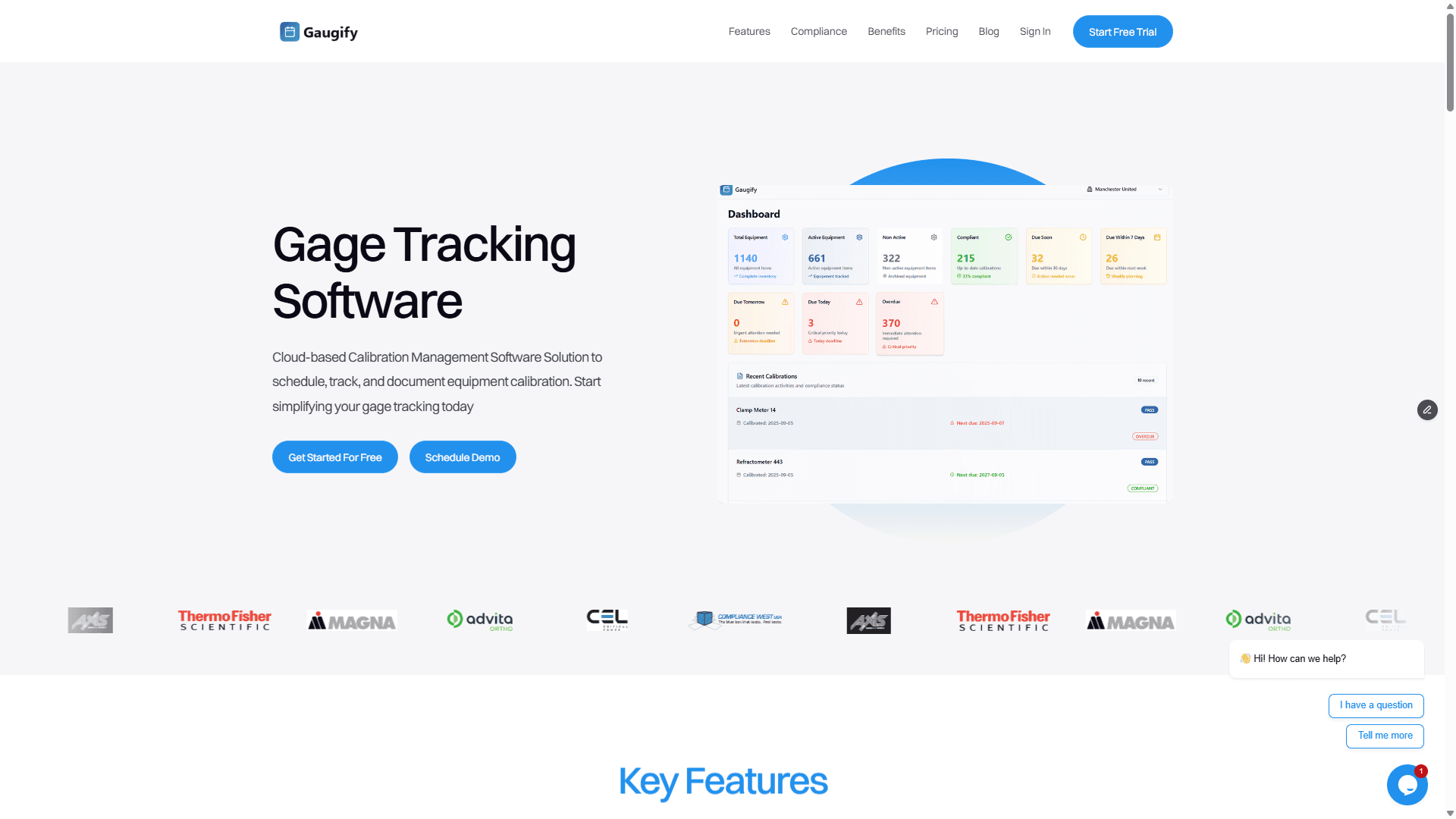
Modern calibration management software transforms air gage calibration from a paper-based administrative burden into a streamlined digital process that enhances both efficiency and compliance. Gaugify's calibration management platform specifically addresses the unique requirements of dimensional measurement equipment like air gages, providing automated scheduling, comprehensive data tracking, and intelligent analysis capabilities.
The software automatically schedules calibration activities based on configurable intervals, sending advance notifications to prevent instruments from falling overdue. For air gages with 6-month calibration intervals, the system can send 30-day, 14-day, and 3-day advance warnings to ensure calibration completion before expiration. This proactive approach eliminates the compliance risks associated with overdue instruments while optimizing calibration resource allocation.
Digital calibration certificates replace paper-based documentation with searchable, tamper-evident records that include all required traceability information. Each certificate links to reference standard calibration records, creating an unbroken traceability chain that satisfies audit requirements. Certificate templates automatically populate with instrument-specific information, eliminating transcription errors while ensuring consistency across all calibration records.
As-Found and As-Left Data Analysis
Gaugify captures both as-found and as-left measurement data during calibration, enabling sophisticated drift analysis that helps optimize calibration intervals and predict instrument failures. The system automatically calculates drift rates, identifies instruments approaching specification limits, and recommends interval adjustments based on historical performance data.
Trend analysis capabilities reveal patterns that manual record-keeping systems cannot detect. For example, the software might identify that air gages in a specific production area consistently drift 20% faster than similar instruments elsewhere, indicating environmental factors requiring attention. This insight enables proactive process improvements that reduce both calibration costs and quality risks.
Statistical process control charts track key calibration parameters over time, highlighting unusual variations that might indicate measurement system problems. When an air gage shows sudden drift acceleration, the system alerts calibration technicians to investigate potential causes like contamination, wear, or environmental changes.
Integration with Production Systems
Advanced calibration management systems integrate with production databases to track which parts were measured with specific instruments during their calibration periods. If a gage is found significantly out-of-specification during calibration, the system can automatically identify all parts measured with that instrument since its last successful calibration, enabling targeted quality investigations.
Mobile accessibility ensures calibration technicians can access instrument information, update calibration records, and generate certificates directly from the production floor. This capability eliminates delays in returning calibrated instruments to service while ensuring that calibration records remain current and accessible for audit purposes.
Optimizing Your Air Gage Calibration Program
Successful air gage calibration programs balance measurement quality requirements with operational efficiency through systematic planning and continuous improvement. Regular program assessment identifies opportunities to reduce costs while enhancing measurement reliability and regulatory compliance.
Calibration data analysis reveals which instruments consistently perform well and which require more frequent attention. This information supports risk-based interval adjustments that focus calibration resources on instruments with higher drift rates while extending intervals for stable instruments. The result is improved measurement reliability at reduced overall calibration costs.
Standardized procedures ensure consistent calibration quality regardless of which technician performs the work. Document step-by-step procedures for each instrument type, including specific reference standards, environmental requirements, and acceptance criteria. Regular technician training on these procedures maintains calibration quality while reducing the time required for each calibration activity.
Ready to transform your air gage calibration management? Gaugify's modern calibration software provides everything you need to maintain measurement traceability, ensure regulatory compliance, and optimize calibration costs. Our intuitive platform handles scheduling, documentation, and analysis automatically, freeing your team to focus on maintaining measurement quality rather than administrative tasks.
Start your free trial today and discover how easy calibration management can be. Join thousands of quality professionals who trust Gaugify to keep their measurement systems calibrated, compliant, and ready for audit. Your first 30 days are completely free - no credit card required.
How to Calibrate Dimensional Air Gages
Dimensional air gages are precision measurement instruments that use compressed air flow to determine the size and geometric characteristics of machined parts with exceptional accuracy. Understanding proper air gage calibration procedures is essential for maintaining measurement reliability in manufacturing and quality control environments. These instruments require meticulous calibration protocols to ensure they deliver the micron-level precision that modern manufacturing demands.
Air gages operate on the principle that air flow through a restriction varies predictably with the size of that restriction. When measuring a part, the instrument forces air through a small gap between the gage head and the workpiece surface. Changes in this gap dimension directly affect the air flow rate or back pressure, which the system converts into dimensional readings. This elegant measurement principle makes air gages ideal for high-volume production environments where speed and repeatability are critical.
Understanding Dimensional Air Gages and Their Measurement Capabilities
Dimensional air gages excel at measuring internal and external diameters, tapers, roundness, and surface finish characteristics. Common applications include measuring cylinder bore diameters in automotive engines, hydraulic valve tolerances, and precision bearing races. These instruments typically achieve measurement uncertainties of ±0.1 to ±0.5 micrometers, making them indispensable for parts with tight tolerances like ±2.5 μm on critical engine components.
The measurement range of air gages varies significantly based on their design. Plug gages for internal measurements might cover ranges from 10mm to 150mm diameter, while snap gages for external measurements can handle parts from 5mm to 300mm. The key advantage lies in their ability to provide continuous dimensional feedback during machining operations, enabling real-time process control that traditional contact measurement methods cannot match.
Air gage systems consist of several critical components: the air supply unit with pressure regulation, the amplification unit that converts air flow changes to dimensional readings, the gage head containing the measurement jets, and the display unit. Each component contributes to overall measurement uncertainty and requires consideration during calibration planning.
Types of Air Gage Configurations
Back pressure systems maintain constant air flow while measuring pressure changes caused by gap variations. These systems work well for measuring internal dimensions like cylinder bores where the gage head fits inside the part. Flow systems maintain constant pressure while measuring air flow changes, making them suitable for external measurements and applications requiring multiple measurement points simultaneously.
Differential air gages compare the measurement point against a master reference, automatically compensating for air supply variations and temperature fluctuations. This configuration provides enhanced stability for critical measurements but requires careful selection and maintenance of the reference masters used during operation.
Critical Importance of Air Gage Calibration
Air gage calibration ensures measurement traceability and reliability in production environments where dimensional quality directly impacts product performance. Unlike many measurement instruments, air gages are highly sensitive to environmental conditions, air supply quality, and component wear, making regular calibration essential for maintaining measurement integrity.
Manufacturing environments subject air gages to contamination from machining fluids, temperature variations, and mechanical wear that gradually degrades measurement accuracy. A cylinder bore measurement system used in engine manufacturing might experience drift of 0.5 μm per month due to jet wear and contamination buildup. Without proper calibration tracking, this drift could result in accepting out-of-specification parts or rejecting good parts, both costly outcomes in high-volume production.
Regulatory compliance adds another layer of importance to air gage calibration. ISO/TS 16949 automotive quality standards require documented measurement system analysis and calibration for all gages used in production acceptance decisions. Similarly, aerospace manufacturers following AS9100 standards must maintain calibration records demonstrating measurement traceability to national standards.
The economic impact of uncalibrated air gages extends beyond immediate quality costs. Consider a transmission manufacturing line where bore measurement uncertainty increases from ±0.2 μm to ±1.0 μm due to calibration drift. This degradation might force tightening of machining tolerances to ensure final part quality, increasing manufacturing costs by 3-5% while reducing production throughput.
Measurement System Analysis Considerations
Air gages used for production decisions require regular Measurement System Analysis (MSA) studies to quantify repeatability and reproducibility. These studies depend on accurate calibration as their foundation. An air gage with calibration drift will show inflated measurement variation during MSA studies, potentially leading to unnecessary process adjustments or equipment replacement decisions.
Step-by-Step Air Gage Calibration Procedure
Successful air gage calibration requires careful attention to environmental conditions, reference standards, and measurement procedures. The process begins with environmental stabilization, ensuring the calibration area maintains 20°C ±2°C temperature with relative humidity between 45-75%. Temperature variations during calibration can introduce measurement errors exceeding the instrument's specification limits.
Reference standards for air gage calibration must have measurement uncertainty at least four times better than the gage being calibrated. For an air gage with ±0.5 μm accuracy specification, reference standards should have uncertainties no greater than ±0.125 μm. Common reference standards include steel or ceramic ring gages for internal measurements and precision cylinders for external measurements, all with NIST-traceable calibration certificates.
Pre-Calibration Preparation
Begin calibration by verifying air supply quality and pressure stability. The air supply should provide clean, dry air at the manufacturer's specified pressure, typically 20-100 PSI depending on the instrument design. Install a pressure gauge at the instrument input to monitor supply stability throughout the calibration process. Pressure variations exceeding ±1% can introduce measurement errors that mask calibration adjustments.
Clean all gage heads and measurement surfaces using appropriate solvents to remove contamination that could affect air flow characteristics. Inspect gage heads under magnification to identify wear or damage to measurement jets. Replace any damaged components before proceeding with calibration.
Allow the complete system to stabilize for at least 30 minutes after initial power-up. Air gage electronics and pneumatic components require thermal equilibrium to achieve specification performance. During this stabilization period, verify that all display functions operate correctly and that the instrument passes any built-in diagnostic tests.
Calibration Measurement Procedure
Select reference standards covering the instrument's full measurement range, with additional standards at critical measurement points. For a cylinder bore gage measuring 80mm ±0.025mm parts, use reference standards at 79.975mm, 80.000mm, and 80.025mm minimum, with additional standards at 79.990mm and 80.010mm for enhanced verification.
Position the first reference standard in the measurement zone and allow readings to stabilize for 10-15 seconds. Record five consecutive readings at 5-second intervals to assess measurement repeatability. Calculate the standard deviation of these readings - it should not exceed 10% of the instrument's resolution specification.
Compare the average reading against the reference standard's certified value. The difference represents the instrument's bias at that measurement point. Repeat this process for all reference standards, creating a complete bias profile across the measurement range.
Document both "as-found" conditions before any adjustments and "as-left" conditions after calibration completion. This data provides insight into instrument drift patterns and helps optimize calibration intervals. Modern calibration management systems automatically track these trends to predict when instruments approach specification limits.
Calibration Adjustments and Verification
Most air gages provide electronic span and offset adjustments to correct measurement bias. Refer to the manufacturer's procedure for adjustment methods, as these vary significantly between instrument designs. Some systems require multi-point calibration adjustments while others use simple two-point scaling.
After completing adjustments, verify calibration accuracy using independent reference standards not used during the adjustment process. This verification step confirms that adjustments improved measurement accuracy without introducing non-linearity or other systematic errors.
Perform a final repeatability assessment at three points across the measurement range. Each point should demonstrate repeatability within the manufacturer's specification limits. If repeatability degrades after calibration adjustments, investigate potential issues with reference standards, environmental conditions, or instrument condition.
Relevant Calibration Standards and Specifications
Air gage calibration procedures must comply with several international and industry-specific standards to ensure measurement traceability and regulatory compliance. ISO 14253-2 provides general guidance for measurement equipment calibration in manufacturing environments, establishing principles for calibration interval determination and measurement uncertainty analysis.
ASME B89.1.5 specifically addresses air gage calibration requirements, including reference standard specifications, environmental conditions, and documentation requirements. This standard requires that calibration procedures demonstrate measurement traceability to national standards through an unbroken chain of calibrations, each with documented measurement uncertainties.
Automotive manufacturers often reference additional standards like ISO/TS 16949 for production measurement equipment. These standards require statistical analysis of calibration data to verify that measurement systems remain capable of detecting out-of-specification parts throughout their calibration intervals.
Industry-Specific Requirements
Aerospace applications following AS9100 standards impose additional requirements for calibration procedures and record keeping. These applications often require shorter calibration intervals and enhanced documentation to support critical safety applications. Medical device manufacturers under ISO 13485 have similar enhanced requirements for measurement equipment used in production acceptance decisions.
Some industries require compliance with ISO 17025 calibration standards when calibrations are performed by external laboratories. This standard ensures that calibration services maintain appropriate technical competence and quality management systems to support measurement traceability claims.
Recommended Air Gage Calibration Intervals
Air gage calibration intervals depend on usage intensity, environmental conditions, and measurement criticality. Production gages operating in machining environments typically require calibration every 3-6 months due to contamination exposure and mechanical wear. Laboratory reference gages in controlled environments might maintain calibration for 12-24 months with proper care and handling.
High-volume production environments accelerate calibration requirements. An air gage measuring 1000 parts per day experiences significantly more wear than one measuring 50 parts per day. Monitor calibration history to identify drift patterns that indicate when more frequent calibration becomes necessary. Instruments showing consistent drift approaching 25% of specification limits between calibrations need shorter intervals.
Environmental factors significantly impact calibration stability. Temperature cycling, humidity variations, and airborne contamination all contribute to measurement drift. Gages operating in temperature-controlled metrology labs maintain calibration longer than those in production environments with ±5°C temperature variations.
Ready to streamline your air gage calibration management? Start your free trial today and see how automated scheduling and drift tracking can optimize your calibration intervals while ensuring compliance.
Risk-Based Calibration Interval Optimization
Risk-based calibration approaches consider the consequences of measurement errors when determining appropriate intervals. Critical safety applications might require monthly calibration verification even when historical data suggests longer intervals are technically acceptable. Cost-sensitive applications might extend intervals slightly while implementing additional process controls to detect measurement issues.
Statistical analysis of calibration history provides objective data for interval optimization. Track the percentage of instruments found out-of-specification during calibration over time. If this percentage remains below 5% for a specific instrument type, consider extending intervals by 25% while monitoring results. If out-of-specification rates exceed 15%, immediately reduce intervals until stability improves.
Common Air Gage Calibration Mistakes and Prevention
Temperature-related errors represent the most common calibration mistake with air gages. Performing calibration immediately after moving instruments between environments introduces thermal expansion errors that can exceed measurement specifications. Always allow complete thermal stabilization before beginning calibration procedures, particularly when moving gages from production areas to calibration labs with different temperatures.
Reference standard selection errors compromise calibration accuracy and traceability. Using reference standards with insufficient accuracy ratios invalidates calibration results. Ensure reference standard uncertainties are at least 4:1 better than the instrument being calibrated, and verify that reference standard calibrations remain current throughout the calibration process.
Inadequate air supply preparation causes inconsistent calibration results and premature instrument wear. Contaminated or unstable air supplies introduce measurement variations that mask actual calibration adjustments. Install appropriate filtration, pressure regulation, and moisture removal equipment to ensure consistent air quality during calibration.
Documentation and Record-Keeping Errors
Incomplete calibration documentation creates compliance risks and prevents effective drift analysis. Record all environmental conditions, reference standards used, adjustment procedures performed, and final verification results. Modern calibration management software eliminates many documentation errors by providing structured data entry forms and automatic calculation of key parameters.
Failing to track "as-found" conditions before calibration adjustments prevents analysis of instrument drift patterns. This data helps optimize calibration intervals and identify instruments requiring more frequent attention. Comprehensive calibration tracking systems automatically capture and analyze this information to improve calibration program effectiveness.
Managing Air Gage Calibration with Modern Software
Modern calibration management software transforms air gage calibration from a paper-based administrative burden into a streamlined digital process that enhances both efficiency and compliance. Gaugify's calibration management platform specifically addresses the unique requirements of dimensional measurement equipment like air gages, providing automated scheduling, comprehensive data tracking, and intelligent analysis capabilities.
The software automatically schedules calibration activities based on configurable intervals, sending advance notifications to prevent instruments from falling overdue. For air gages with 6-month calibration intervals, the system can send 30-day, 14-day, and 3-day advance warnings to ensure calibration completion before expiration. This proactive approach eliminates the compliance risks associated with overdue instruments while optimizing calibration resource allocation.
Digital calibration certificates replace paper-based documentation with searchable, tamper-evident records that include all required traceability information. Each certificate links to reference standard calibration records, creating an unbroken traceability chain that satisfies audit requirements. Certificate templates automatically populate with instrument-specific information, eliminating transcription errors while ensuring consistency across all calibration records.
As-Found and As-Left Data Analysis
Gaugify captures both as-found and as-left measurement data during calibration, enabling sophisticated drift analysis that helps optimize calibration intervals and predict instrument failures. The system automatically calculates drift rates, identifies instruments approaching specification limits, and recommends interval adjustments based on historical performance data.
Trend analysis capabilities reveal patterns that manual record-keeping systems cannot detect. For example, the software might identify that air gages in a specific production area consistently drift 20% faster than similar instruments elsewhere, indicating environmental factors requiring attention. This insight enables proactive process improvements that reduce both calibration costs and quality risks.
Statistical process control charts track key calibration parameters over time, highlighting unusual variations that might indicate measurement system problems. When an air gage shows sudden drift acceleration, the system alerts calibration technicians to investigate potential causes like contamination, wear, or environmental changes.
Integration with Production Systems
Advanced calibration management systems integrate with production databases to track which parts were measured with specific instruments during their calibration periods. If a gage is found significantly out-of-specification during calibration, the system can automatically identify all parts measured with that instrument since its last successful calibration, enabling targeted quality investigations.
Mobile accessibility ensures calibration technicians can access instrument information, update calibration records, and generate certificates directly from the production floor. This capability eliminates delays in returning calibrated instruments to service while ensuring that calibration records remain current and accessible for audit purposes.
Optimizing Your Air Gage Calibration Program
Successful air gage calibration programs balance measurement quality requirements with operational efficiency through systematic planning and continuous improvement. Regular program assessment identifies opportunities to reduce costs while enhancing measurement reliability and regulatory compliance.
Calibration data analysis reveals which instruments consistently perform well and which require more frequent attention. This information supports risk-based interval adjustments that focus calibration resources on instruments with higher drift rates while extending intervals for stable instruments. The result is improved measurement reliability at reduced overall calibration costs.
Standardized procedures ensure consistent calibration quality regardless of which technician performs the work. Document step-by-step procedures for each instrument type, including specific reference standards, environmental requirements, and acceptance criteria. Regular technician training on these procedures maintains calibration quality while reducing the time required for each calibration activity.
Ready to transform your air gage calibration management? Gaugify's modern calibration software provides everything you need to maintain measurement traceability, ensure regulatory compliance, and optimize calibration costs. Our intuitive platform handles scheduling, documentation, and analysis automatically, freeing your team to focus on maintaining measurement quality rather than administrative tasks.
Start your free trial today and discover how easy calibration management can be. Join thousands of quality professionals who trust Gaugify to keep their measurement systems calibrated, compliant, and ready for audit. Your first 30 days are completely free - no credit card required.