
How to Calibrate Feeler Gauges
How to Calibrate Feeler Gauges
David Bentley
Quality Assurance Engineer
12 min read
How to Calibrate Feeler Gauges
Feeler gauges are among the most commonly used precision measurement tools in manufacturing, automotive repair, and mechanical maintenance operations. These thin, flexible metal blades enable technicians to measure narrow gaps, clearances, and spacing with remarkable accuracy. However, like all precision instruments, feeler gauges require regular feeler gauge calibration to maintain their accuracy and ensure reliable measurements that meet quality standards and regulatory requirements.
Whether you're measuring valve clearances in an automotive engine, checking bearing clearances in machinery, or verifying gap tolerances in manufacturing assemblies, properly calibrated feeler gauges are essential for maintaining product quality and operational safety. This comprehensive guide will walk you through the complete calibration process, from understanding why calibration matters to implementing a robust calibration management system.
Understanding Feeler Gauges and Their Measurement Applications
Feeler gauges, also known as thickness gauges or gap gauges, consist of multiple thin metal blades of precisely manufactured thicknesses, typically ranging from 0.002 inches (0.05 mm) to 0.040 inches (1.0 mm) or more. Each blade is clearly marked with its nominal thickness value and arranged in a fan-like configuration held together by a handle or pivot mechanism.
These instruments measure linear dimensions by insertion into narrow spaces where other measuring tools cannot fit. Common applications include:
Automotive maintenance: Measuring spark plug gaps (typically 0.028" to 0.060"), valve clearances (0.006" to 0.012"), and distributor point gaps
Manufacturing quality control: Checking clearances between mating parts, verifying assembly tolerances within ±0.001" specifications
Machinery maintenance: Measuring bearing clearances, shaft-to-housing gaps, and alignment tolerances
Welding operations: Setting root opening gaps in pipe welding (typically 1/16" to 1/8")
Electrical work: Adjusting contact gaps in switches and relays
The accuracy of feeler gauge measurements directly impacts product quality, safety, and performance. A spark plug gap that's off by even 0.005" can cause engine misfiring, while incorrect bearing clearances can lead to premature mechanical failure.
Why Feeler Gauge Calibration Is Critical
Feeler gauge calibration ensures measurement accuracy and traceability, which are fundamental requirements for quality management systems and regulatory compliance. Several factors make regular calibration essential:
Wear and Deformation: Repeated insertion into tight spaces gradually wears blade edges and can cause permanent deformation. A 0.010" blade that has worn to 0.009" will provide false readings, potentially leading to over-tightened assemblies or inadequate clearances.
Environmental Effects: Temperature variations cause thermal expansion and contraction of the steel blades. Corrosion from moisture or chemical exposure can alter blade thickness through material loss or buildup.
Handling Damage: Dropping, bending, or forcing blades into undersized gaps can permanently alter their dimensions. Even minor damage invisible to the naked eye can affect measurement accuracy.
Regulatory Requirements: Industries like aerospace (AS9100), automotive (IATF 16949), and medical devices (ISO 13485) mandate calibrated measurement equipment. ISO 9001 quality management systems require measurement traceability to national standards.
Cost of Non-Conformance: Using out-of-tolerance feeler gauges can result in defective products, warranty claims, safety incidents, and regulatory violations. The cost of proper calibration is minimal compared to these potential consequences.
Step-by-Step Feeler Gauge Calibration Procedure
Proper feeler gauge calibration requires controlled environmental conditions, appropriate reference standards, and systematic measurement procedures. Here's the detailed process:
Environmental Requirements
Calibration must be performed in a controlled environment meeting these specifications:
Temperature: 68°F ± 2°F (20°C ± 1°C) with thermal stability
Humidity: 45% to 55% relative humidity to prevent corrosion
Vibration: Minimal mechanical vibration that could affect measurements
Cleanliness: Dust-free environment to prevent contamination
Allow both the feeler gauges and reference standards to reach thermal equilibrium for at least 2 hours before beginning calibration.
Required Reference Standards
Calibration requires reference standards with accuracy at least 4:1 better than the feeler gauge tolerance. Typical reference standards include:
Calibrated gage blocks: Grade 0 or Grade 1 blocks traceable to NIST
Micrometer: 0-1" outside micrometer with 0.0001" resolution
Dial indicator: 0.0001" resolution indicator with magnetic base
Surface plate: Grade A granite surface plate for measurement reference
Calibration Steps
Step 1: Visual Inspection
Examine each blade for visible damage including nicks, burrs, corrosion, permanent bending, or worn edges. Any blade showing damage should be rejected or repaired before calibration.
Step 2: Cleaning
Clean all blades with appropriate solvent (typically isopropyl alcohol) to remove oil, dirt, and debris. Ensure complete drying before measurement.
Step 3: Thickness Measurement
Measure each blade thickness using the reference micrometer:
Position the blade between micrometer anvils near the tip area used for measurements
Apply consistent measuring force (typically 2-5 pounds)
Take readings at three points: near the tip, middle, and base of the working area
Record the average thickness for each blade
Step 4: Flatness and Parallelism Check
Using a dial indicator and surface plate:
Place the blade flat on the surface plate
Move the dial indicator along the blade length, checking for warpage
Maximum deviation should not exceed ±0.0002" over the working length
Step 5: Functional Test
Test blade flexibility and spring characteristics by gently bending and releasing. Blades should return to their original flat position without permanent set.
Acceptance Criteria
Industry-standard tolerance for feeler gauge calibration typically follows these guidelines:
Blades ≤ 0.010": ±0.0002" tolerance
Blades 0.011" to 0.025": ±0.0003" tolerance
Blades > 0.025": ±0.0005" tolerance
Any blade exceeding these tolerances must be rejected or adjusted if possible.
Ready to streamline your calibration process? Start your free trial of Gaugify and see how our cloud-based system can automate your feeler gauge calibration scheduling and documentation.
Relevant Calibration Standards and Specifications
Several standards govern feeler gauge calibration requirements and procedures:
ISO Standards
ISO 17025: General requirements for testing and calibration laboratories, establishing competency and quality management requirements
ISO 9001: Quality management systems requiring measurement equipment calibration and traceability
ISO 10012: Measurement management systems providing guidance for calibration processes
ASTM Standards
ASTM E177: Standard practice for use of terms precision and bias in test methods
ASTM E691: Standard practice for conducting interlaboratory studies
Military and Aerospace Standards
MIL-STD-45662: Calibration system requirements (now cancelled but still referenced)
AS9100: Aerospace quality management systems requiring calibrated measurement equipment
Manufacturer Specifications
Leading feeler gauge manufacturers like Starrett, Mitutoyo, and Brown & Sharpe provide specific calibration procedures and tolerance requirements in their product documentation. Always consult manufacturer specifications for instrument-specific requirements.
For organizations requiring ISO 17025 compliance, Gaugify provides comprehensive documentation and traceability features to meet accreditation requirements.
Calibration Intervals and Frequency Recommendations
Determining appropriate calibration intervals for feeler gauges depends on several factors that affect measurement accuracy over time:
Standard Calibration Intervals
Heavy industrial use: Every 6 months
Moderate manufacturing use: Annually
Light laboratory use: Every 12-18 months
Infrequent use: Every 2 years minimum
Factors Affecting Calibration Frequency
Usage Intensity: Frequent insertion into tight gaps accelerates blade wear. Automotive technicians using feeler gauges daily may require 6-month intervals, while occasional-use applications can extend to annual calibration.
Environmental Conditions: Harsh environments with temperature extremes, moisture, or corrosive chemicals require more frequent calibration. Marine applications or chemical processing facilities may need quarterly calibration.
Measurement Criticality: Applications affecting safety or high-value products warrant shorter intervals. Aircraft engine maintenance or medical device manufacturing may require quarterly calibration regardless of usage.
Historical Performance: Track calibration results over time. Instruments consistently passing calibration can potentially extend intervals, while those frequently requiring adjustment need shorter intervals.
Quality System Requirements: Some standards mandate specific intervals. Aerospace applications under AS9100 may require intervals as short as 90 days for critical measurements.
Interval Adjustment Strategy
Implement a systematic approach to optimize calibration intervals:
Start with conservative intervals based on manufacturer recommendations
Document as-found conditions during each calibration
Analyze trends in measurement drift over time
Adjust intervals based on actual performance data
Consider statistical methods like control charts to predict calibration needs
Common Feeler Gauge Calibration Mistakes and Prevention
Avoiding common calibration errors ensures reliable results and prevents measurement problems:
Environmental Control Failures
Mistake: Performing calibration without proper temperature stabilization or control.
Prevention: Always allow thermal equilibration and maintain environmental conditions within specified limits. A temperature difference of 5°F can cause measurement errors of 0.0003" in steel blades.
Improper Reference Standards
Mistake: Using reference standards with insufficient accuracy ratios or expired calibration.
Prevention: Maintain 4:1 or better accuracy ratios and ensure all reference standards have current calibration certificates traceable to national standards.
Inadequate Measurement Technique
Mistake: Inconsistent measuring force or location when using micrometers.
Prevention: Establish standard procedures specifying measuring locations, force application, and measurement repetition requirements. Train all personnel in consistent measurement techniques.
Incomplete Documentation
Mistake: Failing to record as-found conditions, environmental parameters, or measurement uncertainty.
Prevention: Use standardized calibration forms capturing all required data. Document any adjustments made and their justification.
Ignoring Measurement Uncertainty
Mistake: Not calculating or considering measurement uncertainty in acceptance decisions.
Prevention: Calculate measurement uncertainty including contributions from reference standards, environmental effects, and procedure repeatability. Apply appropriate guard bands when making pass/fail decisions.
Poor Blade Handling
Mistake: Forcing blades into undersized gaps or allowing blade-to-blade contact during handling.
Prevention: Train users in proper insertion techniques and provide protective storage. Use appropriate insertion angles and avoid excessive force.
Streamlining Feeler Gauge Calibration with Digital Management
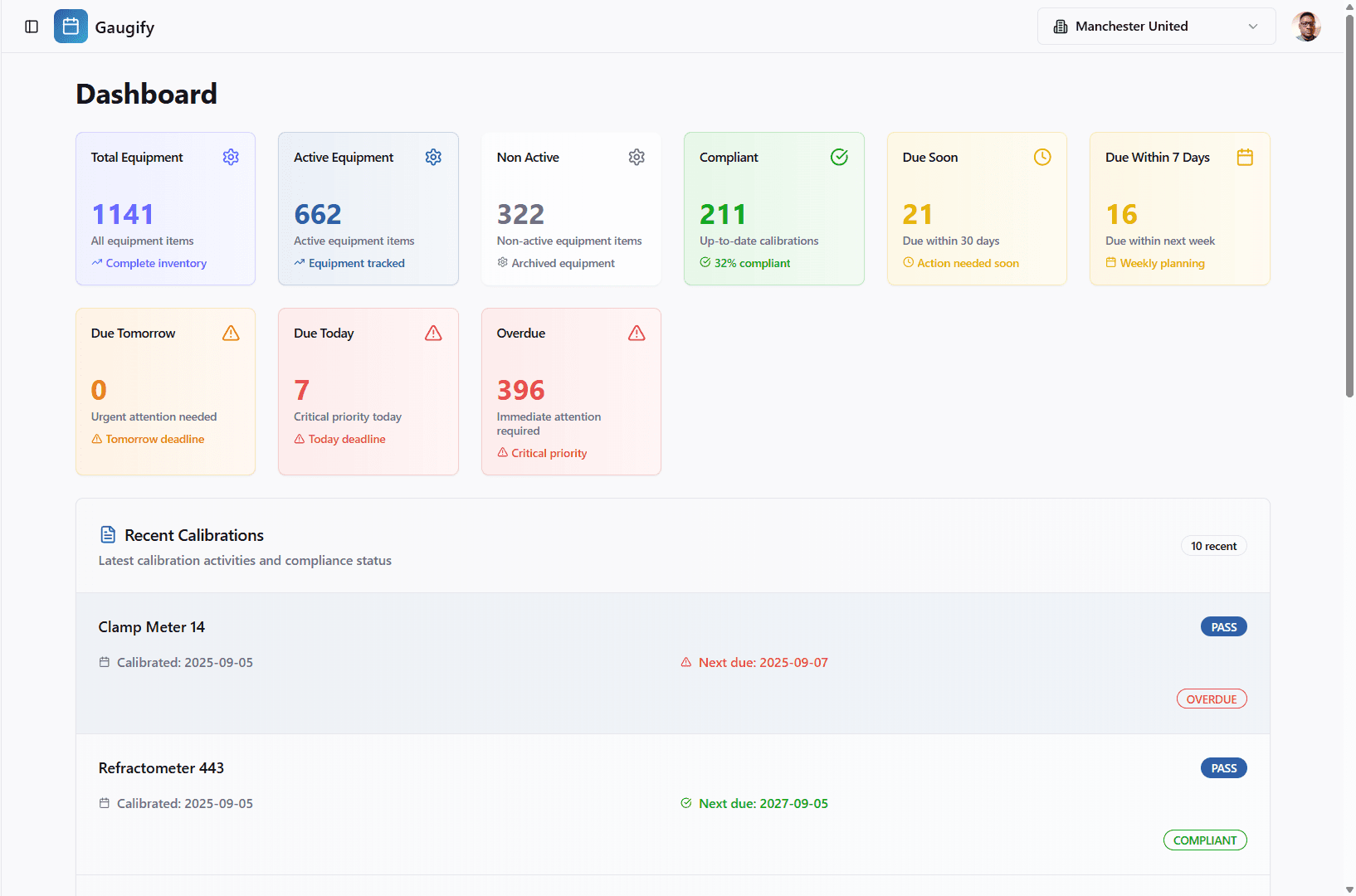
Modern calibration management requires more than just technical procedures—it demands efficient scheduling, comprehensive documentation, and regulatory compliance. Gaugify's cloud-based calibration management software transforms how organizations handle feeler gauge calibration tracking and compliance.
Automated Scheduling and Reminders
Gaugify automatically schedules feeler gauge calibrations based on your defined intervals, whether 6-month, annual, or custom frequencies. The system sends advance notifications to responsible personnel, preventing calibration lapses that could impact quality systems or regulatory compliance. For organizations managing hundreds of feeler gauge sets across multiple locations, this automation eliminates manual tracking spreadsheets and reduces administrative overhead.
Comprehensive Data Management
The platform captures complete calibration records including:
As-found measurements: Document the actual blade thicknesses before any adjustments
As-left conditions: Record final measurements after calibration completion
Environmental parameters: Temperature, humidity, and other conditions during calibration
Reference standards used: Automatic linking to calibrated micrometers and gage blocks
Technician identification: Track who performed each calibration
Measurement uncertainty: Calculate and document uncertainty budgets
Digital Calibration Certificates
Generate professional calibration certificates automatically, including all measurement data, traceability information, and compliance statements. Certificates can be customized with company branding and specific customer requirements, then distributed electronically or printed as needed.
Regulatory Compliance Support
Gaugify's compliance features support various quality standards and regulatory requirements:
Audit trails: Complete history of all calibration activities and data modifications
Traceability chains: Automatic linking from field measurements through reference standards to national standards
Statistical analysis: Trend analysis and control charts for calibration performance monitoring
Document control: Version management for procedures and specifications
Integration with Quality Systems
The platform integrates with existing quality management systems, enabling seamless data flow and eliminating duplicate data entry. API connections allow automatic population of calibration data into ERP systems, quality databases, and maintenance management systems.
Mobile Accessibility
Field technicians can access calibration schedules, record measurements, and generate certificates using mobile devices. This capability is particularly valuable for automotive service operations or field maintenance activities where feeler gauges are calibrated at customer locations.
The system's comprehensive feature set includes advanced analytics, customizable dashboards, and automated compliance reporting that transforms calibration management from a administrative burden into a strategic quality advantage.
Cost-Effective Implementation
With flexible pricing options scaled to organization size and needs, Gaugify provides enterprise-level calibration management capabilities without the complexity and cost of traditional systems. The cloud-based architecture eliminates IT infrastructure requirements while ensuring data security and accessibility.
Transform Your Calibration Management Today
Effective feeler gauge calibration requires technical expertise, proper procedures, and robust management systems. While the calibration process itself follows established technical standards, managing calibration schedules, documentation, and compliance across an organization demands modern digital solutions.
Manual tracking methods using spreadsheets or paper systems introduce risks of missed calibrations, incomplete documentation, and compliance gaps. These risks multiply as organizations grow and regulatory requirements become more stringent.
Gaugify eliminates these challenges by providing a comprehensive, user-friendly platform that automates scheduling, standardizes documentation, and ensures compliance. Organizations using Gaugify report significant improvements in calibration efficiency, compliance confidence, and audit preparedness.
Whether you're managing a small machine shop with a few feeler gauge sets or a large manufacturing operation with hundreds of precision instruments, Gaugify scales to meet your needs. The platform grows with your organization, adding capabilities and users as requirements evolve.
Don't let manual calibration management limit your quality performance or create compliance risks. Start your free trial today and experience how modern calibration management transforms your quality operations. See firsthand how automated scheduling, digital documentation, and regulatory compliance features can streamline your feeler gauge calibration program while reducing administrative overhead and improving measurement confidence.
For organizations ready to implement enterprise-level calibration management, schedule a personalized demo to explore how Gaugify's advanced features align with your specific requirements and quality objectives.
How to Calibrate Feeler Gauges
Feeler gauges are among the most commonly used precision measurement tools in manufacturing, automotive repair, and mechanical maintenance operations. These thin, flexible metal blades enable technicians to measure narrow gaps, clearances, and spacing with remarkable accuracy. However, like all precision instruments, feeler gauges require regular feeler gauge calibration to maintain their accuracy and ensure reliable measurements that meet quality standards and regulatory requirements.
Whether you're measuring valve clearances in an automotive engine, checking bearing clearances in machinery, or verifying gap tolerances in manufacturing assemblies, properly calibrated feeler gauges are essential for maintaining product quality and operational safety. This comprehensive guide will walk you through the complete calibration process, from understanding why calibration matters to implementing a robust calibration management system.
Understanding Feeler Gauges and Their Measurement Applications
Feeler gauges, also known as thickness gauges or gap gauges, consist of multiple thin metal blades of precisely manufactured thicknesses, typically ranging from 0.002 inches (0.05 mm) to 0.040 inches (1.0 mm) or more. Each blade is clearly marked with its nominal thickness value and arranged in a fan-like configuration held together by a handle or pivot mechanism.
These instruments measure linear dimensions by insertion into narrow spaces where other measuring tools cannot fit. Common applications include:
Automotive maintenance: Measuring spark plug gaps (typically 0.028" to 0.060"), valve clearances (0.006" to 0.012"), and distributor point gaps
Manufacturing quality control: Checking clearances between mating parts, verifying assembly tolerances within ±0.001" specifications
Machinery maintenance: Measuring bearing clearances, shaft-to-housing gaps, and alignment tolerances
Welding operations: Setting root opening gaps in pipe welding (typically 1/16" to 1/8")
Electrical work: Adjusting contact gaps in switches and relays
The accuracy of feeler gauge measurements directly impacts product quality, safety, and performance. A spark plug gap that's off by even 0.005" can cause engine misfiring, while incorrect bearing clearances can lead to premature mechanical failure.
Why Feeler Gauge Calibration Is Critical
Feeler gauge calibration ensures measurement accuracy and traceability, which are fundamental requirements for quality management systems and regulatory compliance. Several factors make regular calibration essential:
Wear and Deformation: Repeated insertion into tight spaces gradually wears blade edges and can cause permanent deformation. A 0.010" blade that has worn to 0.009" will provide false readings, potentially leading to over-tightened assemblies or inadequate clearances.
Environmental Effects: Temperature variations cause thermal expansion and contraction of the steel blades. Corrosion from moisture or chemical exposure can alter blade thickness through material loss or buildup.
Handling Damage: Dropping, bending, or forcing blades into undersized gaps can permanently alter their dimensions. Even minor damage invisible to the naked eye can affect measurement accuracy.
Regulatory Requirements: Industries like aerospace (AS9100), automotive (IATF 16949), and medical devices (ISO 13485) mandate calibrated measurement equipment. ISO 9001 quality management systems require measurement traceability to national standards.
Cost of Non-Conformance: Using out-of-tolerance feeler gauges can result in defective products, warranty claims, safety incidents, and regulatory violations. The cost of proper calibration is minimal compared to these potential consequences.
Step-by-Step Feeler Gauge Calibration Procedure
Proper feeler gauge calibration requires controlled environmental conditions, appropriate reference standards, and systematic measurement procedures. Here's the detailed process:
Environmental Requirements
Calibration must be performed in a controlled environment meeting these specifications:
Temperature: 68°F ± 2°F (20°C ± 1°C) with thermal stability
Humidity: 45% to 55% relative humidity to prevent corrosion
Vibration: Minimal mechanical vibration that could affect measurements
Cleanliness: Dust-free environment to prevent contamination
Allow both the feeler gauges and reference standards to reach thermal equilibrium for at least 2 hours before beginning calibration.
Required Reference Standards
Calibration requires reference standards with accuracy at least 4:1 better than the feeler gauge tolerance. Typical reference standards include:
Calibrated gage blocks: Grade 0 or Grade 1 blocks traceable to NIST
Micrometer: 0-1" outside micrometer with 0.0001" resolution
Dial indicator: 0.0001" resolution indicator with magnetic base
Surface plate: Grade A granite surface plate for measurement reference
Calibration Steps
Step 1: Visual Inspection
Examine each blade for visible damage including nicks, burrs, corrosion, permanent bending, or worn edges. Any blade showing damage should be rejected or repaired before calibration.
Step 2: Cleaning
Clean all blades with appropriate solvent (typically isopropyl alcohol) to remove oil, dirt, and debris. Ensure complete drying before measurement.
Step 3: Thickness Measurement
Measure each blade thickness using the reference micrometer:
Position the blade between micrometer anvils near the tip area used for measurements
Apply consistent measuring force (typically 2-5 pounds)
Take readings at three points: near the tip, middle, and base of the working area
Record the average thickness for each blade
Step 4: Flatness and Parallelism Check
Using a dial indicator and surface plate:
Place the blade flat on the surface plate
Move the dial indicator along the blade length, checking for warpage
Maximum deviation should not exceed ±0.0002" over the working length
Step 5: Functional Test
Test blade flexibility and spring characteristics by gently bending and releasing. Blades should return to their original flat position without permanent set.
Acceptance Criteria
Industry-standard tolerance for feeler gauge calibration typically follows these guidelines:
Blades ≤ 0.010": ±0.0002" tolerance
Blades 0.011" to 0.025": ±0.0003" tolerance
Blades > 0.025": ±0.0005" tolerance
Any blade exceeding these tolerances must be rejected or adjusted if possible.
Ready to streamline your calibration process? Start your free trial of Gaugify and see how our cloud-based system can automate your feeler gauge calibration scheduling and documentation.
Relevant Calibration Standards and Specifications
Several standards govern feeler gauge calibration requirements and procedures:
ISO Standards
ISO 17025: General requirements for testing and calibration laboratories, establishing competency and quality management requirements
ISO 9001: Quality management systems requiring measurement equipment calibration and traceability
ISO 10012: Measurement management systems providing guidance for calibration processes
ASTM Standards
ASTM E177: Standard practice for use of terms precision and bias in test methods
ASTM E691: Standard practice for conducting interlaboratory studies
Military and Aerospace Standards
MIL-STD-45662: Calibration system requirements (now cancelled but still referenced)
AS9100: Aerospace quality management systems requiring calibrated measurement equipment
Manufacturer Specifications
Leading feeler gauge manufacturers like Starrett, Mitutoyo, and Brown & Sharpe provide specific calibration procedures and tolerance requirements in their product documentation. Always consult manufacturer specifications for instrument-specific requirements.
For organizations requiring ISO 17025 compliance, Gaugify provides comprehensive documentation and traceability features to meet accreditation requirements.
Calibration Intervals and Frequency Recommendations
Determining appropriate calibration intervals for feeler gauges depends on several factors that affect measurement accuracy over time:
Standard Calibration Intervals
Heavy industrial use: Every 6 months
Moderate manufacturing use: Annually
Light laboratory use: Every 12-18 months
Infrequent use: Every 2 years minimum
Factors Affecting Calibration Frequency
Usage Intensity: Frequent insertion into tight gaps accelerates blade wear. Automotive technicians using feeler gauges daily may require 6-month intervals, while occasional-use applications can extend to annual calibration.
Environmental Conditions: Harsh environments with temperature extremes, moisture, or corrosive chemicals require more frequent calibration. Marine applications or chemical processing facilities may need quarterly calibration.
Measurement Criticality: Applications affecting safety or high-value products warrant shorter intervals. Aircraft engine maintenance or medical device manufacturing may require quarterly calibration regardless of usage.
Historical Performance: Track calibration results over time. Instruments consistently passing calibration can potentially extend intervals, while those frequently requiring adjustment need shorter intervals.
Quality System Requirements: Some standards mandate specific intervals. Aerospace applications under AS9100 may require intervals as short as 90 days for critical measurements.
Interval Adjustment Strategy
Implement a systematic approach to optimize calibration intervals:
Start with conservative intervals based on manufacturer recommendations
Document as-found conditions during each calibration
Analyze trends in measurement drift over time
Adjust intervals based on actual performance data
Consider statistical methods like control charts to predict calibration needs
Common Feeler Gauge Calibration Mistakes and Prevention
Avoiding common calibration errors ensures reliable results and prevents measurement problems:
Environmental Control Failures
Mistake: Performing calibration without proper temperature stabilization or control.
Prevention: Always allow thermal equilibration and maintain environmental conditions within specified limits. A temperature difference of 5°F can cause measurement errors of 0.0003" in steel blades.
Improper Reference Standards
Mistake: Using reference standards with insufficient accuracy ratios or expired calibration.
Prevention: Maintain 4:1 or better accuracy ratios and ensure all reference standards have current calibration certificates traceable to national standards.
Inadequate Measurement Technique
Mistake: Inconsistent measuring force or location when using micrometers.
Prevention: Establish standard procedures specifying measuring locations, force application, and measurement repetition requirements. Train all personnel in consistent measurement techniques.
Incomplete Documentation
Mistake: Failing to record as-found conditions, environmental parameters, or measurement uncertainty.
Prevention: Use standardized calibration forms capturing all required data. Document any adjustments made and their justification.
Ignoring Measurement Uncertainty
Mistake: Not calculating or considering measurement uncertainty in acceptance decisions.
Prevention: Calculate measurement uncertainty including contributions from reference standards, environmental effects, and procedure repeatability. Apply appropriate guard bands when making pass/fail decisions.
Poor Blade Handling
Mistake: Forcing blades into undersized gaps or allowing blade-to-blade contact during handling.
Prevention: Train users in proper insertion techniques and provide protective storage. Use appropriate insertion angles and avoid excessive force.
Streamlining Feeler Gauge Calibration with Digital Management
Modern calibration management requires more than just technical procedures—it demands efficient scheduling, comprehensive documentation, and regulatory compliance. Gaugify's cloud-based calibration management software transforms how organizations handle feeler gauge calibration tracking and compliance.
Automated Scheduling and Reminders
Gaugify automatically schedules feeler gauge calibrations based on your defined intervals, whether 6-month, annual, or custom frequencies. The system sends advance notifications to responsible personnel, preventing calibration lapses that could impact quality systems or regulatory compliance. For organizations managing hundreds of feeler gauge sets across multiple locations, this automation eliminates manual tracking spreadsheets and reduces administrative overhead.
Comprehensive Data Management
The platform captures complete calibration records including:
As-found measurements: Document the actual blade thicknesses before any adjustments
As-left conditions: Record final measurements after calibration completion
Environmental parameters: Temperature, humidity, and other conditions during calibration
Reference standards used: Automatic linking to calibrated micrometers and gage blocks
Technician identification: Track who performed each calibration
Measurement uncertainty: Calculate and document uncertainty budgets
Digital Calibration Certificates
Generate professional calibration certificates automatically, including all measurement data, traceability information, and compliance statements. Certificates can be customized with company branding and specific customer requirements, then distributed electronically or printed as needed.
Regulatory Compliance Support
Gaugify's compliance features support various quality standards and regulatory requirements:
Audit trails: Complete history of all calibration activities and data modifications
Traceability chains: Automatic linking from field measurements through reference standards to national standards
Statistical analysis: Trend analysis and control charts for calibration performance monitoring
Document control: Version management for procedures and specifications
Integration with Quality Systems
The platform integrates with existing quality management systems, enabling seamless data flow and eliminating duplicate data entry. API connections allow automatic population of calibration data into ERP systems, quality databases, and maintenance management systems.
Mobile Accessibility
Field technicians can access calibration schedules, record measurements, and generate certificates using mobile devices. This capability is particularly valuable for automotive service operations or field maintenance activities where feeler gauges are calibrated at customer locations.
The system's comprehensive feature set includes advanced analytics, customizable dashboards, and automated compliance reporting that transforms calibration management from a administrative burden into a strategic quality advantage.
Cost-Effective Implementation
With flexible pricing options scaled to organization size and needs, Gaugify provides enterprise-level calibration management capabilities without the complexity and cost of traditional systems. The cloud-based architecture eliminates IT infrastructure requirements while ensuring data security and accessibility.
Transform Your Calibration Management Today
Effective feeler gauge calibration requires technical expertise, proper procedures, and robust management systems. While the calibration process itself follows established technical standards, managing calibration schedules, documentation, and compliance across an organization demands modern digital solutions.
Manual tracking methods using spreadsheets or paper systems introduce risks of missed calibrations, incomplete documentation, and compliance gaps. These risks multiply as organizations grow and regulatory requirements become more stringent.
Gaugify eliminates these challenges by providing a comprehensive, user-friendly platform that automates scheduling, standardizes documentation, and ensures compliance. Organizations using Gaugify report significant improvements in calibration efficiency, compliance confidence, and audit preparedness.
Whether you're managing a small machine shop with a few feeler gauge sets or a large manufacturing operation with hundreds of precision instruments, Gaugify scales to meet your needs. The platform grows with your organization, adding capabilities and users as requirements evolve.
Don't let manual calibration management limit your quality performance or create compliance risks. Start your free trial today and experience how modern calibration management transforms your quality operations. See firsthand how automated scheduling, digital documentation, and regulatory compliance features can streamline your feeler gauge calibration program while reducing administrative overhead and improving measurement confidence.
For organizations ready to implement enterprise-level calibration management, schedule a personalized demo to explore how Gaugify's advanced features align with your specific requirements and quality objectives.