
How to Calibrate Radius Gauges
How to Calibrate Radius Gauges
David Bentley
Quality Assurance Engineer
12 min read
How to Calibrate Radius Gauges
Radius gauge calibration is a critical quality control process that ensures accurate measurement of concave and convex radii in manufacturing applications. These precision instruments require regular calibration to maintain measurement integrity in industries ranging from aerospace to automotive machining. Whether you're working with fillet gauges checking 0.031" to 0.500" radii or large radius gauges measuring up to 15mm, proper calibration procedures protect your quality system and prevent costly measurement errors.
This comprehensive guide walks through the complete radius gauge calibration process, from understanding why calibration matters to implementing a robust tracking system that keeps your measurement equipment compliant and reliable.
Understanding Radius Gauges and Their Measurement Applications
Radius gauges, also known as fillet gauges or radius leaf gauges, are precision measuring tools designed to determine the radius of curved surfaces, both internal (concave) and external (convex). These instruments typically consist of a set of thin steel blades, each machined to a specific radius dimension, assembled in a fan-like arrangement for easy selection and use.
Common radius gauge configurations include:
Imperial sets: 1/64" to 1/2" in 1/64" increments (26 leaves typical)
Metric sets: 1mm to 15mm in 0.5mm or 1mm increments
Precision sets: 0.5mm to 13mm in 0.1mm increments for high-accuracy applications
Large radius sets: 15mm to 25mm for heavy industrial applications
These gauges serve critical functions in quality control environments. In aerospace manufacturing, technicians use radius gauges to verify corner radii on machined aluminum brackets where a 0.125" radius specification might have a ±0.005" tolerance. Automotive part inspectors rely on these tools to check fillet radii on cast iron engine components. Tool and die shops use precision radius gauges to verify EDM-cut radii that must match CAD specifications within ±0.0005".
The measurement principle involves selecting the appropriate blade and checking the fit against the radius being measured. A properly sized blade will contact the curved surface evenly without gaps or interference, providing a reliable go/no-go indication of radius conformance.
Why Radius Gauge Calibration Is Critical for Quality Control
Radius gauge calibration ensures these precision tools maintain their dimensional accuracy over time and use. Unlike some measuring instruments that may drift gradually, radius gauges can experience specific types of wear and damage that affect measurement reliability.
Several factors make calibration essential:
Wear Pattern Development: Repeated contact with workpieces creates wear patterns on the curved surfaces. A 2mm radius blade used frequently for checking machined steel parts may develop flat spots or surface roughness that prevents proper seating against reference surfaces. This wear can cause false rejections of good parts or, worse, acceptance of parts outside specification limits.
Physical Damage: Radius gauge blades are relatively thin (typically 0.5mm to 1.0mm thickness) and can be bent, nicked, or damaged during use. A bent 3/16" radius blade will show apparent dimensional errors that could lead to incorrect measurement decisions affecting product quality.
Temperature Effects: Steel radius gauges expand and contract with temperature changes. A gauge set calibrated at 68°F (20°C) will read differently in a 85°F shop environment. For precision applications requiring ±0.001" accuracy, these thermal effects become significant.
Compliance Requirements: ISO 9001 quality systems require calibration of measuring equipment used for product acceptance decisions. Many customer specifications explicitly require calibrated gauges with traceability to national standards. Aerospace suppliers working under AS9100 face even stricter requirements for measurement system control.
Consider a real-world scenario: A medical device manufacturer uses radius gauges to inspect surgical instrument handles where patient safety depends on proper fit and finish. An uncalibrated gauge that reads 0.002" oversized could result in accepting parts with inadequate corner radii, potentially causing stress concentrations that lead to device failure during critical procedures.
Step-by-Step Radius Gauge Calibration Procedure
Proper radius gauge calibration requires specialized reference standards, controlled environmental conditions, and systematic measurement procedures. Here's the detailed process used by professional calibration laboratories:
Required Equipment and Standards
The calibration setup requires certified reference standards with known dimensional characteristics:
Radius reference standards: Hardened steel or carbide blocks with precision-machined radii traceable to NIST
Optical comparator: 10X to 50X magnification for visual verification of contact
Surface plate: Grade A or AA granite surface plate for stable reference
Temperature monitoring: Calibrated thermometer accurate to ±0.5°F
Cleaning materials: Lint-free cloths and appropriate solvents
Environmental Requirements
Calibration must occur under controlled conditions to ensure measurement accuracy:
Temperature: 68°F ±2°F (20°C ±1°C) with 4-hour stabilization minimum
Humidity: 45% to 65% RH to prevent corrosion and thermal effects
Vibration isolation: Stable surface free from machinery vibration
Lighting: Adequate illumination for visual inspection (minimum 500 lux)
Calibration Steps
Step 1: Initial Inspection and Cleaning
Examine each blade for physical damage, wear, or contamination. Clean all surfaces with appropriate solvent and lint-free cloths. Document any visible damage that might affect measurements.
Step 2: Temperature Stabilization
Allow the radius gauge set and reference standards to stabilize at calibration temperature for minimum 4 hours. This prevents thermal expansion errors that could affect measurement accuracy.
Step 3: Reference Standard Verification
Verify that reference standards remain within their certified accuracy limits. Check calibration certificates to ensure standards haven't exceeded their calibration intervals.
Step 4: Individual Blade Calibration
For each blade in the set:
Select the corresponding reference standard radius
Position the blade against the reference radius under appropriate lighting
Check for proper contact across the curved surface
Use optical magnification to verify uniform contact without gaps or interference
Document pass/fail results based on acceptance criteria
Step 5: Acceptance Criteria Application
Typical acceptance criteria for radius gauges:
Class 1 gauges: ±0.0002" (±0.005mm) for precision applications
Class 2 gauges: ±0.0005" (±0.013mm) for standard shop use
Visual fit: No visible light gaps under 10X magnification
Step 6: Documentation and Certification
Record as-found and as-left conditions for each blade. Generate calibration certificates showing traceability to national standards and compliance with applicable specifications.
Looking to streamline your radius gauge calibration tracking? Start your free Gaugify trial to automate calibration scheduling, store digital certificates, and maintain complete calibration histories for all your measuring equipment.
Relevant Standards for Radius Gauge Calibration
Several industry standards govern radius gauge calibration procedures and requirements:
ISO Standards
ISO 17025: This standard establishes general requirements for testing and calibration laboratories. It mandates traceability to national measurement standards, uncertainty calculations, and documented calibration procedures. Calibration labs performing radius gauge calibrations must demonstrate compliance with ISO 17025 requirements.
ISO 14253-1: Provides guidance for measurement uncertainty in dimensional measurements, including radius gauge applications. This standard helps establish appropriate acceptance criteria based on measurement uncertainty and part tolerance requirements.
ASME Standards
ASME B89.1.5: Covers measurement uncertainty for coordinate measuring machines but provides principles applicable to radius gauge calibration uncertainty analysis.
ASME Y14.5: The geometric dimensioning and tolerancing standard that defines how radius measurements relate to part function and quality requirements.
Manufacturer Specifications
Leading radius gauge manufacturers provide specific calibration requirements:
Starrett: Specifies ±0.0005" accuracy for their standard radius gauge sets with annual calibration recommendations
Mitutoyo: Provides detailed calibration procedures with specific reference standard requirements in their technical documentation
Brown & Sharpe: Recommends calibration intervals based on usage frequency and application criticality
Industry-specific standards also apply. Aerospace companies often reference AS9102 for first article inspection requirements that include calibrated radius gauges. Medical device manufacturers follow FDA guidelines that mandate calibration system controls for measuring equipment.
Recommended Calibration Intervals and Frequency Factors
Determining appropriate calibration intervals for radius gauges requires balancing measurement risk against calibration costs. Most organizations start with manufacturer recommendations and adjust based on actual performance data.
Standard Calibration Intervals
Annual calibration: Most common interval for general-purpose radius gauges in controlled environments
Semi-annual calibration: High-usage applications or critical quality control points
Quarterly calibration: Precision applications in harsh environments or where measurement failures have high consequences
Factors Affecting Calibration Frequency
Usage Intensity: Radius gauges used multiple times daily require more frequent calibration than those used occasionally. A gauge set checking hundreds of parts daily in a high-volume production environment may need quarterly calibration, while gauges used for periodic audits might maintain accuracy with annual calibration.
Environmental Conditions: Harsh shop floor environments with temperature extremes, contamination, or vibration accelerate gauge degradation. Machine shops with coolant mist, foundries with heat exposure, or outdoor inspection applications typically require shorter calibration intervals.
Application Criticality: Safety-critical applications or those with tight tolerances justify more frequent calibration. Nuclear component inspection, medical device manufacturing, or aerospace critical dimensions often require quarterly or even monthly calibration verification.
Historical Performance: Track calibration results over time to optimize intervals. If radius gauges consistently pass calibration with large margins, intervals might be extended. Conversely, frequent out-of-tolerance conditions indicate the need for shorter intervals or improved handling procedures.
Handling and Storage: Proper storage in protective cases extends calibration intervals. Gauges thrown loose in toolboxes or exposed to shop floor contamination require more frequent verification than those stored in controlled tool cribs.
Risk-Based Calibration Scheduling
Modern quality systems often implement risk-based calibration strategies. High-risk applications (safety-critical, tight tolerances, high failure costs) receive shorter intervals, while lower-risk applications use extended intervals with appropriate monitoring.
Example risk assessment for a 5mm radius gauge set:
High risk: Medical implant inspection - Monthly verification
Medium risk: Automotive component QC - Quarterly calibration
Low risk: General machining inspection - Annual calibration
Common Calibration Mistakes and Prevention Strategies
Avoiding common radius gauge calibration errors prevents measurement system failures and maintains quality control integrity. Here are the most frequent problems and their solutions:
Temperature Control Oversights
Common Mistake: Performing calibration immediately after bringing gauges from different temperature environments. A gauge set stored in a 50°F tool crib and immediately calibrated in a 72°F lab will show apparent dimensional errors due to thermal expansion differences.
Prevention Strategy: Implement mandatory 4-hour temperature stabilization periods. Use temperature monitoring to verify both gauges and standards reach equilibrium before beginning calibration procedures. Document stabilization times and temperatures in calibration records.
Inadequate Reference Standard Management
Common Mistake: Using reference standards beyond their calibration intervals or with questionable traceability. Expired or uncalibrated standards invalidate the entire calibration process and compromise measurement traceability.
Prevention Strategy: Implement automated tracking systems for reference standard calibration status. Gaugify's calibration management features provide automated alerts for expiring reference standards and maintain complete traceability chains for compliance audits.
Insufficient Cleaning and Preparation
Common Mistake: Attempting calibration on contaminated or damaged gauges. Oil residue, metal particles, or corrosion can create false contact points that mask actual dimensional conditions.
Prevention Strategy: Establish standard cleaning procedures using appropriate solvents and inspection protocols. Train technicians to identify and document physical damage that affects measurement capability.
Improper Contact Verification
Common Mistake: Relying solely on tactile feedback to determine proper gauge-to-standard contact. This subjective approach leads to inconsistent calibration results and potential acceptance of worn or damaged gauges.
Prevention Strategy: Use optical magnification (minimum 10X) to verify contact patterns. Establish objective visual criteria for acceptable contact, such as "no visible light gaps across the full contact surface." Train calibration technicians in proper visual inspection techniques.
Documentation and Traceability Gaps
Common Mistake: Incomplete calibration records that lack essential information like environmental conditions, reference standards used, or as-found conditions. Poor documentation creates compliance vulnerabilities and prevents effective calibration interval analysis.
Prevention Strategy: Implement standardized calibration record formats that capture all required information. Use digital systems that enforce complete data entry and maintain permanent, searchable records.
Tracking Radius Gauge Calibration with Modern Software Systems
Manual calibration tracking systems struggle to manage the complexity of modern quality control requirements. Radius gauge calibration involves multiple individual components (each blade), various calibration standards, and complex scheduling requirements that benefit significantly from automated management.
Automated Calibration Scheduling
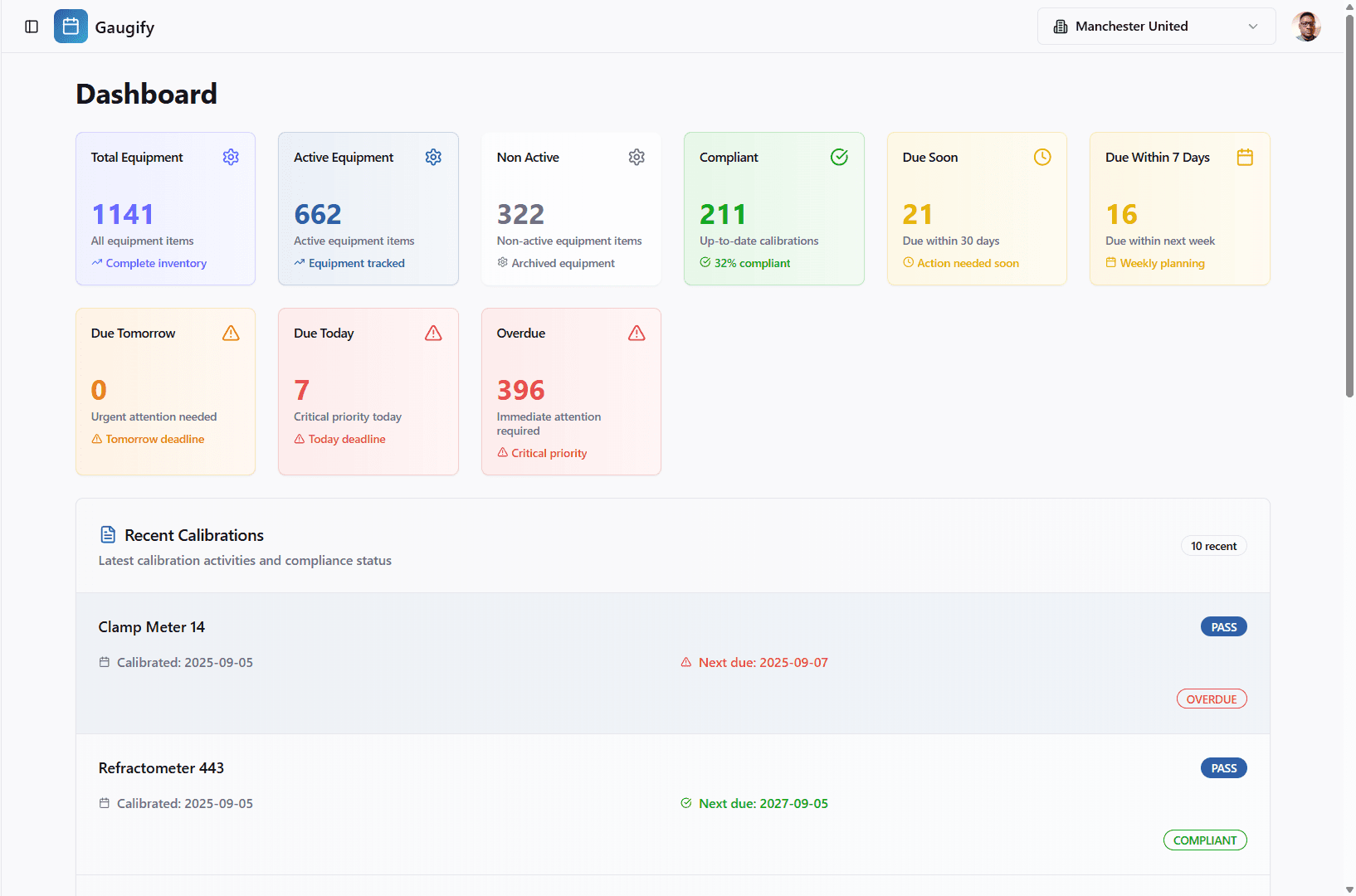
Modern calibration management software automatically tracks individual calibration due dates for each radius gauge set in your inventory. Rather than relying on spreadsheets or paper-based systems that easily become outdated, automated systems provide real-time visibility into calibration status.
Gaugify's cloud-based platform manages complex calibration schedules by tracking individual gauge sets with unique serial numbers, calibration intervals, and usage patterns. The system generates automatic email notifications 30, 14, and 7 days before calibration due dates, ensuring no measuring equipment falls out of compliance.
Digital Certificate Management
Digital calibration certificates eliminate the common problems of lost paperwork, illegible handwriting, and inaccessible filing systems. Modern systems store calibration certificates as searchable PDF documents linked directly to each gauge set record.
Key certificate management features include:
Instant retrieval: Find any calibration certificate in seconds using serial numbers, dates, or technician names
Audit trail maintenance: Complete history of all calibrations with as-found/as-left data comparison
Automated compliance reporting: Generate compliance reports showing calibration status for all measuring equipment
Mobile access: Field technicians can verify calibration status and access certificates using smartphone apps
As-Found and As-Left Data Tracking
Sophisticated calibration tracking captures detailed as-found and as-left measurement data for each radius gauge blade. This information proves invaluable for optimizing calibration intervals and identifying trending issues.
For example, if a 6mm radius blade consistently shows 0.003mm wear patterns at each annual calibration, the data suggests either more frequent calibration or investigation of usage conditions. Conversely, blades that show no measurable change over multiple calibrations might qualify for extended intervals.
Integration with Quality Management Systems
Leading calibration management platforms integrate seamlessly with existing quality management systems, ERP software, and compliance frameworks. This integration eliminates duplicate data entry and ensures calibration information flows automatically throughout the organization.
Gaugify's compliance features support ISO 9001, AS9100, and ISO 17025 requirements with automated documentation, audit trails, and reporting capabilities that satisfy the most demanding quality system audits.
Implementing a Complete Radius Gauge Calibration Program
Successful radius gauge calibration programs require more than just periodic verification procedures. They need comprehensive systems that address procurement, usage, storage, and lifecycle management of these critical measuring tools.
Procurement and Inventory Management
Establish standardized specifications for radius gauge procurement that include accuracy requirements, calibration intervals, and certificate requirements. Many organizations maintain duplicate gauge sets to ensure continuous availability during calibration periods.
Inventory management should track:
Individual gauge set serial numbers and specifications
Assigned locations and responsible personnel
Usage frequency and application criticality
Replacement costs and vendor information
Training and Competency Management
Personnel using radius gauges need proper training in measurement techniques, handling procedures, and calibration status verification. Document training records and maintain competency assessments for all measuring equipment users.
Training topics should cover:
Proper gauge selection for specific radius ranges
Correct measurement technique to avoid damage
Recognition of worn or damaged gauges
Calibration status verification procedures
Documentation requirements for measurement records
Continuous Improvement Through Data Analysis
Use calibration data to drive continuous improvement in your measurement system. Track metrics like out-of-tolerance rates, calibration costs per gauge set, and measurement uncertainty contributions.
Key performance indicators might include:
Calibration pass rates: Target >95% first-time pass rate
Average measurement uncertainty: Should be <10% of part tolerance
Cost per measurement: Include calibration, replacement, and labor costs
Availability rate: Percentage of time gauges are available for use
Ready to transform your calibration management from manual tracking to automated excellence? Schedule a personalized Gaugify demo to see how leading manufacturers streamline their calibration processes, reduce compliance risks, and optimize measurement system performance. Our cloud-based platform handles everything from automated scheduling to digital certificates, giving you complete control over your radius gauge calibration program while saving time and reducing costs.
How to Calibrate Radius Gauges
Radius gauge calibration is a critical quality control process that ensures accurate measurement of concave and convex radii in manufacturing applications. These precision instruments require regular calibration to maintain measurement integrity in industries ranging from aerospace to automotive machining. Whether you're working with fillet gauges checking 0.031" to 0.500" radii or large radius gauges measuring up to 15mm, proper calibration procedures protect your quality system and prevent costly measurement errors.
This comprehensive guide walks through the complete radius gauge calibration process, from understanding why calibration matters to implementing a robust tracking system that keeps your measurement equipment compliant and reliable.
Understanding Radius Gauges and Their Measurement Applications
Radius gauges, also known as fillet gauges or radius leaf gauges, are precision measuring tools designed to determine the radius of curved surfaces, both internal (concave) and external (convex). These instruments typically consist of a set of thin steel blades, each machined to a specific radius dimension, assembled in a fan-like arrangement for easy selection and use.
Common radius gauge configurations include:
Imperial sets: 1/64" to 1/2" in 1/64" increments (26 leaves typical)
Metric sets: 1mm to 15mm in 0.5mm or 1mm increments
Precision sets: 0.5mm to 13mm in 0.1mm increments for high-accuracy applications
Large radius sets: 15mm to 25mm for heavy industrial applications
These gauges serve critical functions in quality control environments. In aerospace manufacturing, technicians use radius gauges to verify corner radii on machined aluminum brackets where a 0.125" radius specification might have a ±0.005" tolerance. Automotive part inspectors rely on these tools to check fillet radii on cast iron engine components. Tool and die shops use precision radius gauges to verify EDM-cut radii that must match CAD specifications within ±0.0005".
The measurement principle involves selecting the appropriate blade and checking the fit against the radius being measured. A properly sized blade will contact the curved surface evenly without gaps or interference, providing a reliable go/no-go indication of radius conformance.
Why Radius Gauge Calibration Is Critical for Quality Control
Radius gauge calibration ensures these precision tools maintain their dimensional accuracy over time and use. Unlike some measuring instruments that may drift gradually, radius gauges can experience specific types of wear and damage that affect measurement reliability.
Several factors make calibration essential:
Wear Pattern Development: Repeated contact with workpieces creates wear patterns on the curved surfaces. A 2mm radius blade used frequently for checking machined steel parts may develop flat spots or surface roughness that prevents proper seating against reference surfaces. This wear can cause false rejections of good parts or, worse, acceptance of parts outside specification limits.
Physical Damage: Radius gauge blades are relatively thin (typically 0.5mm to 1.0mm thickness) and can be bent, nicked, or damaged during use. A bent 3/16" radius blade will show apparent dimensional errors that could lead to incorrect measurement decisions affecting product quality.
Temperature Effects: Steel radius gauges expand and contract with temperature changes. A gauge set calibrated at 68°F (20°C) will read differently in a 85°F shop environment. For precision applications requiring ±0.001" accuracy, these thermal effects become significant.
Compliance Requirements: ISO 9001 quality systems require calibration of measuring equipment used for product acceptance decisions. Many customer specifications explicitly require calibrated gauges with traceability to national standards. Aerospace suppliers working under AS9100 face even stricter requirements for measurement system control.
Consider a real-world scenario: A medical device manufacturer uses radius gauges to inspect surgical instrument handles where patient safety depends on proper fit and finish. An uncalibrated gauge that reads 0.002" oversized could result in accepting parts with inadequate corner radii, potentially causing stress concentrations that lead to device failure during critical procedures.
Step-by-Step Radius Gauge Calibration Procedure
Proper radius gauge calibration requires specialized reference standards, controlled environmental conditions, and systematic measurement procedures. Here's the detailed process used by professional calibration laboratories:
Required Equipment and Standards
The calibration setup requires certified reference standards with known dimensional characteristics:
Radius reference standards: Hardened steel or carbide blocks with precision-machined radii traceable to NIST
Optical comparator: 10X to 50X magnification for visual verification of contact
Surface plate: Grade A or AA granite surface plate for stable reference
Temperature monitoring: Calibrated thermometer accurate to ±0.5°F
Cleaning materials: Lint-free cloths and appropriate solvents
Environmental Requirements
Calibration must occur under controlled conditions to ensure measurement accuracy:
Temperature: 68°F ±2°F (20°C ±1°C) with 4-hour stabilization minimum
Humidity: 45% to 65% RH to prevent corrosion and thermal effects
Vibration isolation: Stable surface free from machinery vibration
Lighting: Adequate illumination for visual inspection (minimum 500 lux)
Calibration Steps
Step 1: Initial Inspection and Cleaning
Examine each blade for physical damage, wear, or contamination. Clean all surfaces with appropriate solvent and lint-free cloths. Document any visible damage that might affect measurements.
Step 2: Temperature Stabilization
Allow the radius gauge set and reference standards to stabilize at calibration temperature for minimum 4 hours. This prevents thermal expansion errors that could affect measurement accuracy.
Step 3: Reference Standard Verification
Verify that reference standards remain within their certified accuracy limits. Check calibration certificates to ensure standards haven't exceeded their calibration intervals.
Step 4: Individual Blade Calibration
For each blade in the set:
Select the corresponding reference standard radius
Position the blade against the reference radius under appropriate lighting
Check for proper contact across the curved surface
Use optical magnification to verify uniform contact without gaps or interference
Document pass/fail results based on acceptance criteria
Step 5: Acceptance Criteria Application
Typical acceptance criteria for radius gauges:
Class 1 gauges: ±0.0002" (±0.005mm) for precision applications
Class 2 gauges: ±0.0005" (±0.013mm) for standard shop use
Visual fit: No visible light gaps under 10X magnification
Step 6: Documentation and Certification
Record as-found and as-left conditions for each blade. Generate calibration certificates showing traceability to national standards and compliance with applicable specifications.
Looking to streamline your radius gauge calibration tracking? Start your free Gaugify trial to automate calibration scheduling, store digital certificates, and maintain complete calibration histories for all your measuring equipment.
Relevant Standards for Radius Gauge Calibration
Several industry standards govern radius gauge calibration procedures and requirements:
ISO Standards
ISO 17025: This standard establishes general requirements for testing and calibration laboratories. It mandates traceability to national measurement standards, uncertainty calculations, and documented calibration procedures. Calibration labs performing radius gauge calibrations must demonstrate compliance with ISO 17025 requirements.
ISO 14253-1: Provides guidance for measurement uncertainty in dimensional measurements, including radius gauge applications. This standard helps establish appropriate acceptance criteria based on measurement uncertainty and part tolerance requirements.
ASME Standards
ASME B89.1.5: Covers measurement uncertainty for coordinate measuring machines but provides principles applicable to radius gauge calibration uncertainty analysis.
ASME Y14.5: The geometric dimensioning and tolerancing standard that defines how radius measurements relate to part function and quality requirements.
Manufacturer Specifications
Leading radius gauge manufacturers provide specific calibration requirements:
Starrett: Specifies ±0.0005" accuracy for their standard radius gauge sets with annual calibration recommendations
Mitutoyo: Provides detailed calibration procedures with specific reference standard requirements in their technical documentation
Brown & Sharpe: Recommends calibration intervals based on usage frequency and application criticality
Industry-specific standards also apply. Aerospace companies often reference AS9102 for first article inspection requirements that include calibrated radius gauges. Medical device manufacturers follow FDA guidelines that mandate calibration system controls for measuring equipment.
Recommended Calibration Intervals and Frequency Factors
Determining appropriate calibration intervals for radius gauges requires balancing measurement risk against calibration costs. Most organizations start with manufacturer recommendations and adjust based on actual performance data.
Standard Calibration Intervals
Annual calibration: Most common interval for general-purpose radius gauges in controlled environments
Semi-annual calibration: High-usage applications or critical quality control points
Quarterly calibration: Precision applications in harsh environments or where measurement failures have high consequences
Factors Affecting Calibration Frequency
Usage Intensity: Radius gauges used multiple times daily require more frequent calibration than those used occasionally. A gauge set checking hundreds of parts daily in a high-volume production environment may need quarterly calibration, while gauges used for periodic audits might maintain accuracy with annual calibration.
Environmental Conditions: Harsh shop floor environments with temperature extremes, contamination, or vibration accelerate gauge degradation. Machine shops with coolant mist, foundries with heat exposure, or outdoor inspection applications typically require shorter calibration intervals.
Application Criticality: Safety-critical applications or those with tight tolerances justify more frequent calibration. Nuclear component inspection, medical device manufacturing, or aerospace critical dimensions often require quarterly or even monthly calibration verification.
Historical Performance: Track calibration results over time to optimize intervals. If radius gauges consistently pass calibration with large margins, intervals might be extended. Conversely, frequent out-of-tolerance conditions indicate the need for shorter intervals or improved handling procedures.
Handling and Storage: Proper storage in protective cases extends calibration intervals. Gauges thrown loose in toolboxes or exposed to shop floor contamination require more frequent verification than those stored in controlled tool cribs.
Risk-Based Calibration Scheduling
Modern quality systems often implement risk-based calibration strategies. High-risk applications (safety-critical, tight tolerances, high failure costs) receive shorter intervals, while lower-risk applications use extended intervals with appropriate monitoring.
Example risk assessment for a 5mm radius gauge set:
High risk: Medical implant inspection - Monthly verification
Medium risk: Automotive component QC - Quarterly calibration
Low risk: General machining inspection - Annual calibration
Common Calibration Mistakes and Prevention Strategies
Avoiding common radius gauge calibration errors prevents measurement system failures and maintains quality control integrity. Here are the most frequent problems and their solutions:
Temperature Control Oversights
Common Mistake: Performing calibration immediately after bringing gauges from different temperature environments. A gauge set stored in a 50°F tool crib and immediately calibrated in a 72°F lab will show apparent dimensional errors due to thermal expansion differences.
Prevention Strategy: Implement mandatory 4-hour temperature stabilization periods. Use temperature monitoring to verify both gauges and standards reach equilibrium before beginning calibration procedures. Document stabilization times and temperatures in calibration records.
Inadequate Reference Standard Management
Common Mistake: Using reference standards beyond their calibration intervals or with questionable traceability. Expired or uncalibrated standards invalidate the entire calibration process and compromise measurement traceability.
Prevention Strategy: Implement automated tracking systems for reference standard calibration status. Gaugify's calibration management features provide automated alerts for expiring reference standards and maintain complete traceability chains for compliance audits.
Insufficient Cleaning and Preparation
Common Mistake: Attempting calibration on contaminated or damaged gauges. Oil residue, metal particles, or corrosion can create false contact points that mask actual dimensional conditions.
Prevention Strategy: Establish standard cleaning procedures using appropriate solvents and inspection protocols. Train technicians to identify and document physical damage that affects measurement capability.
Improper Contact Verification
Common Mistake: Relying solely on tactile feedback to determine proper gauge-to-standard contact. This subjective approach leads to inconsistent calibration results and potential acceptance of worn or damaged gauges.
Prevention Strategy: Use optical magnification (minimum 10X) to verify contact patterns. Establish objective visual criteria for acceptable contact, such as "no visible light gaps across the full contact surface." Train calibration technicians in proper visual inspection techniques.
Documentation and Traceability Gaps
Common Mistake: Incomplete calibration records that lack essential information like environmental conditions, reference standards used, or as-found conditions. Poor documentation creates compliance vulnerabilities and prevents effective calibration interval analysis.
Prevention Strategy: Implement standardized calibration record formats that capture all required information. Use digital systems that enforce complete data entry and maintain permanent, searchable records.
Tracking Radius Gauge Calibration with Modern Software Systems
Manual calibration tracking systems struggle to manage the complexity of modern quality control requirements. Radius gauge calibration involves multiple individual components (each blade), various calibration standards, and complex scheduling requirements that benefit significantly from automated management.
Automated Calibration Scheduling
Modern calibration management software automatically tracks individual calibration due dates for each radius gauge set in your inventory. Rather than relying on spreadsheets or paper-based systems that easily become outdated, automated systems provide real-time visibility into calibration status.
Gaugify's cloud-based platform manages complex calibration schedules by tracking individual gauge sets with unique serial numbers, calibration intervals, and usage patterns. The system generates automatic email notifications 30, 14, and 7 days before calibration due dates, ensuring no measuring equipment falls out of compliance.
Digital Certificate Management
Digital calibration certificates eliminate the common problems of lost paperwork, illegible handwriting, and inaccessible filing systems. Modern systems store calibration certificates as searchable PDF documents linked directly to each gauge set record.
Key certificate management features include:
Instant retrieval: Find any calibration certificate in seconds using serial numbers, dates, or technician names
Audit trail maintenance: Complete history of all calibrations with as-found/as-left data comparison
Automated compliance reporting: Generate compliance reports showing calibration status for all measuring equipment
Mobile access: Field technicians can verify calibration status and access certificates using smartphone apps
As-Found and As-Left Data Tracking
Sophisticated calibration tracking captures detailed as-found and as-left measurement data for each radius gauge blade. This information proves invaluable for optimizing calibration intervals and identifying trending issues.
For example, if a 6mm radius blade consistently shows 0.003mm wear patterns at each annual calibration, the data suggests either more frequent calibration or investigation of usage conditions. Conversely, blades that show no measurable change over multiple calibrations might qualify for extended intervals.
Integration with Quality Management Systems
Leading calibration management platforms integrate seamlessly with existing quality management systems, ERP software, and compliance frameworks. This integration eliminates duplicate data entry and ensures calibration information flows automatically throughout the organization.
Gaugify's compliance features support ISO 9001, AS9100, and ISO 17025 requirements with automated documentation, audit trails, and reporting capabilities that satisfy the most demanding quality system audits.
Implementing a Complete Radius Gauge Calibration Program
Successful radius gauge calibration programs require more than just periodic verification procedures. They need comprehensive systems that address procurement, usage, storage, and lifecycle management of these critical measuring tools.
Procurement and Inventory Management
Establish standardized specifications for radius gauge procurement that include accuracy requirements, calibration intervals, and certificate requirements. Many organizations maintain duplicate gauge sets to ensure continuous availability during calibration periods.
Inventory management should track:
Individual gauge set serial numbers and specifications
Assigned locations and responsible personnel
Usage frequency and application criticality
Replacement costs and vendor information
Training and Competency Management
Personnel using radius gauges need proper training in measurement techniques, handling procedures, and calibration status verification. Document training records and maintain competency assessments for all measuring equipment users.
Training topics should cover:
Proper gauge selection for specific radius ranges
Correct measurement technique to avoid damage
Recognition of worn or damaged gauges
Calibration status verification procedures
Documentation requirements for measurement records
Continuous Improvement Through Data Analysis
Use calibration data to drive continuous improvement in your measurement system. Track metrics like out-of-tolerance rates, calibration costs per gauge set, and measurement uncertainty contributions.
Key performance indicators might include:
Calibration pass rates: Target >95% first-time pass rate
Average measurement uncertainty: Should be <10% of part tolerance
Cost per measurement: Include calibration, replacement, and labor costs
Availability rate: Percentage of time gauges are available for use
Ready to transform your calibration management from manual tracking to automated excellence? Schedule a personalized Gaugify demo to see how leading manufacturers streamline their calibration processes, reduce compliance risks, and optimize measurement system performance. Our cloud-based platform handles everything from automated scheduling to digital certificates, giving you complete control over your radius gauge calibration program while saving time and reducing costs.