
How to Calibrate Outside Micrometers vs Inside Micrometers
How to Calibrate Outside Micrometers vs Inside Micrometers
David Bentley
Quality Assurance Engineer
12 min read
How to Calibrate Outside Micrometers vs Inside Micrometers
Precision measurement instruments like outside micrometers and inside micrometers are the backbone of quality control in manufacturing. While both instruments measure dimensional characteristics with incredible accuracy, inside micrometer calibration requires distinctly different procedures and considerations compared to outside micrometer calibration. Understanding these differences is crucial for quality managers, lab technicians, and shop floor supervisors who depend on accurate measurements to maintain product specifications and compliance.
Inside micrometers measure internal dimensions such as bore diameters, internal grooves, and hole depths, while outside micrometers measure external dimensions like shaft diameters, thickness, and external features. Both instruments typically offer resolution to 0.0001" (0.002mm) or better, but their calibration methodologies differ significantly due to their measurement geometries and reference standard requirements.
Understanding Inside Micrometers vs Outside Micrometers
Outside micrometers, also known as external micrometers, use a C-frame design with an anvil and spindle that close around the measured object. Common types include 0-1", 1-2", 2-3" ranges, with larger frame micrometers extending to 24" or more. These instruments measure external dimensions by applying consistent pressure through a friction thimble or ratchet mechanism.
Inside micrometers measure internal dimensions using either a two-point contact system or a three-point contact system. Traditional inside micrometers use extension rods to achieve various measurement ranges, typically from 2" to 12" or larger. Digital inside micrometers often incorporate electronic readouts with resolution to 0.00005" (0.001mm). Three-point inside micrometers, also called bore gages, use three contact points to center automatically within cylindrical bores.
The fundamental difference in measurement geometry creates distinct calibration challenges. Outside micrometers measure across external surfaces where reference standards like gage blocks can be easily positioned. Inside micrometers must be calibrated using internal reference standards such as ring gages, setting rings, or precision bore standards where access and alignment become critical factors.
Measurement Applications and Tolerances
Outside micrometers commonly verify dimensions like bearing journal diameters (±0.0005"), shaft tolerances (±0.0002"), and plate thickness measurements (±0.001"). Inside micrometers measure bearing bore diameters (±0.0003"), cylinder bore dimensions (±0.0005"), and internal groove widths (±0.001"). These tight tolerances demand calibration accuracy that's typically 10 times better than the measurement tolerance being verified.
Why Calibration Is Critical for Inside Micrometer Measurements
Inside micrometer calibration presents unique challenges that make regular calibration even more critical than outside micrometers. The internal measurement geometry creates several factors that affect measurement accuracy and stability over time.
First, inside micrometers experience different wear patterns compared to outside micrometers. The contact points wear against internal surfaces that may contain debris, cutting fluids, or abrasive particles. This wear affects the instrument's zero point and span accuracy differently than external measurements where surfaces are typically more accessible for cleaning.
Second, thermal effects impact inside micrometers differently due to heat retention within measured parts. When measuring internal dimensions of machined components, residual heat from manufacturing processes can cause thermal expansion that affects both the part and the measuring instrument. Inside micrometers retain this heat longer due to their enclosed measurement geometry.
Third, the force application in inside micrometers requires careful control to avoid measurement errors. Unlike outside micrometers where consistent force is applied through ratchet mechanisms, inside micrometers rely on operator technique to achieve proper contact pressure. This variability makes calibration verification more critical to ensure measurement repeatability.
Calibration Drift and Stability
Inside micrometers typically exhibit different drift characteristics compared to outside micrometers. The internal measurement mechanism experiences more complex stress patterns during use, leading to potential changes in the instrument's measurement characteristics. Regular calibration intervals become essential to detect these changes before they impact measurement accuracy.
Studies show that inside micrometers used in high-volume production environments may drift 0.0001" to 0.0003" over six-month periods, while outside micrometers in similar conditions might drift only 0.00005" to 0.0001". This difference underscores the importance of establishing appropriate calibration frequencies based on actual instrument performance data.
Step-by-Step Inside Micrometer Calibration Procedure
Successful inside micrometer calibration requires specific reference standards, controlled environmental conditions, and systematic procedures that differ significantly from outside micrometer calibration. The following procedure applies to traditional inside micrometers with extension rods, with modifications noted for digital and three-point instruments.
Required Equipment and Standards
Inside micrometer calibration requires ring gages or setting rings with certified dimensions traceable to national standards. For a typical 2-8" inside micrometer set, you'll need certified ring gages at 2.0000", 4.0000", 6.0000", and 8.0000" with accuracy of ±0.00005" or better. Additional intermediate sizes like 3.0000" and 5.0000" provide verification points across the measurement range.
Digital inside micrometers may require specific setting fixtures provided by the manufacturer. Mitutoyo digital inside micrometers, for example, use precision setting rings with built-in temperature compensation. Starrett digital inside micrometers require certified master rings with specific surface finish requirements (16 Ra or better).
Environmental conditions must be controlled to 68°F ±2°F (20°C ±1°C) with relative humidity between 45-65%. All standards and instruments should be stabilized at room temperature for at least 2 hours before calibration begins.
Calibration Steps
Step 1: Initial Inspection and Cleaning
Inspect the inside micrometer for physical damage, worn contact points, or binding in the adjustment mechanism. Clean all surfaces with isopropyl alcohol and lint-free cloths. Check extension rods for straightness and proper thread engagement. Verify that the instrument's serial number matches calibration records.
Step 2: Zero Point Verification
Install the appropriate extension rod for the smallest measurement range (typically 2"). Insert the micrometer into the 2.0000" ring gage and adjust to light contact with both measurement points. The reading should indicate 2.0000" ±0.0001". Record the as-found reading before making any adjustments.
Step 3: Span Accuracy Verification
Test each measurement range using certified ring gages. For a 2-8" micrometer, measure the 2", 4", 6", and 8" ring gages using appropriate extension rods. Each measurement should be within ±0.0001" of the ring gage certified value. Take five repeated measurements at each point and calculate the average.
Step 4: Repeatability Testing
Perform ten consecutive measurements on a single ring gage (typically 4.0000") using the same operator technique. Calculate the standard deviation, which should not exceed 0.00005" for precision inside micrometers. This test validates measurement consistency and operator technique.
Step 5: Adjustment and As-Left Verification
If measurements exceed acceptance criteria, perform adjustments according to manufacturer specifications. Many inside micrometers have adjustment screws or removable contact points for calibration correction. After adjustments, repeat the verification measurements and record as-left values.
Special Considerations for Three-Point Inside Micrometers
Three-point inside micrometers (bore gages) require additional calibration steps due to their self-centering mechanism. These instruments use three contact points arranged 120 degrees apart to automatically center within cylindrical bores. Calibration requires certified ring gages with specific roundness tolerances (typically 0.00005" or better) to ensure accurate reference standards.
The calibration procedure includes verification of the centering mechanism by measuring ring gages in different orientations. The instrument should read the same value regardless of its rotational position within the ring gage, with variation not exceeding 0.00003".
Relevant Standards for Inside Micrometer Calibration
Several national and international standards govern inside micrometer calibration procedures, providing traceability requirements and acceptance criteria for measurement accuracy.
ASME B89.1.5M-1998 provides the primary standard for micrometer calibration in the United States, covering both inside and outside micrometers. This standard specifies calibration procedures, environmental requirements, and acceptance criteria based on instrument accuracy classes. For inside micrometers, the standard requires calibration points at minimum and maximum measurement ranges, with intermediate points every 25% of the measurement span.
ISO 3611:2010 establishes international requirements for inside micrometer calibration, including uncertainty budgets and traceability requirements. The standard specifies that reference ring gages must have measurement uncertainty not exceeding 1/3 of the micrometer's acceptance criteria, typically resulting in ring gage accuracy requirements of ±0.000033" or better.
NIST Special Publication 250-43 provides guidance for establishing measurement traceability for dimensional measurements, including inside micrometers used in calibration laboratories. This publication addresses uncertainty analysis and calibration certificate requirements for instruments used in ISO/IEC 17025 accredited laboratories.
Manufacturer-Specific Requirements
Leading manufacturers provide detailed calibration specifications that often exceed general standards. Mitutoyo specifies calibration procedures for their Holtest series inside micrometers, requiring specific torque values for extension rod installation (8-10 inch-pounds) and contact pressure guidelines (2-3 pounds force). Starrett provides calibration certificates for their reference ring gages with expanded uncertainty statements and temperature coefficients.
Brown & Sharpe (Hexagon) specifies calibration intervals and adjustment procedures for their TESA-HITE inside micrometers, including electronic calibration for digital models using certified electronic simulation standards.
Calibration Intervals for Inside Micrometer Calibration
Determining appropriate calibration intervals for inside micrometers requires consideration of usage frequency, environmental conditions, and measurement criticality. Unlike outside micrometers where annual calibration is often standard, inside micrometers may require more frequent calibration due to their measurement complexity and wear characteristics.
High-production manufacturing environments typically calibrate inside micrometers every 6-9 months, while precision measurement laboratories may extend intervals to 12 months with proper handling and storage. Quality control applications measuring critical dimensions (aircraft engine components, medical devices) often require quarterly calibration to ensure measurement integrity.
Several factors influence calibration frequency decisions:
Usage Frequency: Inside micrometers used for daily production measurements require more frequent calibration than instruments used weekly for inspection purposes
Measurement Criticality: Instruments measuring safety-critical dimensions or tight tolerances (±0.0002") need shorter calibration intervals
Environmental Conditions: Shop floor environments with temperature variations, cutting fluids, and debris accelerate calibration requirements
Historical Performance: Tracking calibration data over time reveals instrument-specific drift patterns that inform interval optimization
Interval Optimization Strategies
Modern calibration management approaches use statistical analysis of historical calibration data to optimize intervals. If an inside micrometer consistently passes calibration with minimal drift over four consecutive 6-month periods, extending to 9-month intervals may be justified. Conversely, instruments showing drift approaching acceptance limits require shortened intervals or more frequent intermediate checks.
Advanced calibration management software tracks this performance data automatically, providing interval recommendations based on actual instrument behavior rather than generic manufacturer suggestions.
Common Inside Micrometer Calibration Mistakes
Inside micrometer calibration presents unique challenges that can lead to measurement errors if not properly addressed. Understanding these common mistakes helps ensure accurate calibration results and reliable measurement performance.
Inadequate Temperature Stabilization
The most frequent mistake in inside micrometer calibration involves insufficient temperature stabilization of reference standards and instruments. Ring gages and inside micrometers have different thermal expansion coefficients, requiring extended stabilization periods to achieve thermal equilibrium. Steel ring gages expand approximately 0.0000063" per inch per °F, while micrometer frames may expand at different rates.
Best practice requires 2-4 hours of temperature stabilization in controlled environments. Rushing this process can introduce measurement errors of 0.0001" or more, especially with larger measurement ranges where thermal effects accumulate.
Improper Contact Pressure
Unlike outside micrometers with ratchet mechanisms that provide consistent contact pressure, inside micrometers rely on operator technique to achieve proper contact. Excessive pressure can compress the ring gage or deflect the micrometer, while insufficient pressure creates measurement uncertainty.
Proper technique involves light contact with slight oscillation to ensure both contact points touch the ring gage simultaneously. Training operators to recognize the correct "feel" for contact pressure is essential for repeatable measurements. Digital force gages can be used during training to quantify proper contact pressure (typically 2-3 pounds force).
Ring Gage Contamination and Wear
Reference ring gages accumulate contamination and experience wear that affects calibration accuracy. Fingerprints, dust, and microscopic debris on ring gage surfaces can cause measurement errors of 0.00005" to 0.0001". Regular cleaning with appropriate solvents and inspection under magnification prevents these errors.
Ring gage wear occurs gradually and may not be visible during routine use. Annual verification of ring gage dimensions ensures continued accuracy as reference standards. Worn ring gages showing dimensional changes exceeding ±0.00005" should be recertified or replaced.
Extension Rod Assembly Errors
Traditional inside micrometers use extension rods to achieve various measurement ranges. Improper assembly, worn threads, or incorrect rod selection can introduce significant measurement errors. Each extension rod must be properly seated and tightened to specification torque values.
Cross-threading during assembly can damage both the extension rod and micrometer head, creating permanent accuracy problems. Using thread lubricants and careful assembly techniques prevents this damage while ensuring proper mechanical connections.
Ready to eliminate these calibration challenges? Start your free trial of Gaugify today and see how automated calibration management prevents common mistakes while ensuring measurement accuracy.
Tracking Inside Micrometer Calibration with Modern Software
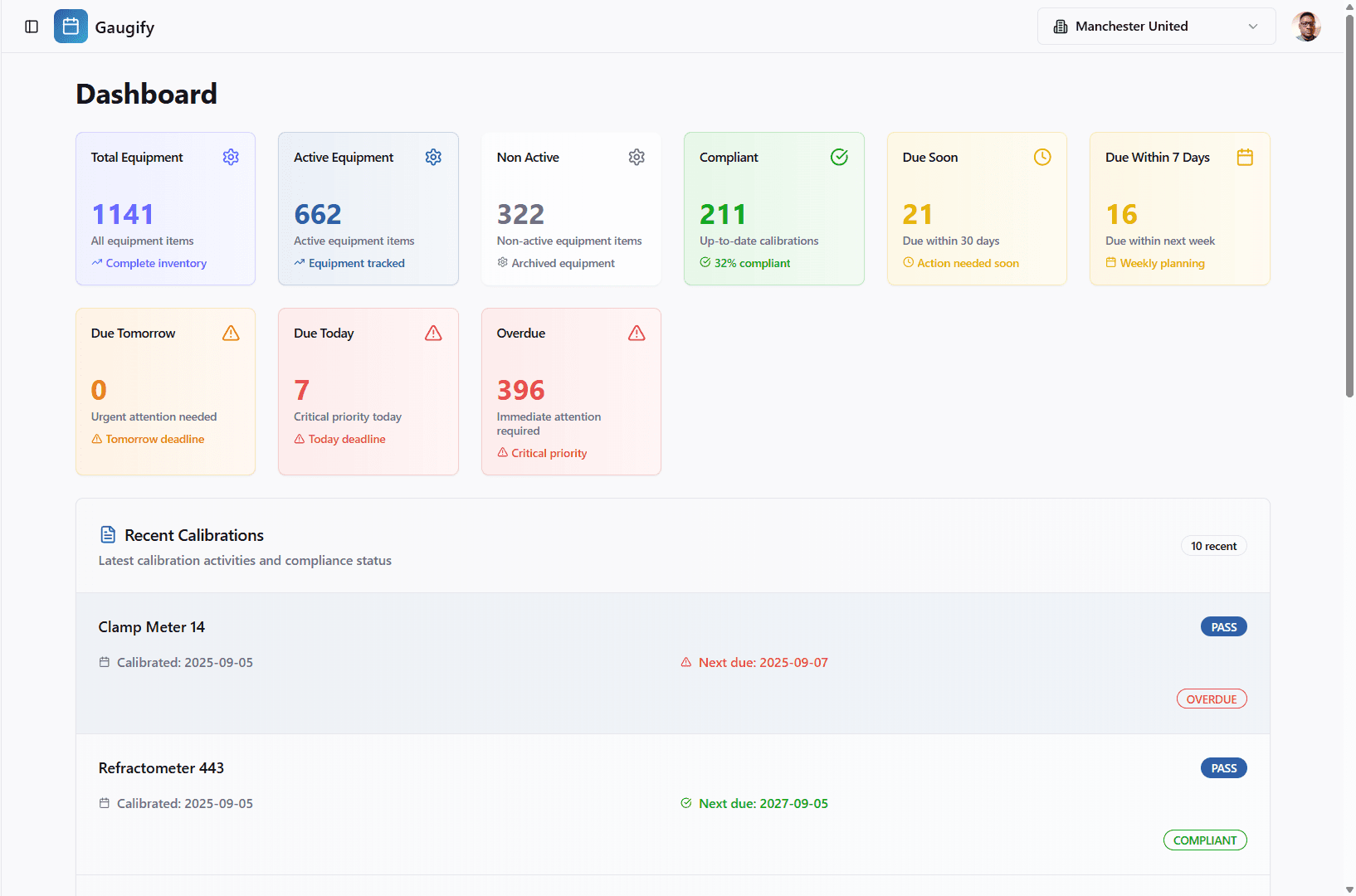
Modern calibration management software transforms how organizations track and manage inside micrometer calibration programs. Traditional paper-based systems struggle to manage the complex requirements of inside micrometer calibration, including multiple measurement points, extension rod configurations, and temperature compensation data.
Gaugify's cloud-based calibration management platform addresses these challenges with specialized features designed for precision measurement instruments like inside micrometers.
Automated Scheduling and Reminders
Gaugify automatically tracks calibration due dates for each inside micrometer, considering individual instrument histories and usage patterns. The system sends email reminders 30, 14, and 7 days before calibration due dates, ensuring instruments never expire unexpectedly. For organizations with multiple locations, centralized scheduling prevents conflicts and optimizes calibration resource allocation.
The platform accommodates complex calibration schedules where different measurement ranges require different intervals. A 2-8" inside micrometer might need 6-month calibration for the 2-4" ranges used daily, while the 6-8" ranges used monthly could extend to 12-month intervals.
Comprehensive As-Found and As-Left Documentation
Inside micrometer calibration generates significant data across multiple measurement points and extension rod configurations. Gaugify captures this complexity with customizable data entry forms that record:
As-found measurements at each calibration point
Ring gage serial numbers and certified values
Environmental conditions (temperature, humidity)
Extension rod configurations and serial numbers
Repeatability test results and statistical analysis
As-left measurements after adjustments
Uncertainty calculations and acceptance criteria
This comprehensive documentation supports compliance requirements for ISO 9001, AS9100, and FDA regulations while providing the detailed records needed for measurement uncertainty analysis.
Digital Calibration Certificates
Gaugify generates professional calibration certificates that include all relevant measurement data, uncertainty statements, and traceability information. For inside micrometers, certificates document the complete measurement range verification with specific reference standards used for each point.
Digital certificates include measurement uncertainty budgets calculated from reference standard uncertainties, environmental conditions, and instrument resolution. This detailed uncertainty analysis supports measurement decision rules and helps determine measurement capability for specific applications.
Trend Analysis and Performance Tracking
Historical calibration data reveals instrument performance trends that inform maintenance decisions and calibration interval optimization. Gaugify's analytical tools track measurement drift patterns, identify instruments requiring attention, and predict potential failures before they impact production quality.
For inside micrometers, trend analysis might reveal that instruments used in specific applications experience faster drift in certain measurement ranges. This information guides preventive maintenance programs and helps optimize calibration procedures for maximum efficiency.
Optimizing Your Inside Micrometer Calibration Program
Successful inside micrometer calibration programs combine proper procedures, appropriate intervals, and effective management systems to ensure measurement accuracy and compliance. The complexity of inside micrometer calibration makes systematic management essential for maintaining quality control standards.
Organizations achieving calibration excellence focus on several key areas: standardized procedures that account for inside micrometer-specific requirements, environmental control that ensures measurement accuracy, comprehensive training that addresses proper calibration techniques, and data management systems that track performance and optimize intervals.
The investment in proper inside micrometer calibration management pays dividends through reduced measurement uncertainty, improved product quality, and enhanced regulatory compliance. Quality managers who implement systematic approaches to inside micrometer calibration typically see measurable improvements in measurement consistency and reduction in quality escapes.
Ready to Transform Your Calibration Management?
Gaugify's modern calibration management platform eliminates the complexity and risk associated with manual calibration tracking. With specialized features designed for precision measurement instruments like inside micrometers, Gaugify ensures your calibration program meets the highest standards for accuracy and compliance.
Join thousands of quality professionals who trust Gaugify to manage their critical measurement instruments. Our cloud-based platform provides the tools, automation, and insights needed to maintain measurement excellence while reducing administrative burden.
Start your free trial today and experience how modern calibration management transforms your quality control operations. No credit card required, full access to all features, and expert support to help you get started.
Questions about implementing Gaugify for your specific calibration requirements? Schedule a personalized demo with our calibration experts who understand the unique challenges of inside micrometer calibration and can show you exactly how Gaugify addresses your needs.
How to Calibrate Outside Micrometers vs Inside Micrometers
Precision measurement instruments like outside micrometers and inside micrometers are the backbone of quality control in manufacturing. While both instruments measure dimensional characteristics with incredible accuracy, inside micrometer calibration requires distinctly different procedures and considerations compared to outside micrometer calibration. Understanding these differences is crucial for quality managers, lab technicians, and shop floor supervisors who depend on accurate measurements to maintain product specifications and compliance.
Inside micrometers measure internal dimensions such as bore diameters, internal grooves, and hole depths, while outside micrometers measure external dimensions like shaft diameters, thickness, and external features. Both instruments typically offer resolution to 0.0001" (0.002mm) or better, but their calibration methodologies differ significantly due to their measurement geometries and reference standard requirements.
Understanding Inside Micrometers vs Outside Micrometers
Outside micrometers, also known as external micrometers, use a C-frame design with an anvil and spindle that close around the measured object. Common types include 0-1", 1-2", 2-3" ranges, with larger frame micrometers extending to 24" or more. These instruments measure external dimensions by applying consistent pressure through a friction thimble or ratchet mechanism.
Inside micrometers measure internal dimensions using either a two-point contact system or a three-point contact system. Traditional inside micrometers use extension rods to achieve various measurement ranges, typically from 2" to 12" or larger. Digital inside micrometers often incorporate electronic readouts with resolution to 0.00005" (0.001mm). Three-point inside micrometers, also called bore gages, use three contact points to center automatically within cylindrical bores.
The fundamental difference in measurement geometry creates distinct calibration challenges. Outside micrometers measure across external surfaces where reference standards like gage blocks can be easily positioned. Inside micrometers must be calibrated using internal reference standards such as ring gages, setting rings, or precision bore standards where access and alignment become critical factors.
Measurement Applications and Tolerances
Outside micrometers commonly verify dimensions like bearing journal diameters (±0.0005"), shaft tolerances (±0.0002"), and plate thickness measurements (±0.001"). Inside micrometers measure bearing bore diameters (±0.0003"), cylinder bore dimensions (±0.0005"), and internal groove widths (±0.001"). These tight tolerances demand calibration accuracy that's typically 10 times better than the measurement tolerance being verified.
Why Calibration Is Critical for Inside Micrometer Measurements
Inside micrometer calibration presents unique challenges that make regular calibration even more critical than outside micrometers. The internal measurement geometry creates several factors that affect measurement accuracy and stability over time.
First, inside micrometers experience different wear patterns compared to outside micrometers. The contact points wear against internal surfaces that may contain debris, cutting fluids, or abrasive particles. This wear affects the instrument's zero point and span accuracy differently than external measurements where surfaces are typically more accessible for cleaning.
Second, thermal effects impact inside micrometers differently due to heat retention within measured parts. When measuring internal dimensions of machined components, residual heat from manufacturing processes can cause thermal expansion that affects both the part and the measuring instrument. Inside micrometers retain this heat longer due to their enclosed measurement geometry.
Third, the force application in inside micrometers requires careful control to avoid measurement errors. Unlike outside micrometers where consistent force is applied through ratchet mechanisms, inside micrometers rely on operator technique to achieve proper contact pressure. This variability makes calibration verification more critical to ensure measurement repeatability.
Calibration Drift and Stability
Inside micrometers typically exhibit different drift characteristics compared to outside micrometers. The internal measurement mechanism experiences more complex stress patterns during use, leading to potential changes in the instrument's measurement characteristics. Regular calibration intervals become essential to detect these changes before they impact measurement accuracy.
Studies show that inside micrometers used in high-volume production environments may drift 0.0001" to 0.0003" over six-month periods, while outside micrometers in similar conditions might drift only 0.00005" to 0.0001". This difference underscores the importance of establishing appropriate calibration frequencies based on actual instrument performance data.
Step-by-Step Inside Micrometer Calibration Procedure
Successful inside micrometer calibration requires specific reference standards, controlled environmental conditions, and systematic procedures that differ significantly from outside micrometer calibration. The following procedure applies to traditional inside micrometers with extension rods, with modifications noted for digital and three-point instruments.
Required Equipment and Standards
Inside micrometer calibration requires ring gages or setting rings with certified dimensions traceable to national standards. For a typical 2-8" inside micrometer set, you'll need certified ring gages at 2.0000", 4.0000", 6.0000", and 8.0000" with accuracy of ±0.00005" or better. Additional intermediate sizes like 3.0000" and 5.0000" provide verification points across the measurement range.
Digital inside micrometers may require specific setting fixtures provided by the manufacturer. Mitutoyo digital inside micrometers, for example, use precision setting rings with built-in temperature compensation. Starrett digital inside micrometers require certified master rings with specific surface finish requirements (16 Ra or better).
Environmental conditions must be controlled to 68°F ±2°F (20°C ±1°C) with relative humidity between 45-65%. All standards and instruments should be stabilized at room temperature for at least 2 hours before calibration begins.
Calibration Steps
Step 1: Initial Inspection and Cleaning
Inspect the inside micrometer for physical damage, worn contact points, or binding in the adjustment mechanism. Clean all surfaces with isopropyl alcohol and lint-free cloths. Check extension rods for straightness and proper thread engagement. Verify that the instrument's serial number matches calibration records.
Step 2: Zero Point Verification
Install the appropriate extension rod for the smallest measurement range (typically 2"). Insert the micrometer into the 2.0000" ring gage and adjust to light contact with both measurement points. The reading should indicate 2.0000" ±0.0001". Record the as-found reading before making any adjustments.
Step 3: Span Accuracy Verification
Test each measurement range using certified ring gages. For a 2-8" micrometer, measure the 2", 4", 6", and 8" ring gages using appropriate extension rods. Each measurement should be within ±0.0001" of the ring gage certified value. Take five repeated measurements at each point and calculate the average.
Step 4: Repeatability Testing
Perform ten consecutive measurements on a single ring gage (typically 4.0000") using the same operator technique. Calculate the standard deviation, which should not exceed 0.00005" for precision inside micrometers. This test validates measurement consistency and operator technique.
Step 5: Adjustment and As-Left Verification
If measurements exceed acceptance criteria, perform adjustments according to manufacturer specifications. Many inside micrometers have adjustment screws or removable contact points for calibration correction. After adjustments, repeat the verification measurements and record as-left values.
Special Considerations for Three-Point Inside Micrometers
Three-point inside micrometers (bore gages) require additional calibration steps due to their self-centering mechanism. These instruments use three contact points arranged 120 degrees apart to automatically center within cylindrical bores. Calibration requires certified ring gages with specific roundness tolerances (typically 0.00005" or better) to ensure accurate reference standards.
The calibration procedure includes verification of the centering mechanism by measuring ring gages in different orientations. The instrument should read the same value regardless of its rotational position within the ring gage, with variation not exceeding 0.00003".
Relevant Standards for Inside Micrometer Calibration
Several national and international standards govern inside micrometer calibration procedures, providing traceability requirements and acceptance criteria for measurement accuracy.
ASME B89.1.5M-1998 provides the primary standard for micrometer calibration in the United States, covering both inside and outside micrometers. This standard specifies calibration procedures, environmental requirements, and acceptance criteria based on instrument accuracy classes. For inside micrometers, the standard requires calibration points at minimum and maximum measurement ranges, with intermediate points every 25% of the measurement span.
ISO 3611:2010 establishes international requirements for inside micrometer calibration, including uncertainty budgets and traceability requirements. The standard specifies that reference ring gages must have measurement uncertainty not exceeding 1/3 of the micrometer's acceptance criteria, typically resulting in ring gage accuracy requirements of ±0.000033" or better.
NIST Special Publication 250-43 provides guidance for establishing measurement traceability for dimensional measurements, including inside micrometers used in calibration laboratories. This publication addresses uncertainty analysis and calibration certificate requirements for instruments used in ISO/IEC 17025 accredited laboratories.
Manufacturer-Specific Requirements
Leading manufacturers provide detailed calibration specifications that often exceed general standards. Mitutoyo specifies calibration procedures for their Holtest series inside micrometers, requiring specific torque values for extension rod installation (8-10 inch-pounds) and contact pressure guidelines (2-3 pounds force). Starrett provides calibration certificates for their reference ring gages with expanded uncertainty statements and temperature coefficients.
Brown & Sharpe (Hexagon) specifies calibration intervals and adjustment procedures for their TESA-HITE inside micrometers, including electronic calibration for digital models using certified electronic simulation standards.
Calibration Intervals for Inside Micrometer Calibration
Determining appropriate calibration intervals for inside micrometers requires consideration of usage frequency, environmental conditions, and measurement criticality. Unlike outside micrometers where annual calibration is often standard, inside micrometers may require more frequent calibration due to their measurement complexity and wear characteristics.
High-production manufacturing environments typically calibrate inside micrometers every 6-9 months, while precision measurement laboratories may extend intervals to 12 months with proper handling and storage. Quality control applications measuring critical dimensions (aircraft engine components, medical devices) often require quarterly calibration to ensure measurement integrity.
Several factors influence calibration frequency decisions:
Usage Frequency: Inside micrometers used for daily production measurements require more frequent calibration than instruments used weekly for inspection purposes
Measurement Criticality: Instruments measuring safety-critical dimensions or tight tolerances (±0.0002") need shorter calibration intervals
Environmental Conditions: Shop floor environments with temperature variations, cutting fluids, and debris accelerate calibration requirements
Historical Performance: Tracking calibration data over time reveals instrument-specific drift patterns that inform interval optimization
Interval Optimization Strategies
Modern calibration management approaches use statistical analysis of historical calibration data to optimize intervals. If an inside micrometer consistently passes calibration with minimal drift over four consecutive 6-month periods, extending to 9-month intervals may be justified. Conversely, instruments showing drift approaching acceptance limits require shortened intervals or more frequent intermediate checks.
Advanced calibration management software tracks this performance data automatically, providing interval recommendations based on actual instrument behavior rather than generic manufacturer suggestions.
Common Inside Micrometer Calibration Mistakes
Inside micrometer calibration presents unique challenges that can lead to measurement errors if not properly addressed. Understanding these common mistakes helps ensure accurate calibration results and reliable measurement performance.
Inadequate Temperature Stabilization
The most frequent mistake in inside micrometer calibration involves insufficient temperature stabilization of reference standards and instruments. Ring gages and inside micrometers have different thermal expansion coefficients, requiring extended stabilization periods to achieve thermal equilibrium. Steel ring gages expand approximately 0.0000063" per inch per °F, while micrometer frames may expand at different rates.
Best practice requires 2-4 hours of temperature stabilization in controlled environments. Rushing this process can introduce measurement errors of 0.0001" or more, especially with larger measurement ranges where thermal effects accumulate.
Improper Contact Pressure
Unlike outside micrometers with ratchet mechanisms that provide consistent contact pressure, inside micrometers rely on operator technique to achieve proper contact. Excessive pressure can compress the ring gage or deflect the micrometer, while insufficient pressure creates measurement uncertainty.
Proper technique involves light contact with slight oscillation to ensure both contact points touch the ring gage simultaneously. Training operators to recognize the correct "feel" for contact pressure is essential for repeatable measurements. Digital force gages can be used during training to quantify proper contact pressure (typically 2-3 pounds force).
Ring Gage Contamination and Wear
Reference ring gages accumulate contamination and experience wear that affects calibration accuracy. Fingerprints, dust, and microscopic debris on ring gage surfaces can cause measurement errors of 0.00005" to 0.0001". Regular cleaning with appropriate solvents and inspection under magnification prevents these errors.
Ring gage wear occurs gradually and may not be visible during routine use. Annual verification of ring gage dimensions ensures continued accuracy as reference standards. Worn ring gages showing dimensional changes exceeding ±0.00005" should be recertified or replaced.
Extension Rod Assembly Errors
Traditional inside micrometers use extension rods to achieve various measurement ranges. Improper assembly, worn threads, or incorrect rod selection can introduce significant measurement errors. Each extension rod must be properly seated and tightened to specification torque values.
Cross-threading during assembly can damage both the extension rod and micrometer head, creating permanent accuracy problems. Using thread lubricants and careful assembly techniques prevents this damage while ensuring proper mechanical connections.
Ready to eliminate these calibration challenges? Start your free trial of Gaugify today and see how automated calibration management prevents common mistakes while ensuring measurement accuracy.
Tracking Inside Micrometer Calibration with Modern Software
Modern calibration management software transforms how organizations track and manage inside micrometer calibration programs. Traditional paper-based systems struggle to manage the complex requirements of inside micrometer calibration, including multiple measurement points, extension rod configurations, and temperature compensation data.
Gaugify's cloud-based calibration management platform addresses these challenges with specialized features designed for precision measurement instruments like inside micrometers.
Automated Scheduling and Reminders
Gaugify automatically tracks calibration due dates for each inside micrometer, considering individual instrument histories and usage patterns. The system sends email reminders 30, 14, and 7 days before calibration due dates, ensuring instruments never expire unexpectedly. For organizations with multiple locations, centralized scheduling prevents conflicts and optimizes calibration resource allocation.
The platform accommodates complex calibration schedules where different measurement ranges require different intervals. A 2-8" inside micrometer might need 6-month calibration for the 2-4" ranges used daily, while the 6-8" ranges used monthly could extend to 12-month intervals.
Comprehensive As-Found and As-Left Documentation
Inside micrometer calibration generates significant data across multiple measurement points and extension rod configurations. Gaugify captures this complexity with customizable data entry forms that record:
As-found measurements at each calibration point
Ring gage serial numbers and certified values
Environmental conditions (temperature, humidity)
Extension rod configurations and serial numbers
Repeatability test results and statistical analysis
As-left measurements after adjustments
Uncertainty calculations and acceptance criteria
This comprehensive documentation supports compliance requirements for ISO 9001, AS9100, and FDA regulations while providing the detailed records needed for measurement uncertainty analysis.
Digital Calibration Certificates
Gaugify generates professional calibration certificates that include all relevant measurement data, uncertainty statements, and traceability information. For inside micrometers, certificates document the complete measurement range verification with specific reference standards used for each point.
Digital certificates include measurement uncertainty budgets calculated from reference standard uncertainties, environmental conditions, and instrument resolution. This detailed uncertainty analysis supports measurement decision rules and helps determine measurement capability for specific applications.
Trend Analysis and Performance Tracking
Historical calibration data reveals instrument performance trends that inform maintenance decisions and calibration interval optimization. Gaugify's analytical tools track measurement drift patterns, identify instruments requiring attention, and predict potential failures before they impact production quality.
For inside micrometers, trend analysis might reveal that instruments used in specific applications experience faster drift in certain measurement ranges. This information guides preventive maintenance programs and helps optimize calibration procedures for maximum efficiency.
Optimizing Your Inside Micrometer Calibration Program
Successful inside micrometer calibration programs combine proper procedures, appropriate intervals, and effective management systems to ensure measurement accuracy and compliance. The complexity of inside micrometer calibration makes systematic management essential for maintaining quality control standards.
Organizations achieving calibration excellence focus on several key areas: standardized procedures that account for inside micrometer-specific requirements, environmental control that ensures measurement accuracy, comprehensive training that addresses proper calibration techniques, and data management systems that track performance and optimize intervals.
The investment in proper inside micrometer calibration management pays dividends through reduced measurement uncertainty, improved product quality, and enhanced regulatory compliance. Quality managers who implement systematic approaches to inside micrometer calibration typically see measurable improvements in measurement consistency and reduction in quality escapes.
Ready to Transform Your Calibration Management?
Gaugify's modern calibration management platform eliminates the complexity and risk associated with manual calibration tracking. With specialized features designed for precision measurement instruments like inside micrometers, Gaugify ensures your calibration program meets the highest standards for accuracy and compliance.
Join thousands of quality professionals who trust Gaugify to manage their critical measurement instruments. Our cloud-based platform provides the tools, automation, and insights needed to maintain measurement excellence while reducing administrative burden.
Start your free trial today and experience how modern calibration management transforms your quality control operations. No credit card required, full access to all features, and expert support to help you get started.
Questions about implementing Gaugify for your specific calibration requirements? Schedule a personalized demo with our calibration experts who understand the unique challenges of inside micrometer calibration and can show you exactly how Gaugify addresses your needs.