
How to Calibrate Ovens and Furnaces
How to Calibrate Ovens and Furnaces
David Bentley
Quality Assurance Engineer
12 min read
How to Calibrate Ovens and Furnaces
Industrial ovens and furnaces are critical temperature control equipment found in manufacturing facilities, laboratories, and quality control departments across industries. Whether you're operating a 200°C drying oven for material testing or a 1200°C heat treatment furnace for metallurgical processes, proper oven furnace calibration ensures accurate temperature control, product quality, and regulatory compliance. This comprehensive guide walks you through the essential steps, standards, and best practices for calibrating these vital instruments.
Understanding Industrial Ovens and Furnaces
Industrial ovens and furnaces are temperature-controlled chambers designed to heat materials, components, or samples to specific temperatures for various processes. Common types include:
Laboratory ovens: Typically operating from ambient to 300°C for drying, curing, and sterilization
Industrial ovens: Range from 200°C to 600°C for powder coating, aging, and stress relief
Muffle furnaces: Operating up to 1200°C for ashing, annealing, and heat treatment
Vacuum ovens: Combine heat and vacuum for moisture-sensitive materials
Conveyor ovens: Continuous processing systems with multiple temperature zones
These instruments measure and control temperature using various sensor technologies including thermocouples (Type K, Type J, Type R), RTDs (Pt100, Pt1000), and thermistors. The controller maintains setpoint temperature through PID control loops, making accurate calibration essential for consistent results.
Key Performance Parameters
When calibrating ovens and furnaces, focus on these critical parameters:
Temperature accuracy: How closely the displayed temperature matches the actual chamber temperature
Temperature uniformity: Temperature variation across different locations within the chamber
Temperature stability: Variation over time at a stable setpoint
Overshoot/undershoot: Temperature excursions during heating and cooling cycles
Why Oven Furnace Calibration is Critical
Temperature control accuracy directly impacts product quality, process repeatability, and regulatory compliance. Consider these real-world consequences of inadequate calibration:
A pharmaceutical manufacturer discovered their 60°C stability testing oven was actually operating at 64°C—a 4°C error that accelerated drug degradation and invalidated six months of stability data. The resulting investigation cost over $200,000 in retesting and regulatory filing delays.
Similarly, an automotive parts supplier found their heat treatment furnace running 15°C low, resulting in insufficient hardness in critical safety components. The discovery during a customer audit led to a costly recall and damaged supplier relationship.
Regulatory Requirements
Multiple industries mandate regular oven and furnace calibration:
Pharmaceutical (FDA 21 CFR Part 211): Equipment used in drug manufacturing must be calibrated to ensure identity, strength, quality, and purity
Medical devices (ISO 13485): Temperature-critical processes require validated, calibrated equipment
Aerospace (AS9100): Heat treatment processes demand strict temperature control and documentation
Automotive (IATF 16949): Special processes like curing and annealing require statistical process control
Beyond compliance, proper calibration ensures energy efficiency, extends equipment life, and reduces product defects. A well-calibrated oven operating within ±2°C of setpoint typically uses 5-10% less energy than one with poor control.
Step-by-Step Oven Furnace Calibration Procedure
Follow this detailed procedure for accurate calibration results. Always consult your specific equipment manual and applicable standards for any additional requirements.
Required Equipment and Standards
Gather these calibrated reference standards before beginning:
Calibrated temperature sensors: Type K thermocouples or Pt100 RTDs with accuracy of ±0.1°C or better
Data logger or multipoint thermometer: Fluke 1586A, Keysight 34972A, or similar with appropriate input modules
Reference thermometer: Hart Scientific 1523 or equivalent with NIST-traceable calibration
Insulated wire: High-temperature wire rated above maximum operating temperature
Thermal barriers: Ceramic or fiberglass insulation to minimize heat loss at sensor entry points
Environmental Preparation
Ensure optimal calibration conditions:
Allow the oven/furnace to stabilize at room temperature before starting
Verify ambient temperature is within manufacturer's specified operating range (typically 15-35°C)
Check that facility electrical power is stable (±5% of nominal voltage)
Document ambient conditions including temperature, humidity, and barometric pressure
Sensor Placement Strategy
Proper sensor placement is critical for meaningful results. For uniform temperature mapping:
Small laboratory ovens (under 1 cubic foot): Use minimum 5 sensors—center, four corners at the working level
Large industrial ovens: Follow the "cubic root rule"—if chamber volume is 27 cubic feet, use at least 9 sensors (3×3×1 grid)
Multi-zone furnaces: Place at least 3 sensors per zone, including zone boundaries
Position sensors at the working level where actual products will be placed, not just at geometric center. Avoid placing sensors directly in front of heating elements or exhaust vents.
Calibration Test Points
Select test temperatures that span the instrument's working range:
Low point: Lowest process temperature or 50°C, whichever is higher
Mid-point: Typical operating temperature
High point: Maximum process temperature or 80% of full scale
For critical applications, test additional points. A pharmaceutical stability oven used at 25°C, 40°C, and 60°C should be calibrated at all three temperatures plus intermediate points.
Detailed Calibration Steps
Step 1: Initial Documentation
Record equipment identification, model, serial number, current calibration status, and environmental conditions. Take photos of the setup for documentation.
Step 2: Sensor Installation
Install reference sensors according to your placement plan. Route wires to minimize heat loss and electromagnetic interference. Use ceramic or high-temperature tape to secure sensors without affecting air circulation.
Step 3: Stabilization Period
Set the first test temperature and allow adequate stabilization time. Small laboratory ovens typically require 30-60 minutes, while large furnaces may need 2-4 hours. Monitor temperature trends—true stability means less than ±0.5°C variation over 15 minutes.
Step 4: Data Collection
Record readings from all sensors simultaneously at 1-minute intervals for at least 15 minutes after achieving stability. Calculate average, minimum, maximum, and standard deviation for each sensor location.
Step 5: Uniformity Analysis
Compare readings across all sensor locations. Calculate the maximum temperature difference within the chamber. Typical acceptance criteria:
Laboratory ovens: ±2°C to ±5°C depending on application
Precision furnaces: ±1°C or better
General industrial ovens: ±5°C to ±10°C
Step 6: Display Accuracy Check
Compare the oven's temperature display or controller readout to your reference sensor average. Document any offset for correction or adjustment.
Step 7: Repeat for All Test Points
Repeat steps 3-6 for each calibration temperature. Allow adequate cooling time between high-temperature test points.
Ready to streamline your calibration process? Start your free Gaugify trial and discover how our modern calibration management system can eliminate manual paperwork and ensure you never miss a calibration deadline.
Relevant Standards for Oven Furnace Calibration
Several standards govern oven and furnace calibration procedures and acceptance criteria:
ASTM Standards
ASTM E220: Standard test method for calibration of thermocouples by comparison techniques
ASTM E563: Standard practice for preparation and use of an ice-point bath as a reference temperature
ASTM E1137: Standard specification for industrial platinum resistance thermometers
ASTM E2877: Standard guide for digital contact thermometers
ISO Standards
ISO/IEC 17025: General requirements for testing and calibration laboratories
ISO 17665: Sterilization of health care products using moist heat
ISO 15765: Sterilization of medical devices using dry heat
Organizations seeking ISO 17025 compliance must demonstrate traceability to national standards and maintain detailed calibration records.
Industry-Specific Guidelines
Different industries have additional requirements:
FDA Guidance: Process validation guidance emphasizes temperature distribution studies and ongoing monitoring
USP <61>: Microbiological examination of nonsterile products specifies incubator temperature requirements
NIST Special Publication 250-35: Provides guidance for temperature calibrations
Recommended Calibration Intervals
Calibration frequency depends on several factors including criticality of application, stability history, manufacturer recommendations, and regulatory requirements.
Standard Intervals
Laboratory ovens (non-critical applications): Annually
Process ovens (manufacturing): Every 6-12 months
Critical process furnaces: Quarterly or semi-annually
Pharmaceutical/medical device ovens: Every 6 months or per validation protocol
High-temperature furnaces (>1000°C): Every 3-6 months due to sensor drift
Factors Affecting Calibration Frequency
Equipment Age and Condition: Older equipment or units with maintenance issues may require more frequent calibration. A 15-year-old laboratory oven with worn heating elements showed significant drift after just 4 months, necessitating quarterly calibration.
Operating Environment: Harsh environments accelerate sensor degradation. Ovens in dusty foundries or corrosive chemical plants need more frequent attention than those in clean laboratories.
Usage Intensity: Equipment running 24/7 experiences more thermal cycling and component wear than intermittently used units.
Historical Performance: Track calibration results over time. Equipment consistently passing with small deviations may qualify for extended intervals, while units showing increasing drift need more frequent calibration.
Risk-Based Calibration Intervals
Modern calibration programs use risk assessment to optimize intervals:
High risk (product safety/regulatory impact): Conservative intervals with intermediate checks
Medium risk (quality impact): Standard intervals with trend monitoring
Low risk (non-critical applications): Extended intervals based on stability data
Common Calibration Mistakes and How to Avoid Them
Learn from these frequent errors that can invalidate calibration results and waste valuable time.
Insufficient Stabilization Time
The Mistake: Rushing to take readings before the oven reaches thermal equilibrium. Large thermal masses require significant time to stabilize.
Real Example: A technician calibrating a large curing oven took readings just 30 minutes after reaching setpoint temperature. The apparent 8°C error was actually due to continuing temperature rise. Proper 3-hour stabilization showed the oven was within specification.
Prevention: Monitor temperature trends, not just values. True stability means less than 0.5°C change over 15-30 minutes depending on oven size.
Poor Sensor Placement
The Mistake: Placing reference sensors in unrepresentative locations or allowing them to contact hot surfaces.
Prevention: Position sensors at working level where products are actually placed. Use appropriate mounting methods—suspend sensors in air for convection ovens, mount on fixtures that simulate actual product thermal mass for conduction applications.
Ignoring Temperature Uniformity
The Mistake: Only checking display accuracy without mapping temperature distribution throughout the chamber.
Real Example: A powder coating oven showed perfect display accuracy at the geometric center but had 15°C cold spots near the door that caused coating defects. Proper mapping would have identified this issue.
Prevention: Always perform uniformity surveys, especially for new equipment or after maintenance. Focus on areas where products are actually processed.
Wrong Reference Standards
The Mistake: Using reference instruments with inadequate accuracy ratios or expired calibrations.
Prevention: Maintain 4:1 accuracy ratio minimum (reference instrument should be 4 times more accurate than the unit under test). Verify reference instrument calibration certificates are current and traceable.
Environmental Factors
The Mistake: Not accounting for ambient conditions that affect oven performance.
Prevention: Document ambient temperature, humidity, and electrical conditions. Schedule calibrations during normal operating conditions, not during extreme weather or facility maintenance.
Streamline Oven Furnace Calibration Management with Gaugify
Managing calibration schedules, certificates, and compliance documentation for multiple ovens and furnaces can quickly become overwhelming. Gaugify's modern calibration management platform transforms this complex process into an automated, efficient system.
Automated Scheduling and Reminders
Never miss another oven calibration deadline. Gaugify automatically calculates due dates based on your specified intervals and sends email reminders well in advance. Whether you're managing quarterly furnace calibrations or annual laboratory oven checks, the system keeps everything on schedule.
Set up custom reminder schedules for different equipment types—receive 30-day advance notices for critical process ovens and 14-day reminders for general laboratory equipment. Escalation reminders ensure overdue calibrations get immediate attention.
Comprehensive Data Management
Store detailed calibration data including as-found and as-left readings, temperature uniformity maps, and environmental conditions. Gaugify's flexible data entry accommodates various calibration procedures and acceptance criteria.
Upload temperature distribution charts, photos of sensor placement, and any supporting documentation. Everything stays organized and instantly accessible for audits, investigations, or equipment troubleshooting.
Automated Certificate Generation
Generate professional calibration certificates instantly with all required information including:
Equipment identification and specifications
Calibration procedure and standards used
Environmental conditions
As-found and as-left readings
Measurement uncertainty calculations
Next due date and recommendations
Custom certificate templates ensure compliance with your specific industry requirements and quality system standards.
Advanced Analytics and Trending
Track equipment performance over time with automated drift analysis and trend charts. Identify ovens showing increasing calibration errors before they fail specification limits. This predictive approach prevents quality issues and optimizes calibration intervals based on actual performance data.
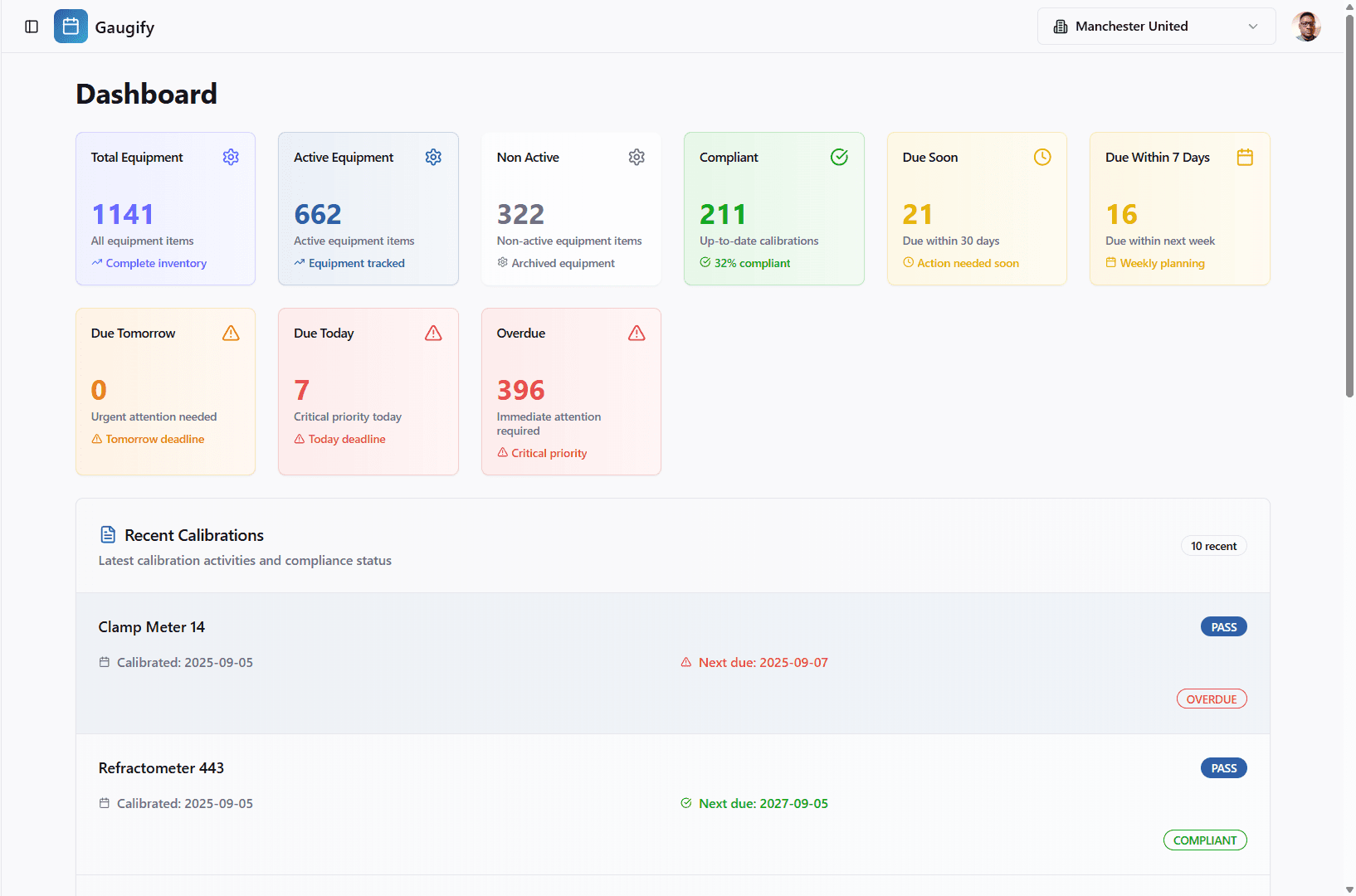
Generate reports showing calibration compliance rates, overdue items, and equipment requiring attention. Management dashboards provide real-time visibility into your entire calibration program.
Seamless Integration and Mobile Access
Access calibration schedules and enter data from any device, anywhere. Technicians can update calibration status directly from the shop floor using tablets or smartphones. Integration with existing asset management systems eliminates duplicate data entry.
The cloud-based platform ensures data security, automatic backups, and seamless updates without IT overhead. Built-in compliance features support FDA, ISO 17025, and other regulatory requirements.
Get Started with Professional Oven Furnace Calibration Management
Proper oven and furnace calibration requires attention to detail, appropriate procedures, and systematic record keeping. By following the guidelines in this comprehensive guide, you'll ensure accurate temperature control, regulatory compliance, and consistent product quality.
Don't let manual calibration tracking hold back your quality program. Start your free 30-day Gaugify trial today and experience how modern calibration management software can transform your operation. Eliminate spreadsheets, prevent overdue calibrations, and gain complete visibility into your equipment performance.
Ready to see Gaugify in action? Schedule a personalized demo to discover how our platform can streamline your specific calibration challenges and support your quality objectives.
With proper calibration procedures and the right management tools, your ovens and furnaces will deliver the reliable, accurate temperature control your processes demand. Take the first step toward calibration excellence today.
How to Calibrate Ovens and Furnaces
Industrial ovens and furnaces are critical temperature control equipment found in manufacturing facilities, laboratories, and quality control departments across industries. Whether you're operating a 200°C drying oven for material testing or a 1200°C heat treatment furnace for metallurgical processes, proper oven furnace calibration ensures accurate temperature control, product quality, and regulatory compliance. This comprehensive guide walks you through the essential steps, standards, and best practices for calibrating these vital instruments.
Understanding Industrial Ovens and Furnaces
Industrial ovens and furnaces are temperature-controlled chambers designed to heat materials, components, or samples to specific temperatures for various processes. Common types include:
Laboratory ovens: Typically operating from ambient to 300°C for drying, curing, and sterilization
Industrial ovens: Range from 200°C to 600°C for powder coating, aging, and stress relief
Muffle furnaces: Operating up to 1200°C for ashing, annealing, and heat treatment
Vacuum ovens: Combine heat and vacuum for moisture-sensitive materials
Conveyor ovens: Continuous processing systems with multiple temperature zones
These instruments measure and control temperature using various sensor technologies including thermocouples (Type K, Type J, Type R), RTDs (Pt100, Pt1000), and thermistors. The controller maintains setpoint temperature through PID control loops, making accurate calibration essential for consistent results.
Key Performance Parameters
When calibrating ovens and furnaces, focus on these critical parameters:
Temperature accuracy: How closely the displayed temperature matches the actual chamber temperature
Temperature uniformity: Temperature variation across different locations within the chamber
Temperature stability: Variation over time at a stable setpoint
Overshoot/undershoot: Temperature excursions during heating and cooling cycles
Why Oven Furnace Calibration is Critical
Temperature control accuracy directly impacts product quality, process repeatability, and regulatory compliance. Consider these real-world consequences of inadequate calibration:
A pharmaceutical manufacturer discovered their 60°C stability testing oven was actually operating at 64°C—a 4°C error that accelerated drug degradation and invalidated six months of stability data. The resulting investigation cost over $200,000 in retesting and regulatory filing delays.
Similarly, an automotive parts supplier found their heat treatment furnace running 15°C low, resulting in insufficient hardness in critical safety components. The discovery during a customer audit led to a costly recall and damaged supplier relationship.
Regulatory Requirements
Multiple industries mandate regular oven and furnace calibration:
Pharmaceutical (FDA 21 CFR Part 211): Equipment used in drug manufacturing must be calibrated to ensure identity, strength, quality, and purity
Medical devices (ISO 13485): Temperature-critical processes require validated, calibrated equipment
Aerospace (AS9100): Heat treatment processes demand strict temperature control and documentation
Automotive (IATF 16949): Special processes like curing and annealing require statistical process control
Beyond compliance, proper calibration ensures energy efficiency, extends equipment life, and reduces product defects. A well-calibrated oven operating within ±2°C of setpoint typically uses 5-10% less energy than one with poor control.
Step-by-Step Oven Furnace Calibration Procedure
Follow this detailed procedure for accurate calibration results. Always consult your specific equipment manual and applicable standards for any additional requirements.
Required Equipment and Standards
Gather these calibrated reference standards before beginning:
Calibrated temperature sensors: Type K thermocouples or Pt100 RTDs with accuracy of ±0.1°C or better
Data logger or multipoint thermometer: Fluke 1586A, Keysight 34972A, or similar with appropriate input modules
Reference thermometer: Hart Scientific 1523 or equivalent with NIST-traceable calibration
Insulated wire: High-temperature wire rated above maximum operating temperature
Thermal barriers: Ceramic or fiberglass insulation to minimize heat loss at sensor entry points
Environmental Preparation
Ensure optimal calibration conditions:
Allow the oven/furnace to stabilize at room temperature before starting
Verify ambient temperature is within manufacturer's specified operating range (typically 15-35°C)
Check that facility electrical power is stable (±5% of nominal voltage)
Document ambient conditions including temperature, humidity, and barometric pressure
Sensor Placement Strategy
Proper sensor placement is critical for meaningful results. For uniform temperature mapping:
Small laboratory ovens (under 1 cubic foot): Use minimum 5 sensors—center, four corners at the working level
Large industrial ovens: Follow the "cubic root rule"—if chamber volume is 27 cubic feet, use at least 9 sensors (3×3×1 grid)
Multi-zone furnaces: Place at least 3 sensors per zone, including zone boundaries
Position sensors at the working level where actual products will be placed, not just at geometric center. Avoid placing sensors directly in front of heating elements or exhaust vents.
Calibration Test Points
Select test temperatures that span the instrument's working range:
Low point: Lowest process temperature or 50°C, whichever is higher
Mid-point: Typical operating temperature
High point: Maximum process temperature or 80% of full scale
For critical applications, test additional points. A pharmaceutical stability oven used at 25°C, 40°C, and 60°C should be calibrated at all three temperatures plus intermediate points.
Detailed Calibration Steps
Step 1: Initial Documentation
Record equipment identification, model, serial number, current calibration status, and environmental conditions. Take photos of the setup for documentation.
Step 2: Sensor Installation
Install reference sensors according to your placement plan. Route wires to minimize heat loss and electromagnetic interference. Use ceramic or high-temperature tape to secure sensors without affecting air circulation.
Step 3: Stabilization Period
Set the first test temperature and allow adequate stabilization time. Small laboratory ovens typically require 30-60 minutes, while large furnaces may need 2-4 hours. Monitor temperature trends—true stability means less than ±0.5°C variation over 15 minutes.
Step 4: Data Collection
Record readings from all sensors simultaneously at 1-minute intervals for at least 15 minutes after achieving stability. Calculate average, minimum, maximum, and standard deviation for each sensor location.
Step 5: Uniformity Analysis
Compare readings across all sensor locations. Calculate the maximum temperature difference within the chamber. Typical acceptance criteria:
Laboratory ovens: ±2°C to ±5°C depending on application
Precision furnaces: ±1°C or better
General industrial ovens: ±5°C to ±10°C
Step 6: Display Accuracy Check
Compare the oven's temperature display or controller readout to your reference sensor average. Document any offset for correction or adjustment.
Step 7: Repeat for All Test Points
Repeat steps 3-6 for each calibration temperature. Allow adequate cooling time between high-temperature test points.
Ready to streamline your calibration process? Start your free Gaugify trial and discover how our modern calibration management system can eliminate manual paperwork and ensure you never miss a calibration deadline.
Relevant Standards for Oven Furnace Calibration
Several standards govern oven and furnace calibration procedures and acceptance criteria:
ASTM Standards
ASTM E220: Standard test method for calibration of thermocouples by comparison techniques
ASTM E563: Standard practice for preparation and use of an ice-point bath as a reference temperature
ASTM E1137: Standard specification for industrial platinum resistance thermometers
ASTM E2877: Standard guide for digital contact thermometers
ISO Standards
ISO/IEC 17025: General requirements for testing and calibration laboratories
ISO 17665: Sterilization of health care products using moist heat
ISO 15765: Sterilization of medical devices using dry heat
Organizations seeking ISO 17025 compliance must demonstrate traceability to national standards and maintain detailed calibration records.
Industry-Specific Guidelines
Different industries have additional requirements:
FDA Guidance: Process validation guidance emphasizes temperature distribution studies and ongoing monitoring
USP <61>: Microbiological examination of nonsterile products specifies incubator temperature requirements
NIST Special Publication 250-35: Provides guidance for temperature calibrations
Recommended Calibration Intervals
Calibration frequency depends on several factors including criticality of application, stability history, manufacturer recommendations, and regulatory requirements.
Standard Intervals
Laboratory ovens (non-critical applications): Annually
Process ovens (manufacturing): Every 6-12 months
Critical process furnaces: Quarterly or semi-annually
Pharmaceutical/medical device ovens: Every 6 months or per validation protocol
High-temperature furnaces (>1000°C): Every 3-6 months due to sensor drift
Factors Affecting Calibration Frequency
Equipment Age and Condition: Older equipment or units with maintenance issues may require more frequent calibration. A 15-year-old laboratory oven with worn heating elements showed significant drift after just 4 months, necessitating quarterly calibration.
Operating Environment: Harsh environments accelerate sensor degradation. Ovens in dusty foundries or corrosive chemical plants need more frequent attention than those in clean laboratories.
Usage Intensity: Equipment running 24/7 experiences more thermal cycling and component wear than intermittently used units.
Historical Performance: Track calibration results over time. Equipment consistently passing with small deviations may qualify for extended intervals, while units showing increasing drift need more frequent calibration.
Risk-Based Calibration Intervals
Modern calibration programs use risk assessment to optimize intervals:
High risk (product safety/regulatory impact): Conservative intervals with intermediate checks
Medium risk (quality impact): Standard intervals with trend monitoring
Low risk (non-critical applications): Extended intervals based on stability data
Common Calibration Mistakes and How to Avoid Them
Learn from these frequent errors that can invalidate calibration results and waste valuable time.
Insufficient Stabilization Time
The Mistake: Rushing to take readings before the oven reaches thermal equilibrium. Large thermal masses require significant time to stabilize.
Real Example: A technician calibrating a large curing oven took readings just 30 minutes after reaching setpoint temperature. The apparent 8°C error was actually due to continuing temperature rise. Proper 3-hour stabilization showed the oven was within specification.
Prevention: Monitor temperature trends, not just values. True stability means less than 0.5°C change over 15-30 minutes depending on oven size.
Poor Sensor Placement
The Mistake: Placing reference sensors in unrepresentative locations or allowing them to contact hot surfaces.
Prevention: Position sensors at working level where products are actually placed. Use appropriate mounting methods—suspend sensors in air for convection ovens, mount on fixtures that simulate actual product thermal mass for conduction applications.
Ignoring Temperature Uniformity
The Mistake: Only checking display accuracy without mapping temperature distribution throughout the chamber.
Real Example: A powder coating oven showed perfect display accuracy at the geometric center but had 15°C cold spots near the door that caused coating defects. Proper mapping would have identified this issue.
Prevention: Always perform uniformity surveys, especially for new equipment or after maintenance. Focus on areas where products are actually processed.
Wrong Reference Standards
The Mistake: Using reference instruments with inadequate accuracy ratios or expired calibrations.
Prevention: Maintain 4:1 accuracy ratio minimum (reference instrument should be 4 times more accurate than the unit under test). Verify reference instrument calibration certificates are current and traceable.
Environmental Factors
The Mistake: Not accounting for ambient conditions that affect oven performance.
Prevention: Document ambient temperature, humidity, and electrical conditions. Schedule calibrations during normal operating conditions, not during extreme weather or facility maintenance.
Streamline Oven Furnace Calibration Management with Gaugify
Managing calibration schedules, certificates, and compliance documentation for multiple ovens and furnaces can quickly become overwhelming. Gaugify's modern calibration management platform transforms this complex process into an automated, efficient system.
Automated Scheduling and Reminders
Never miss another oven calibration deadline. Gaugify automatically calculates due dates based on your specified intervals and sends email reminders well in advance. Whether you're managing quarterly furnace calibrations or annual laboratory oven checks, the system keeps everything on schedule.
Set up custom reminder schedules for different equipment types—receive 30-day advance notices for critical process ovens and 14-day reminders for general laboratory equipment. Escalation reminders ensure overdue calibrations get immediate attention.
Comprehensive Data Management
Store detailed calibration data including as-found and as-left readings, temperature uniformity maps, and environmental conditions. Gaugify's flexible data entry accommodates various calibration procedures and acceptance criteria.
Upload temperature distribution charts, photos of sensor placement, and any supporting documentation. Everything stays organized and instantly accessible for audits, investigations, or equipment troubleshooting.
Automated Certificate Generation
Generate professional calibration certificates instantly with all required information including:
Equipment identification and specifications
Calibration procedure and standards used
Environmental conditions
As-found and as-left readings
Measurement uncertainty calculations
Next due date and recommendations
Custom certificate templates ensure compliance with your specific industry requirements and quality system standards.
Advanced Analytics and Trending
Track equipment performance over time with automated drift analysis and trend charts. Identify ovens showing increasing calibration errors before they fail specification limits. This predictive approach prevents quality issues and optimizes calibration intervals based on actual performance data.
Generate reports showing calibration compliance rates, overdue items, and equipment requiring attention. Management dashboards provide real-time visibility into your entire calibration program.
Seamless Integration and Mobile Access
Access calibration schedules and enter data from any device, anywhere. Technicians can update calibration status directly from the shop floor using tablets or smartphones. Integration with existing asset management systems eliminates duplicate data entry.
The cloud-based platform ensures data security, automatic backups, and seamless updates without IT overhead. Built-in compliance features support FDA, ISO 17025, and other regulatory requirements.
Get Started with Professional Oven Furnace Calibration Management
Proper oven and furnace calibration requires attention to detail, appropriate procedures, and systematic record keeping. By following the guidelines in this comprehensive guide, you'll ensure accurate temperature control, regulatory compliance, and consistent product quality.
Don't let manual calibration tracking hold back your quality program. Start your free 30-day Gaugify trial today and experience how modern calibration management software can transform your operation. Eliminate spreadsheets, prevent overdue calibrations, and gain complete visibility into your equipment performance.
Ready to see Gaugify in action? Schedule a personalized demo to discover how our platform can streamline your specific calibration challenges and support your quality objectives.
With proper calibration procedures and the right management tools, your ovens and furnaces will deliver the reliable, accurate temperature control your processes demand. Take the first step toward calibration excellence today.