
How to Calibrate Ultrasonic Thickness Gauges
How to Calibrate Ultrasonic Thickness Gauges
David Bentley
Quality Assurance Engineer
12 min read
How to Calibrate Ultrasonic Thickness Gauges
Ultrasonic thickness gauge calibration is a critical process that ensures accurate material thickness measurements across manufacturing, petrochemical, aerospace, and marine industries. These precision instruments require regular calibration to maintain measurement integrity, comply with quality standards, and prevent costly material failures. Whether you're measuring pipe wall thickness, tank floors, or aircraft components, proper calibration procedures are essential for reliable results.
Ultrasonic thickness gauges work by transmitting high-frequency sound waves through materials and measuring the time it takes for the echo to return from the back wall. This non-destructive testing method allows technicians to assess material thickness without cutting or damaging components, making it invaluable for preventive maintenance and quality control applications.
Understanding Ultrasonic Thickness Gauges and Their Applications
Ultrasonic thickness gauges are portable, battery-operated instruments that measure material thickness using ultrasonic pulse-echo technology. The transducer emits ultrasonic pulses at frequencies typically ranging from 1 MHz to 20 MHz, depending on the application and material type. Common applications include:
Pipeline integrity assessment: Measuring wall thickness in oil and gas pipelines to detect corrosion and erosion
Storage tank inspection: Evaluating bottom plate thickness in fuel and chemical storage tanks
Marine hull surveys: Assessing hull plating thickness on ships and offshore structures
Aerospace component inspection: Measuring aluminum and composite panel thickness on aircraft
Manufacturing quality control: Verifying plate and sheet thickness during production
These instruments typically measure thickness ranges from 0.025 mm to 635 mm (0.001" to 25"), depending on the model and transducer frequency. Popular manufacturers include Olympus, GE Inspection Technologies, Dakota Ultrasonics, and Cygnus Instruments, each offering models with specific measurement capabilities and accuracy specifications.
Key Components and Measurement Principles
Modern ultrasonic thickness gauges consist of several critical components that work together to provide accurate measurements. The main unit contains the ultrasonic pulser-receiver electronics, digital processing circuits, and display. The transducer converts electrical energy into mechanical sound waves and vice versa. Couplant gel ensures proper acoustic transmission between the transducer and test material.
The measurement process relies on the acoustic velocity of sound waves through the material being tested. The gauge calculates thickness using the formula: Thickness = (Velocity × Time) ÷ 2, where the division by two accounts for the round-trip travel time of the ultrasonic pulse.
Why Ultrasonic Thickness Gauge Calibration is Critical
Regular ultrasonic thickness gauge calibration ensures measurement accuracy and traceability required by quality management systems and regulatory standards. Unlike simple dimensional gages, these electronic instruments are subject to drift from electronic component aging, temperature fluctuations, battery voltage variations, and physical damage from field use.
Calibration becomes even more critical when considering the safety implications of thickness measurements. In the petrochemical industry, for example, underestimating pipe wall thickness due to an out-of-calibration gauge could lead to catastrophic failure and environmental damage. Similarly, overestimating thickness might result in unnecessary component replacement and increased maintenance costs.
Factors Affecting Measurement Accuracy
Several factors can impact ultrasonic thickness gauge performance between calibration intervals:
Electronic drift: Analog components in the pulser-receiver circuits can drift over time, affecting timing accuracy
Transducer wear: The piezoelectric element and wear plate can degrade with use, altering frequency response
Environmental conditions: Temperature and humidity variations can affect both electronics and transducer performance
Mechanical damage: Drops, impacts, or exposure to harsh chemicals can affect internal calibration
Battery voltage: Low battery conditions can cause timing errors and reduced measurement accuracy
These factors make regular calibration essential for maintaining measurement uncertainty within acceptable limits, typically ±0.025 mm (±0.001") or ±1% of reading, whichever is greater.
Step-by-Step Ultrasonic Thickness Gauge Calibration Procedure
Proper ultrasonic thickness gauge calibration requires certified reference standards, controlled environmental conditions, and systematic testing procedures. The following procedure applies to most commercial ultrasonic thickness gauges and should be adapted based on manufacturer specifications and applicable standards.
Required Equipment and Standards
Before beginning calibration, ensure you have the following equipment:
Calibrated thickness standards: Steel step blocks or individual thickness standards traceable to NIST, covering the gauge's measurement range (typically 1.000 mm, 5.000 mm, 10.000 mm, 25.000 mm)
Reference transducer: Calibrated transducer of the same frequency and type used during calibration
Ultrasonic couplant: Glycerin or commercial ultrasonic gel for acoustic coupling
Environmental monitoring equipment: Thermometer and hygrometer for recording conditions
Calibration software or data sheets: For recording as-found and as-left data
Thickness standards should have certified thickness values with uncertainties no greater than 1/10th of the gauge's accuracy specification. For a gauge with ±0.025 mm accuracy, standards should be certified to ±0.0025 mm or better.
Environmental Conditions
Perform calibration in a controlled environment meeting the following conditions:
Temperature: 20°C ± 5°C (68°F ± 9°F)
Relative humidity: 45% to 75% RH
Vibration: Minimal mechanical vibration
Electromagnetic interference: Away from strong magnetic fields or radio frequency sources
Allow the gauge and standards to stabilize at room temperature for at least 30 minutes before beginning calibration procedures.
Pre-Calibration Inspection and As-Found Testing
Start by conducting a thorough visual inspection of the ultrasonic thickness gauge and transducer. Check for physical damage, cracked displays, damaged connectors, or signs of liquid intrusion. Verify that the serial numbers match the calibration certificate and work order.
Record as-found readings on each thickness standard before making any adjustments. This data provides valuable insight into the gauge's stability and helps identify drift patterns. Use the following procedure for each standard:
Apply a thin layer of couplant to the standard surface
Place the transducer perpendicular to the surface with light, consistent pressure
Wait for the reading to stabilize and record the displayed value
Lift the transducer, reapply couplant, and repeat the measurement
Calculate the average of three readings for each standard
Compare as-found readings to the certified standard values and calculate the error for each point. If errors exceed the gauge's stated accuracy specification, the instrument fails as-found testing and requires adjustment or repair.
Calibration Adjustment Procedure
Most modern ultrasonic thickness gauges feature internal calibration adjustments accessible through menu functions. The specific procedure varies by manufacturer, but generally follows these steps:
Zero offset adjustment: Set the gauge to display zero thickness when measuring the transducer's internal delay
Velocity calibration: Adjust the sound velocity setting using a known thickness standard (typically 5.000 mm steel)
Linearity verification: Confirm accuracy across the full measurement range using multiple standards
Resolution check: Verify the gauge can resolve thickness differences equal to its stated resolution
For velocity calibration, place the transducer on the reference standard and use the gauge's calibration function to set the displayed value to match the certified thickness. This automatically adjusts the internal velocity setting for the material and transducer combination.
After completing adjustments, perform as-left testing using the same standards and procedures used for as-found testing. Document all readings and verify they fall within the gauge's accuracy specification.
Relevant Calibration Standards and Specifications
Several national and international standards govern ultrasonic thickness gauge calibration procedures and requirements. Understanding these standards helps ensure compliance with customer requirements and regulatory obligations.
Key Standards and Guidelines
ASTM E797 - Standard Practice for Measuring Thickness by Manual Ultrasonic Pulse-Echo Contact Method provides comprehensive guidance on ultrasonic thickness measurement procedures, including calibration requirements and uncertainty analysis. This standard specifies that gauges should be calibrated using thickness standards with known acoustic velocities.
ISO 16809 - Non-destructive testing - Ultrasonic thickness measurement establishes international requirements for ultrasonic thickness measurement equipment and procedures. The standard emphasizes traceability of calibration standards and documentation of measurement uncertainty.
ASME Section V Article 4 covers ultrasonic testing requirements for pressure vessel applications, including specific calibration procedures for thickness measurement equipment used in code inspections.
API 570 - Piping Inspection Code and API 653 - Tank Inspection, Repair, Alteration, and Reconstruction reference ultrasonic thickness measurement requirements for petrochemical applications, including calibration intervals and accuracy requirements.
Manufacturer Specifications
Always consult the manufacturer's calibration manual for instrument-specific requirements. Leading manufacturers typically specify:
Olympus: Annual calibration with ±1% accuracy verification using certified thickness standards
GE/Baker Hughes: 6-month calibration intervals for critical applications, annual for general use
Dakota Ultrasonics: Calibration using steel standards ranging from 1.000" to 8.000" thickness
Cygnus: Multi-echo verification and linearity testing across full measurement range
These specifications often include detailed procedures for specific gauge models and may require proprietary calibration software or hardware.
Recommended Ultrasonic Thickness Gauge Calibration Intervals
Calibration intervals for ultrasonic thickness gauges depend on several factors including application criticality, environmental conditions, usage frequency, and historical performance data. Most organizations start with manufacturer recommendations and adjust based on actual drift patterns observed during calibration.
Industry-Standard Intervals
Common calibration intervals by industry and application include:
Aerospace applications: 6 months due to critical safety requirements and tight tolerance specifications
Petrochemical inspection: 12 months for routine piping inspection, 6 months for critical process equipment
Marine surveys: 12 months for commercial vessels, 6 months for military and offshore applications
Manufacturing quality control: 12 months for production inspection, 6 months for final acceptance testing
General NDT services: 12 months with interim checks using check standards
These intervals assume normal operating conditions and proper handling procedures. Harsh environments or heavy usage may require shorter intervals.
Factors Influencing Calibration Frequency
Several factors should be considered when establishing calibration intervals:
Usage intensity: Gauges used daily in production environments experience more wear than those used occasionally for spot checks. High-volume users often require 6-month intervals, while occasional users may extend to 18 months.
Environmental conditions: Exposure to temperature extremes, humidity, dust, or corrosive atmospheres accelerates component degradation. Offshore and chemical plant applications typically require shorter intervals.
Historical stability: Gauges that consistently pass calibration with minimal drift may be candidates for extended intervals, while units showing significant drift require more frequent calibration.
Regulatory requirements: Some industries mandate specific intervals regardless of historical performance. Nuclear, aerospace, and FDA-regulated industries often specify maximum 12-month intervals.
Most calibration management systems like Gaugify's advanced features can track these factors and recommend optimal intervals based on actual performance data.
Common Ultrasonic Thickness Gauge Calibration Mistakes and How to Avoid Them
Even experienced technicians can make calibration errors that compromise measurement accuracy and compliance. Understanding common mistakes helps ensure reliable calibration results and avoid costly re-work.
Inadequate Standard Preparation
One of the most frequent mistakes involves improper preparation of thickness standards. Standards must be clean, free of corrosion, and at thermal equilibrium with the gauge. Surface contamination, even microscopic oxide layers, can affect ultrasonic coupling and introduce measurement errors.
Always clean standards with appropriate solvents and verify smooth, parallel surfaces before use. Check for surface wear that might affect certified thickness values, and replace standards when wear exceeds acceptable limits.
Incorrect Couplant Application
Couplant application significantly affects measurement accuracy during calibration. Too little couplant creates air gaps that attenuate ultrasonic signals, while excessive couplant can create additional acoustic paths that affect timing measurements.
Apply a thin, uniform layer of couplant and ensure complete coverage between the transducer and standard surface. Remove air bubbles by gently moving the transducer during initial contact. Use the same couplant type during calibration that will be used during actual measurements.
Inadequate Temperature Stabilization
Temperature affects both the ultrasonic velocity in materials and the electronic performance of the gauge. Calibrating immediately after moving equipment from different temperature environments can introduce significant errors.
Allow adequate time for thermal stabilization - typically 30 minutes for every 10°C temperature difference. Monitor temperatures throughout the calibration process and document environmental conditions on calibration certificates.
Ignoring Transducer Calibration
Many technicians focus solely on the main gauge unit while neglecting transducer calibration. Transducers are precision devices that can drift independently of the main electronics, particularly the delay time and frequency response characteristics.
Always calibrate the gauge with the specific transducer that will be used for measurements. If multiple transducers are used with one gauge, each combination requires separate calibration or verification. Document transducer serial numbers and maintain calibration records for each unit.
Insufficient Data Documentation
Incomplete calibration records create compliance issues and make it difficult to analyze gauge performance trends. Many organizations fail to record as-found data or document environmental conditions during calibration.
Maintain detailed records including as-found readings, adjustments made, as-left readings, environmental conditions, and standards used. This data supports measurement uncertainty calculations and helps optimize calibration intervals.
Tracking Ultrasonic Thickness Gauge Calibration with Modern Software
Managing calibration schedules, documentation, and compliance for ultrasonic thickness gauges requires robust tracking systems that can handle the complexity of these precision instruments. Traditional paper-based systems and spreadsheets often fail to provide the automation and reporting capabilities needed for efficient calibration management.
Modern calibration management software provides comprehensive solutions for tracking ultrasonic thickness gauge calibrations, from initial scheduling through certificate generation and compliance reporting. Gaugify's cloud-based platform specifically addresses the unique requirements of NDT equipment calibration.
Automated Scheduling and Notifications
Ultrasonic thickness gauges often have different calibration intervals based on their specific applications and risk levels. A gauge used for critical pipeline inspection might require 6-month calibration, while one used for general manufacturing QC operates on a 12-month schedule.
Advanced calibration software automatically tracks these individual schedules and sends notifications well before due dates. Email alerts, dashboard warnings, and mobile notifications ensure that no gauge operates beyond its calibration due date. The system can also account for lead times required for scheduling calibration services or shipping instruments to external laboratories.
For organizations with large fleets of ultrasonic equipment, starting a free trial of comprehensive calibration management software can immediately improve compliance and reduce administrative overhead.
As-Found and As-Left Data Management
Proper documentation of calibration results requires recording both as-found and as-left measurements for each thickness standard used during calibration. This data provides valuable insights into gauge stability and helps optimize calibration intervals.
Modern systems store complete calibration histories with graphical trending that shows measurement drift over time. When a gauge consistently shows minimal drift, the data supports extending calibration intervals. Conversely, units showing significant drift patterns may require more frequent calibration or investigation of root causes.
The software can also calculate measurement uncertainty based on calibration data, reference standard uncertainties, and environmental conditions - essential information for ISO 17025 compliance in testing and calibration laboratories.
Digital Certificate Generation
Calibration certificates for ultrasonic thickness gauges must include specific information about the calibration procedure, standards used, environmental conditions, and measurement results. Manual certificate preparation is time-consuming and prone to errors.
Automated certificate generation pulls data directly from the calibration database and populates standardized templates that meet industry requirements. Certificates can include traceability information for reference standards, measurement uncertainty statements, and recommendations for calibration intervals.
Digital certificates with electronic signatures eliminate the need for paper storage and make it easy to provide immediate proof of calibration to customers and auditors. The system maintains permanent archives with search capabilities that make historical records instantly accessible.
Compliance Reporting and Analytics
Quality management systems require regular reporting on calibration program effectiveness, including metrics like on-time calibration rates, out-of-tolerance findings, and cost per measurement point. Manual compilation of these reports from paper records or multiple spreadsheets is extremely time-consuming.
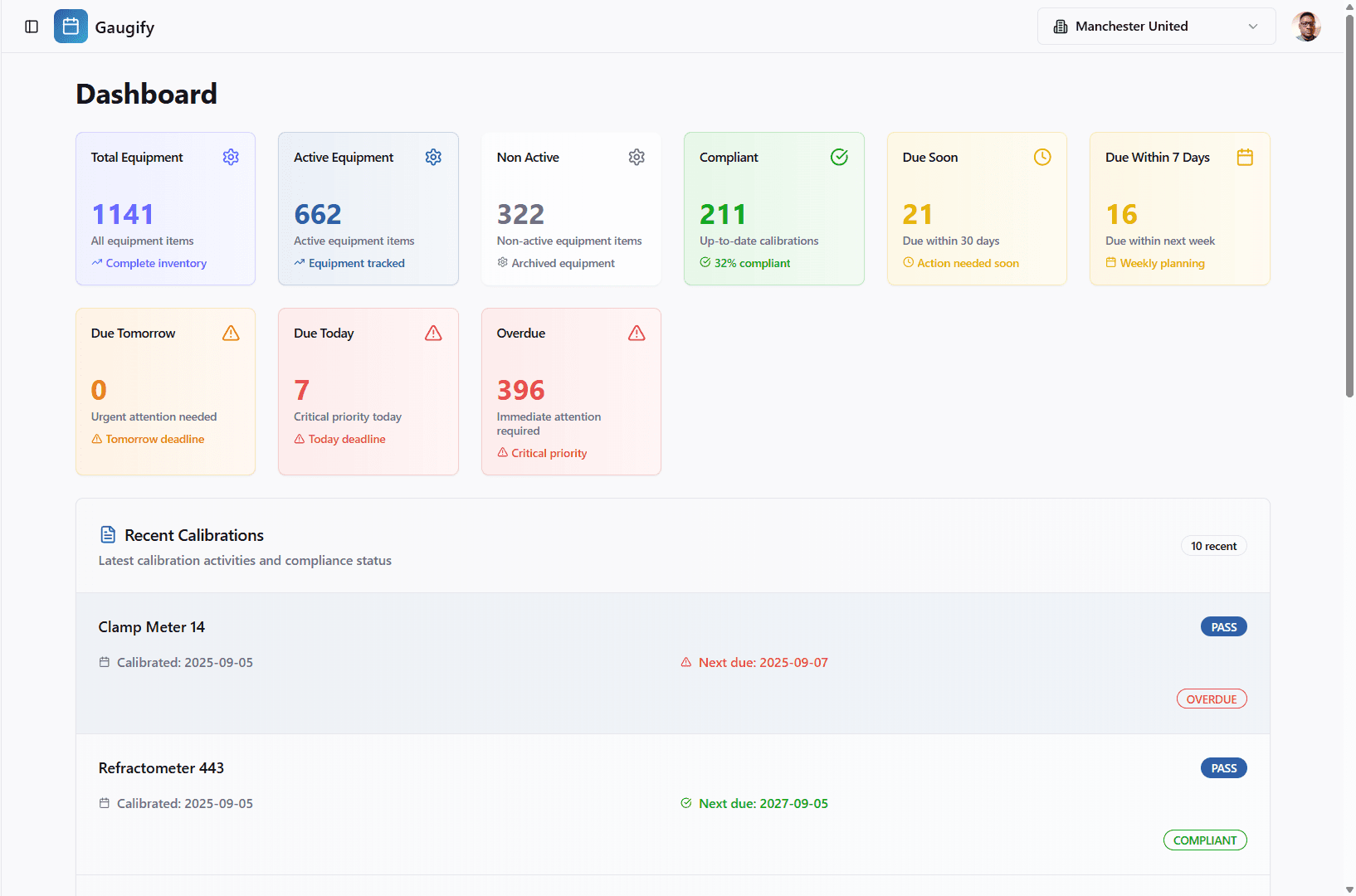
Comprehensive calibration management systems provide automated reporting with real-time dashboards showing current compliance status across all ultrasonic thickness gauges. Advanced compliance features can track regulatory requirements specific to different industries and generate audit-ready documentation.
Analytics capabilities help identify trends in calibration data, optimize scheduling, and reduce overall program costs. For example, the system might identify that gauges from a specific manufacturer consistently require shorter calibration intervals, supporting decisions about future equipment purchases.
Optimizing Your Ultrasonic Thickness Gauge Calibration Program
Effective calibration of ultrasonic thickness gauges requires attention to technical procedures, documentation requirements, and program management. Success depends on understanding the unique characteristics of these instruments and implementing systematic approaches to maintain measurement accuracy and compliance.
The key elements of a successful program include proper calibration procedures using traceable standards, appropriate calibration intervals based on risk assessment and historical data, and comprehensive documentation systems that support continuous improvement. Regular training for technicians and periodic review of calibration results ensure ongoing effectiveness.
Modern calibration management software eliminates many of the administrative challenges associated with maintaining large numbers of precision instruments while providing the documentation and reporting capabilities required by quality standards and regulatory requirements.
Ready to streamline your ultrasonic thickness gauge calibration program? Schedule a personalized demo to see how Gaugify can help you maintain compliance, reduce administrative overhead, and optimize your calibration intervals based on actual performance data. Our cloud-based platform is designed specifically for the unique requirements of precision measurement instrument management.
How to Calibrate Ultrasonic Thickness Gauges
Ultrasonic thickness gauge calibration is a critical process that ensures accurate material thickness measurements across manufacturing, petrochemical, aerospace, and marine industries. These precision instruments require regular calibration to maintain measurement integrity, comply with quality standards, and prevent costly material failures. Whether you're measuring pipe wall thickness, tank floors, or aircraft components, proper calibration procedures are essential for reliable results.
Ultrasonic thickness gauges work by transmitting high-frequency sound waves through materials and measuring the time it takes for the echo to return from the back wall. This non-destructive testing method allows technicians to assess material thickness without cutting or damaging components, making it invaluable for preventive maintenance and quality control applications.
Understanding Ultrasonic Thickness Gauges and Their Applications
Ultrasonic thickness gauges are portable, battery-operated instruments that measure material thickness using ultrasonic pulse-echo technology. The transducer emits ultrasonic pulses at frequencies typically ranging from 1 MHz to 20 MHz, depending on the application and material type. Common applications include:
Pipeline integrity assessment: Measuring wall thickness in oil and gas pipelines to detect corrosion and erosion
Storage tank inspection: Evaluating bottom plate thickness in fuel and chemical storage tanks
Marine hull surveys: Assessing hull plating thickness on ships and offshore structures
Aerospace component inspection: Measuring aluminum and composite panel thickness on aircraft
Manufacturing quality control: Verifying plate and sheet thickness during production
These instruments typically measure thickness ranges from 0.025 mm to 635 mm (0.001" to 25"), depending on the model and transducer frequency. Popular manufacturers include Olympus, GE Inspection Technologies, Dakota Ultrasonics, and Cygnus Instruments, each offering models with specific measurement capabilities and accuracy specifications.
Key Components and Measurement Principles
Modern ultrasonic thickness gauges consist of several critical components that work together to provide accurate measurements. The main unit contains the ultrasonic pulser-receiver electronics, digital processing circuits, and display. The transducer converts electrical energy into mechanical sound waves and vice versa. Couplant gel ensures proper acoustic transmission between the transducer and test material.
The measurement process relies on the acoustic velocity of sound waves through the material being tested. The gauge calculates thickness using the formula: Thickness = (Velocity × Time) ÷ 2, where the division by two accounts for the round-trip travel time of the ultrasonic pulse.
Why Ultrasonic Thickness Gauge Calibration is Critical
Regular ultrasonic thickness gauge calibration ensures measurement accuracy and traceability required by quality management systems and regulatory standards. Unlike simple dimensional gages, these electronic instruments are subject to drift from electronic component aging, temperature fluctuations, battery voltage variations, and physical damage from field use.
Calibration becomes even more critical when considering the safety implications of thickness measurements. In the petrochemical industry, for example, underestimating pipe wall thickness due to an out-of-calibration gauge could lead to catastrophic failure and environmental damage. Similarly, overestimating thickness might result in unnecessary component replacement and increased maintenance costs.
Factors Affecting Measurement Accuracy
Several factors can impact ultrasonic thickness gauge performance between calibration intervals:
Electronic drift: Analog components in the pulser-receiver circuits can drift over time, affecting timing accuracy
Transducer wear: The piezoelectric element and wear plate can degrade with use, altering frequency response
Environmental conditions: Temperature and humidity variations can affect both electronics and transducer performance
Mechanical damage: Drops, impacts, or exposure to harsh chemicals can affect internal calibration
Battery voltage: Low battery conditions can cause timing errors and reduced measurement accuracy
These factors make regular calibration essential for maintaining measurement uncertainty within acceptable limits, typically ±0.025 mm (±0.001") or ±1% of reading, whichever is greater.
Step-by-Step Ultrasonic Thickness Gauge Calibration Procedure
Proper ultrasonic thickness gauge calibration requires certified reference standards, controlled environmental conditions, and systematic testing procedures. The following procedure applies to most commercial ultrasonic thickness gauges and should be adapted based on manufacturer specifications and applicable standards.
Required Equipment and Standards
Before beginning calibration, ensure you have the following equipment:
Calibrated thickness standards: Steel step blocks or individual thickness standards traceable to NIST, covering the gauge's measurement range (typically 1.000 mm, 5.000 mm, 10.000 mm, 25.000 mm)
Reference transducer: Calibrated transducer of the same frequency and type used during calibration
Ultrasonic couplant: Glycerin or commercial ultrasonic gel for acoustic coupling
Environmental monitoring equipment: Thermometer and hygrometer for recording conditions
Calibration software or data sheets: For recording as-found and as-left data
Thickness standards should have certified thickness values with uncertainties no greater than 1/10th of the gauge's accuracy specification. For a gauge with ±0.025 mm accuracy, standards should be certified to ±0.0025 mm or better.
Environmental Conditions
Perform calibration in a controlled environment meeting the following conditions:
Temperature: 20°C ± 5°C (68°F ± 9°F)
Relative humidity: 45% to 75% RH
Vibration: Minimal mechanical vibration
Electromagnetic interference: Away from strong magnetic fields or radio frequency sources
Allow the gauge and standards to stabilize at room temperature for at least 30 minutes before beginning calibration procedures.
Pre-Calibration Inspection and As-Found Testing
Start by conducting a thorough visual inspection of the ultrasonic thickness gauge and transducer. Check for physical damage, cracked displays, damaged connectors, or signs of liquid intrusion. Verify that the serial numbers match the calibration certificate and work order.
Record as-found readings on each thickness standard before making any adjustments. This data provides valuable insight into the gauge's stability and helps identify drift patterns. Use the following procedure for each standard:
Apply a thin layer of couplant to the standard surface
Place the transducer perpendicular to the surface with light, consistent pressure
Wait for the reading to stabilize and record the displayed value
Lift the transducer, reapply couplant, and repeat the measurement
Calculate the average of three readings for each standard
Compare as-found readings to the certified standard values and calculate the error for each point. If errors exceed the gauge's stated accuracy specification, the instrument fails as-found testing and requires adjustment or repair.
Calibration Adjustment Procedure
Most modern ultrasonic thickness gauges feature internal calibration adjustments accessible through menu functions. The specific procedure varies by manufacturer, but generally follows these steps:
Zero offset adjustment: Set the gauge to display zero thickness when measuring the transducer's internal delay
Velocity calibration: Adjust the sound velocity setting using a known thickness standard (typically 5.000 mm steel)
Linearity verification: Confirm accuracy across the full measurement range using multiple standards
Resolution check: Verify the gauge can resolve thickness differences equal to its stated resolution
For velocity calibration, place the transducer on the reference standard and use the gauge's calibration function to set the displayed value to match the certified thickness. This automatically adjusts the internal velocity setting for the material and transducer combination.
After completing adjustments, perform as-left testing using the same standards and procedures used for as-found testing. Document all readings and verify they fall within the gauge's accuracy specification.
Relevant Calibration Standards and Specifications
Several national and international standards govern ultrasonic thickness gauge calibration procedures and requirements. Understanding these standards helps ensure compliance with customer requirements and regulatory obligations.
Key Standards and Guidelines
ASTM E797 - Standard Practice for Measuring Thickness by Manual Ultrasonic Pulse-Echo Contact Method provides comprehensive guidance on ultrasonic thickness measurement procedures, including calibration requirements and uncertainty analysis. This standard specifies that gauges should be calibrated using thickness standards with known acoustic velocities.
ISO 16809 - Non-destructive testing - Ultrasonic thickness measurement establishes international requirements for ultrasonic thickness measurement equipment and procedures. The standard emphasizes traceability of calibration standards and documentation of measurement uncertainty.
ASME Section V Article 4 covers ultrasonic testing requirements for pressure vessel applications, including specific calibration procedures for thickness measurement equipment used in code inspections.
API 570 - Piping Inspection Code and API 653 - Tank Inspection, Repair, Alteration, and Reconstruction reference ultrasonic thickness measurement requirements for petrochemical applications, including calibration intervals and accuracy requirements.
Manufacturer Specifications
Always consult the manufacturer's calibration manual for instrument-specific requirements. Leading manufacturers typically specify:
Olympus: Annual calibration with ±1% accuracy verification using certified thickness standards
GE/Baker Hughes: 6-month calibration intervals for critical applications, annual for general use
Dakota Ultrasonics: Calibration using steel standards ranging from 1.000" to 8.000" thickness
Cygnus: Multi-echo verification and linearity testing across full measurement range
These specifications often include detailed procedures for specific gauge models and may require proprietary calibration software or hardware.
Recommended Ultrasonic Thickness Gauge Calibration Intervals
Calibration intervals for ultrasonic thickness gauges depend on several factors including application criticality, environmental conditions, usage frequency, and historical performance data. Most organizations start with manufacturer recommendations and adjust based on actual drift patterns observed during calibration.
Industry-Standard Intervals
Common calibration intervals by industry and application include:
Aerospace applications: 6 months due to critical safety requirements and tight tolerance specifications
Petrochemical inspection: 12 months for routine piping inspection, 6 months for critical process equipment
Marine surveys: 12 months for commercial vessels, 6 months for military and offshore applications
Manufacturing quality control: 12 months for production inspection, 6 months for final acceptance testing
General NDT services: 12 months with interim checks using check standards
These intervals assume normal operating conditions and proper handling procedures. Harsh environments or heavy usage may require shorter intervals.
Factors Influencing Calibration Frequency
Several factors should be considered when establishing calibration intervals:
Usage intensity: Gauges used daily in production environments experience more wear than those used occasionally for spot checks. High-volume users often require 6-month intervals, while occasional users may extend to 18 months.
Environmental conditions: Exposure to temperature extremes, humidity, dust, or corrosive atmospheres accelerates component degradation. Offshore and chemical plant applications typically require shorter intervals.
Historical stability: Gauges that consistently pass calibration with minimal drift may be candidates for extended intervals, while units showing significant drift require more frequent calibration.
Regulatory requirements: Some industries mandate specific intervals regardless of historical performance. Nuclear, aerospace, and FDA-regulated industries often specify maximum 12-month intervals.
Most calibration management systems like Gaugify's advanced features can track these factors and recommend optimal intervals based on actual performance data.
Common Ultrasonic Thickness Gauge Calibration Mistakes and How to Avoid Them
Even experienced technicians can make calibration errors that compromise measurement accuracy and compliance. Understanding common mistakes helps ensure reliable calibration results and avoid costly re-work.
Inadequate Standard Preparation
One of the most frequent mistakes involves improper preparation of thickness standards. Standards must be clean, free of corrosion, and at thermal equilibrium with the gauge. Surface contamination, even microscopic oxide layers, can affect ultrasonic coupling and introduce measurement errors.
Always clean standards with appropriate solvents and verify smooth, parallel surfaces before use. Check for surface wear that might affect certified thickness values, and replace standards when wear exceeds acceptable limits.
Incorrect Couplant Application
Couplant application significantly affects measurement accuracy during calibration. Too little couplant creates air gaps that attenuate ultrasonic signals, while excessive couplant can create additional acoustic paths that affect timing measurements.
Apply a thin, uniform layer of couplant and ensure complete coverage between the transducer and standard surface. Remove air bubbles by gently moving the transducer during initial contact. Use the same couplant type during calibration that will be used during actual measurements.
Inadequate Temperature Stabilization
Temperature affects both the ultrasonic velocity in materials and the electronic performance of the gauge. Calibrating immediately after moving equipment from different temperature environments can introduce significant errors.
Allow adequate time for thermal stabilization - typically 30 minutes for every 10°C temperature difference. Monitor temperatures throughout the calibration process and document environmental conditions on calibration certificates.
Ignoring Transducer Calibration
Many technicians focus solely on the main gauge unit while neglecting transducer calibration. Transducers are precision devices that can drift independently of the main electronics, particularly the delay time and frequency response characteristics.
Always calibrate the gauge with the specific transducer that will be used for measurements. If multiple transducers are used with one gauge, each combination requires separate calibration or verification. Document transducer serial numbers and maintain calibration records for each unit.
Insufficient Data Documentation
Incomplete calibration records create compliance issues and make it difficult to analyze gauge performance trends. Many organizations fail to record as-found data or document environmental conditions during calibration.
Maintain detailed records including as-found readings, adjustments made, as-left readings, environmental conditions, and standards used. This data supports measurement uncertainty calculations and helps optimize calibration intervals.
Tracking Ultrasonic Thickness Gauge Calibration with Modern Software
Managing calibration schedules, documentation, and compliance for ultrasonic thickness gauges requires robust tracking systems that can handle the complexity of these precision instruments. Traditional paper-based systems and spreadsheets often fail to provide the automation and reporting capabilities needed for efficient calibration management.
Modern calibration management software provides comprehensive solutions for tracking ultrasonic thickness gauge calibrations, from initial scheduling through certificate generation and compliance reporting. Gaugify's cloud-based platform specifically addresses the unique requirements of NDT equipment calibration.
Automated Scheduling and Notifications
Ultrasonic thickness gauges often have different calibration intervals based on their specific applications and risk levels. A gauge used for critical pipeline inspection might require 6-month calibration, while one used for general manufacturing QC operates on a 12-month schedule.
Advanced calibration software automatically tracks these individual schedules and sends notifications well before due dates. Email alerts, dashboard warnings, and mobile notifications ensure that no gauge operates beyond its calibration due date. The system can also account for lead times required for scheduling calibration services or shipping instruments to external laboratories.
For organizations with large fleets of ultrasonic equipment, starting a free trial of comprehensive calibration management software can immediately improve compliance and reduce administrative overhead.
As-Found and As-Left Data Management
Proper documentation of calibration results requires recording both as-found and as-left measurements for each thickness standard used during calibration. This data provides valuable insights into gauge stability and helps optimize calibration intervals.
Modern systems store complete calibration histories with graphical trending that shows measurement drift over time. When a gauge consistently shows minimal drift, the data supports extending calibration intervals. Conversely, units showing significant drift patterns may require more frequent calibration or investigation of root causes.
The software can also calculate measurement uncertainty based on calibration data, reference standard uncertainties, and environmental conditions - essential information for ISO 17025 compliance in testing and calibration laboratories.
Digital Certificate Generation
Calibration certificates for ultrasonic thickness gauges must include specific information about the calibration procedure, standards used, environmental conditions, and measurement results. Manual certificate preparation is time-consuming and prone to errors.
Automated certificate generation pulls data directly from the calibration database and populates standardized templates that meet industry requirements. Certificates can include traceability information for reference standards, measurement uncertainty statements, and recommendations for calibration intervals.
Digital certificates with electronic signatures eliminate the need for paper storage and make it easy to provide immediate proof of calibration to customers and auditors. The system maintains permanent archives with search capabilities that make historical records instantly accessible.
Compliance Reporting and Analytics
Quality management systems require regular reporting on calibration program effectiveness, including metrics like on-time calibration rates, out-of-tolerance findings, and cost per measurement point. Manual compilation of these reports from paper records or multiple spreadsheets is extremely time-consuming.
Comprehensive calibration management systems provide automated reporting with real-time dashboards showing current compliance status across all ultrasonic thickness gauges. Advanced compliance features can track regulatory requirements specific to different industries and generate audit-ready documentation.
Analytics capabilities help identify trends in calibration data, optimize scheduling, and reduce overall program costs. For example, the system might identify that gauges from a specific manufacturer consistently require shorter calibration intervals, supporting decisions about future equipment purchases.
Optimizing Your Ultrasonic Thickness Gauge Calibration Program
Effective calibration of ultrasonic thickness gauges requires attention to technical procedures, documentation requirements, and program management. Success depends on understanding the unique characteristics of these instruments and implementing systematic approaches to maintain measurement accuracy and compliance.
The key elements of a successful program include proper calibration procedures using traceable standards, appropriate calibration intervals based on risk assessment and historical data, and comprehensive documentation systems that support continuous improvement. Regular training for technicians and periodic review of calibration results ensure ongoing effectiveness.
Modern calibration management software eliminates many of the administrative challenges associated with maintaining large numbers of precision instruments while providing the documentation and reporting capabilities required by quality standards and regulatory requirements.
Ready to streamline your ultrasonic thickness gauge calibration program? Schedule a personalized demo to see how Gaugify can help you maintain compliance, reduce administrative overhead, and optimize your calibration intervals based on actual performance data. Our cloud-based platform is designed specifically for the unique requirements of precision measurement instrument management.