
How to Calibrate Rockwell Hardness Test Blocks
How to Calibrate Rockwell Hardness Test Blocks
David Bentley
Quality Assurance Engineer
12 min read
How to Calibrate Rockwell Hardness Test Blocks
Hardness test block calibration is a critical quality control procedure that ensures your Rockwell hardness testing equipment delivers accurate, traceable measurements. These reference standards, typically made from hardened steel or other materials with precisely known hardness values, serve as the foundation for validating hardness testers across manufacturing, aerospace, automotive, and materials testing laboratories.
Rockwell hardness test blocks come in various scales (HRA, HRB, HRC, etc.) with certified hardness values ranging from 20 HRC to 65 HRC for C-scale blocks, or 25 HRB to 100 HRB for B-scale blocks. Each block undergoes rigorous characterization at accredited calibration laboratories to establish its reference hardness value within tight tolerances—typically ±0.5 HRC or ±1.0 HRB depending on the hardness level and scale.
Understanding Rockwell Hardness Test Blocks and Their Critical Role
Rockwell hardness test blocks function as physical reference standards that validate the performance of hardness testing machines. Unlike other calibration artifacts that might measure dimensional properties, these blocks verify the complex interaction between the tester's applied force, indenter geometry, and measurement system accuracy.
A typical test block measures approximately 1 inch thick by 2-3 inches in diameter, with a flat, polished surface free from scratches, oxidation, or other defects that could affect indentation quality. The blocks contain homogeneous material with consistent hardness distribution, verified through multiple measurements across the surface during the initial certification process.
Each certified block comes with a calibration certificate listing:
Certified hardness value (e.g., 62.3 HRC)
Measurement uncertainty (typically ±0.3 HRC)
Testing conditions (temperature, humidity, force verification)
Traceability to national standards (NIST in the US)
Expiration date for the certification
Why Hardness Test Block Calibration Demands Precision
Hardness testing affects critical decisions throughout manufacturing processes—from incoming material verification to final product acceptance. A drift of just 2-3 HRC units can mean the difference between accepting parts that meet aerospace specifications versus rejecting compliant components, potentially costing thousands of dollars in scrapped materials or failed audits.
Consider a gear manufacturer producing transmission components requiring 58-62 HRC after heat treatment. If their hardness tester reads 2 HRC units low due to improper calibration, parts measuring 60 HRC would actually be 62 HRC—acceptable by specification but undetected without proper calibration verification. Conversely, truly compliant 59 HRC parts would register as 57 HRC and face rejection.
ISO/TS 16949 automotive quality systems, AS9100 aerospace standards, and FDA medical device regulations all require documented calibration of hardness testing equipment with traceable reference standards. Calibration records must demonstrate measurement accuracy within specified tolerances, typically requiring test block verification at multiple hardness levels to cover the full testing range.
Step-by-Step Hardness Test Block Calibration Procedure
Environmental Preparation and Setup
Establish controlled environmental conditions before beginning calibration. ASTM E18 specifies testing temperatures between 10°C and 35°C with variations not exceeding ±2°C during testing. Humidity should remain stable, and both the hardness tester and test blocks must reach thermal equilibrium—typically requiring 2-4 hours in the testing environment.
Clean the test block surface using ethanol or acetone to remove oils, fingerprints, or debris. Inspect under magnification for surface defects, scratches, or wear patterns that could affect indentation quality. Blocks showing significant wear or surface damage require replacement or recertification.
Reference Standard Selection and Verification
Select certified reference blocks covering your typical testing range. For comprehensive calibration, use three blocks:
Low range: 25-35 HRC or 80-100 HRB
Mid range: 40-50 HRC or 60-80 HRB
High range: 55-65 HRC or 25-40 HRB
Verify each reference block's certification remains current—most certifications expire after 12-24 months depending on usage frequency and storage conditions. Document the certified values, uncertainties, and traceability information in your calibration records.
Calibration Testing Sequence
Position the test block on the hardness tester anvil, ensuring flat, stable contact without rocking or deflection. The testing surface should be at least 2.5mm from any edge and previous indentations should be spaced at least 3 indenter diameters apart.
Perform five measurements on each reference block following this sequence:
Initial Setup:
Verify proper indenter installation (diamond Brale for HRC, 1/16" ball for HRB)
Confirm correct force settings (150 kgf for HRC, 100 kgf for HRB)
Check timing parameters (dwell time typically 2-8 seconds)
Measurement Process:
Make first indentation and record reading
Move to new location maintaining proper spacing
Repeat for total of five measurements per block
Calculate average and compare to certified value
Acceptance Criteria and Documentation
ASTM E18 specifies acceptance criteria based on the difference between your measured average and the certified block value:
HRC scale: ±1.0 HRC for blocks ≤40 HRC, ±1.5 HRC for blocks >40 HRC
HRB scale: ±2.0 HRB for all ranges
Individual measurement spread: Should not exceed 2.0 HRC or 4.0 HRB
If measurements fall outside these limits, investigate potential causes: worn indenters, improper force calibration, environmental variations, or contaminated test surfaces. Corrective action might require indenter replacement, force system recalibration, or professional service.
Managing this documentation manually becomes overwhelming with multiple hardness testers and frequent calibration schedules. Start your free Gaugify trial to automate calibration scheduling, capture as-found and as-left data digitally, and generate compliance-ready certificates instantly.
Governing Standards for Hardness Test Block Calibration
Multiple international standards govern hardness test block calibration, each addressing specific aspects of the process:
ASTM E18 - Standard Test Methods for Rockwell Hardness
This primary standard defines Rockwell hardness testing procedures, including calibration requirements for both direct and indirect verification methods. ASTM E18 specifies force application rates, dwell times, indenter specifications, and acceptance criteria for reference block verification.
ISO 6508 Series - Rockwell Hardness Test
The ISO equivalent provides similar guidance with some regional variations in acceptance criteria and measurement uncertainty requirements. Part 1 covers the test method, Part 2 addresses verification of testing machines, and Part 3 defines calibration requirements for reference blocks.
ASTM E140 - Hardness Conversion Tables
When calibrating across multiple scales or comparing results between different hardness methods, ASTM E140 provides conversion relationships. However, direct calibration using blocks certified in the actual test scale provides superior accuracy.
Manufacturer-Specific Requirements
Equipment manufacturers like Wilson, Newage, and Instron often specify additional calibration requirements beyond generic standards. These might include more frequent verification intervals, specific environmental conditions, or enhanced documentation requirements for warranty compliance.
Quality systems like ISO 17025 accredited laboratories require additional measurement uncertainty calculations, proficiency testing participation, and enhanced traceability documentation that exceeds basic ASTM requirements.
Optimal Calibration Intervals for Hardness Test Block Calibration
Establishing appropriate calibration intervals balances measurement reliability against operational costs and downtime. Several factors influence optimal scheduling:
Usage-Based Intervals
High-volume production environments typically require more frequent calibration than occasional-use laboratories. A production shop performing 50+ hardness tests daily might need weekly block verification, while a materials lab conducting 10-20 tests weekly could extend intervals to monthly or quarterly.
Document the number of tests performed between calibrations to establish usage patterns. Blocks showing consistent performance over extended periods might qualify for longer intervals, while those displaying drift trends require more frequent verification.
Environmental Considerations
Harsh environments accelerate calibration drift through several mechanisms:
Temperature cycling affects both tester mechanics and block material properties
Humidity variations can cause corrosion or surface contamination
Vibration from nearby machinery affects force application consistency
Contamination from machining fluids or grinding dust degrades surface quality
Controlled laboratory environments might support 6-12 month calibration intervals, while shop floor installations often require monthly verification.
Risk-Based Assessment
Critical applications warrant more conservative calibration intervals regardless of historical stability. Aerospace components requiring hardness verification for flight safety, medical devices affecting patient outcomes, or nuclear applications demand enhanced calibration frequency with documented risk assessments.
Consider the cost of potential failures against calibration expenses. A $50 monthly calibration becomes insignificant compared to scrapping $10,000 worth of machined aerospace components due to undetected hardness tester drift.
Common Hardness Test Block Calibration Mistakes and Prevention Strategies
Surface Preparation Oversights
The most frequent calibration errors stem from inadequate surface preparation. Fingerprints containing skin oils can alter surface hardness by several points, while microscopic debris creates artificial hardness variations. Even clean-appearing surfaces may harbor invisible contamination affecting results.
Develop standardized cleaning procedures using appropriate solvents followed by lint-free drying. Store cleaned blocks in protective cases to prevent recontamination between uses.
Environmental Control Negligence
Temperature variations during calibration create measurement errors that operators often attribute to equipment problems rather than environmental causes. A 5°C temperature difference can shift hardness readings by 1-2 HRC units through thermal expansion effects on both the tester mechanism and test block material.
Monitor and record environmental conditions throughout calibration procedures. Delay calibration if conditions exceed specified limits rather than generating questionable data.
Statistical Analysis Shortcuts
Taking only one or two measurements per block provides insufficient data for reliable calibration assessment. Single measurements cannot detect repeatability problems, while averaged results from multiple measurements provide much better uncertainty estimation.
Always perform the minimum five measurements per block specified in standards, and consider additional measurements if initial results show high variability.
Documentation Deficiencies
Incomplete calibration records create compliance vulnerabilities during audits and make troubleshooting difficult when problems arise. Missing information about environmental conditions, reference standard certifications, or corrective actions can invalidate otherwise acceptable calibration data.
Implement comprehensive documentation procedures capturing all relevant calibration parameters. Digital systems like Gaugify's calibration management platform automatically prompt for required information and prevent incomplete records.
Streamlining Hardness Test Block Calibration with Modern Management Systems
Traditional paper-based calibration tracking becomes unmanageable as organizations scale their testing capabilities. Multiple hardness testers across different locations, varying calibration intervals, and complex compliance requirements demand systematic management approaches.
Automated Scheduling and Reminders
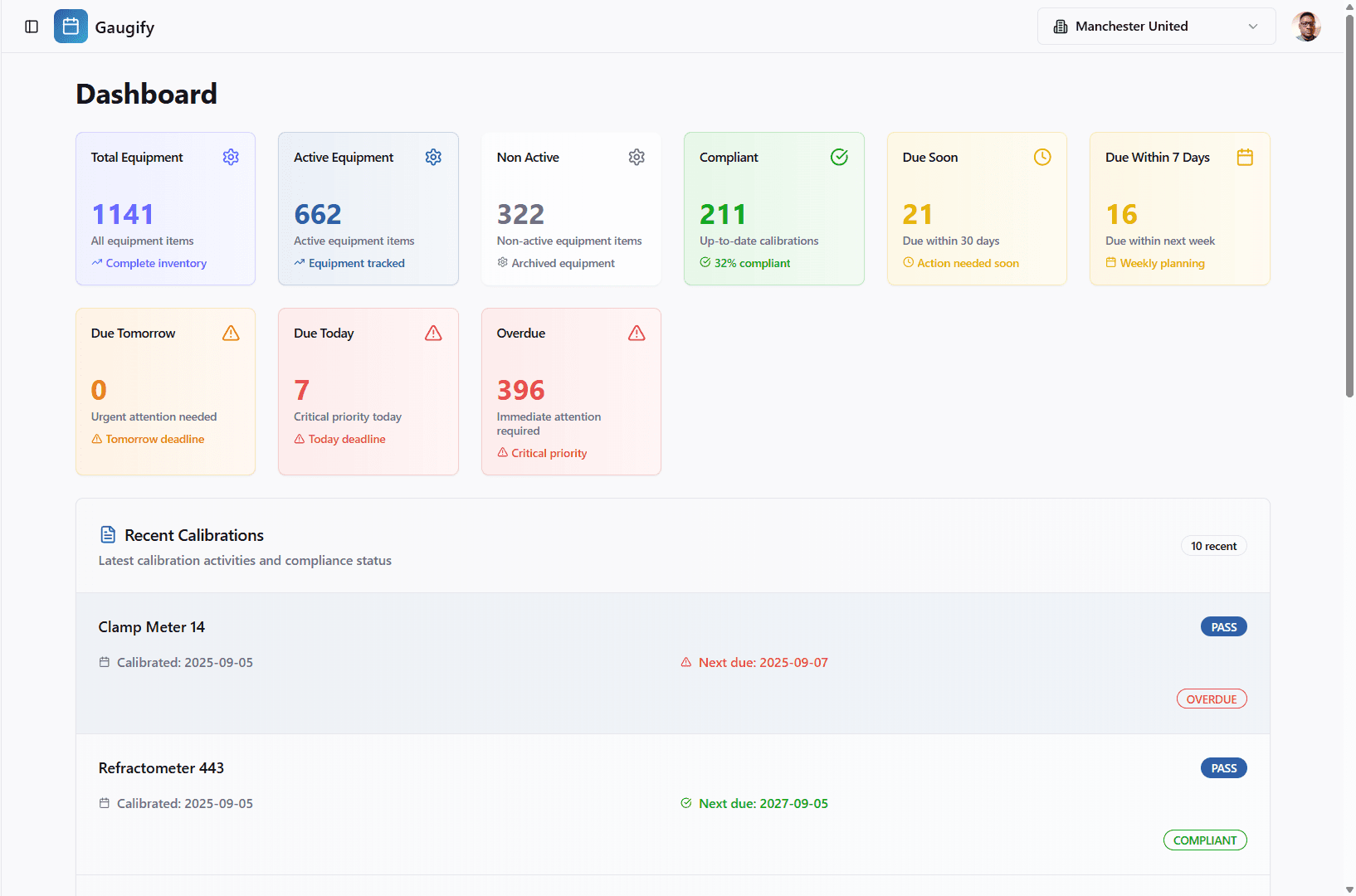
Modern calibration management software automatically schedules calibration activities based on configurable intervals, usage metrics, or risk assessments. Gaugify's platform sends advance notifications to technicians, preventing overdue calibrations that could invalidate testing results or create compliance issues.
The system tracks individual test block usage, automatically adjusting calibration schedules based on actual testing volume rather than arbitrary time intervals. Heavy-use blocks receive more frequent attention while seldom-used standards extend their intervals appropriately.
Digital Data Capture and Analysis
Digital calibration records eliminate transcription errors while providing powerful analysis capabilities impossible with paper systems. As-found and as-left data entry includes automatic range checking against acceptance criteria, immediately flagging out-of-tolerance conditions requiring corrective action.
Trend analysis identifies gradual drift patterns before they affect product quality, enabling proactive maintenance scheduling and more informed calibration interval adjustments. Historical data supports measurement uncertainty calculations required for advanced quality systems.
Compliance Documentation Generation
Audit-ready calibration certificates generate automatically from captured data, ensuring consistent formatting and completeness while eliminating time-consuming manual certificate preparation. Compliance features include customizable certificate templates, electronic signatures, and automatic distribution to stakeholders.
Integration with broader quality management systems provides seamless data flow from calibration activities through production testing and final product release decisions.
Multi-Location Coordination
Organizations operating multiple facilities benefit from centralized calibration oversight with local execution flexibility. Corporate quality managers gain visibility into calibration status across all locations while site technicians maintain operational control over their specific equipment.
Standardized procedures and acceptance criteria ensure consistency between locations, while centralized reporting supports corporate audits and compliance assessments.
Implementing Effective Hardness Test Block Calibration Programs
Success with hardness test block calibration requires systematic implementation addressing technical, procedural, and organizational aspects. Start with a comprehensive assessment of current practices, identifying gaps in documentation, training, or equipment capabilities.
Develop written procedures covering all calibration aspects from environmental controls through data analysis and corrective actions. Train technicians on both theoretical principles and practical techniques, emphasizing the critical role accurate calibration plays in overall product quality.
Invest in appropriate reference standards covering your full testing range, ensuring certifications remain current and traceability documentation meets your quality system requirements. Consider backup standards for critical applications where calibration interruptions could halt production.
Modern calibration management software transforms hardness test block calibration from a documentation burden into a value-adding quality control activity. Schedule a Gaugify demonstration to see how digital calibration management streamlines your hardness testing operations while strengthening compliance and improving measurement reliability. Our platform handles everything from automated scheduling and digital data capture to trend analysis and audit-ready documentation, letting your team focus on what matters most—ensuring product quality through accurate hardness testing.
How to Calibrate Rockwell Hardness Test Blocks
Hardness test block calibration is a critical quality control procedure that ensures your Rockwell hardness testing equipment delivers accurate, traceable measurements. These reference standards, typically made from hardened steel or other materials with precisely known hardness values, serve as the foundation for validating hardness testers across manufacturing, aerospace, automotive, and materials testing laboratories.
Rockwell hardness test blocks come in various scales (HRA, HRB, HRC, etc.) with certified hardness values ranging from 20 HRC to 65 HRC for C-scale blocks, or 25 HRB to 100 HRB for B-scale blocks. Each block undergoes rigorous characterization at accredited calibration laboratories to establish its reference hardness value within tight tolerances—typically ±0.5 HRC or ±1.0 HRB depending on the hardness level and scale.
Understanding Rockwell Hardness Test Blocks and Their Critical Role
Rockwell hardness test blocks function as physical reference standards that validate the performance of hardness testing machines. Unlike other calibration artifacts that might measure dimensional properties, these blocks verify the complex interaction between the tester's applied force, indenter geometry, and measurement system accuracy.
A typical test block measures approximately 1 inch thick by 2-3 inches in diameter, with a flat, polished surface free from scratches, oxidation, or other defects that could affect indentation quality. The blocks contain homogeneous material with consistent hardness distribution, verified through multiple measurements across the surface during the initial certification process.
Each certified block comes with a calibration certificate listing:
Certified hardness value (e.g., 62.3 HRC)
Measurement uncertainty (typically ±0.3 HRC)
Testing conditions (temperature, humidity, force verification)
Traceability to national standards (NIST in the US)
Expiration date for the certification
Why Hardness Test Block Calibration Demands Precision
Hardness testing affects critical decisions throughout manufacturing processes—from incoming material verification to final product acceptance. A drift of just 2-3 HRC units can mean the difference between accepting parts that meet aerospace specifications versus rejecting compliant components, potentially costing thousands of dollars in scrapped materials or failed audits.
Consider a gear manufacturer producing transmission components requiring 58-62 HRC after heat treatment. If their hardness tester reads 2 HRC units low due to improper calibration, parts measuring 60 HRC would actually be 62 HRC—acceptable by specification but undetected without proper calibration verification. Conversely, truly compliant 59 HRC parts would register as 57 HRC and face rejection.
ISO/TS 16949 automotive quality systems, AS9100 aerospace standards, and FDA medical device regulations all require documented calibration of hardness testing equipment with traceable reference standards. Calibration records must demonstrate measurement accuracy within specified tolerances, typically requiring test block verification at multiple hardness levels to cover the full testing range.
Step-by-Step Hardness Test Block Calibration Procedure
Environmental Preparation and Setup
Establish controlled environmental conditions before beginning calibration. ASTM E18 specifies testing temperatures between 10°C and 35°C with variations not exceeding ±2°C during testing. Humidity should remain stable, and both the hardness tester and test blocks must reach thermal equilibrium—typically requiring 2-4 hours in the testing environment.
Clean the test block surface using ethanol or acetone to remove oils, fingerprints, or debris. Inspect under magnification for surface defects, scratches, or wear patterns that could affect indentation quality. Blocks showing significant wear or surface damage require replacement or recertification.
Reference Standard Selection and Verification
Select certified reference blocks covering your typical testing range. For comprehensive calibration, use three blocks:
Low range: 25-35 HRC or 80-100 HRB
Mid range: 40-50 HRC or 60-80 HRB
High range: 55-65 HRC or 25-40 HRB
Verify each reference block's certification remains current—most certifications expire after 12-24 months depending on usage frequency and storage conditions. Document the certified values, uncertainties, and traceability information in your calibration records.
Calibration Testing Sequence
Position the test block on the hardness tester anvil, ensuring flat, stable contact without rocking or deflection. The testing surface should be at least 2.5mm from any edge and previous indentations should be spaced at least 3 indenter diameters apart.
Perform five measurements on each reference block following this sequence:
Initial Setup:
Verify proper indenter installation (diamond Brale for HRC, 1/16" ball for HRB)
Confirm correct force settings (150 kgf for HRC, 100 kgf for HRB)
Check timing parameters (dwell time typically 2-8 seconds)
Measurement Process:
Make first indentation and record reading
Move to new location maintaining proper spacing
Repeat for total of five measurements per block
Calculate average and compare to certified value
Acceptance Criteria and Documentation
ASTM E18 specifies acceptance criteria based on the difference between your measured average and the certified block value:
HRC scale: ±1.0 HRC for blocks ≤40 HRC, ±1.5 HRC for blocks >40 HRC
HRB scale: ±2.0 HRB for all ranges
Individual measurement spread: Should not exceed 2.0 HRC or 4.0 HRB
If measurements fall outside these limits, investigate potential causes: worn indenters, improper force calibration, environmental variations, or contaminated test surfaces. Corrective action might require indenter replacement, force system recalibration, or professional service.
Managing this documentation manually becomes overwhelming with multiple hardness testers and frequent calibration schedules. Start your free Gaugify trial to automate calibration scheduling, capture as-found and as-left data digitally, and generate compliance-ready certificates instantly.
Governing Standards for Hardness Test Block Calibration
Multiple international standards govern hardness test block calibration, each addressing specific aspects of the process:
ASTM E18 - Standard Test Methods for Rockwell Hardness
This primary standard defines Rockwell hardness testing procedures, including calibration requirements for both direct and indirect verification methods. ASTM E18 specifies force application rates, dwell times, indenter specifications, and acceptance criteria for reference block verification.
ISO 6508 Series - Rockwell Hardness Test
The ISO equivalent provides similar guidance with some regional variations in acceptance criteria and measurement uncertainty requirements. Part 1 covers the test method, Part 2 addresses verification of testing machines, and Part 3 defines calibration requirements for reference blocks.
ASTM E140 - Hardness Conversion Tables
When calibrating across multiple scales or comparing results between different hardness methods, ASTM E140 provides conversion relationships. However, direct calibration using blocks certified in the actual test scale provides superior accuracy.
Manufacturer-Specific Requirements
Equipment manufacturers like Wilson, Newage, and Instron often specify additional calibration requirements beyond generic standards. These might include more frequent verification intervals, specific environmental conditions, or enhanced documentation requirements for warranty compliance.
Quality systems like ISO 17025 accredited laboratories require additional measurement uncertainty calculations, proficiency testing participation, and enhanced traceability documentation that exceeds basic ASTM requirements.
Optimal Calibration Intervals for Hardness Test Block Calibration
Establishing appropriate calibration intervals balances measurement reliability against operational costs and downtime. Several factors influence optimal scheduling:
Usage-Based Intervals
High-volume production environments typically require more frequent calibration than occasional-use laboratories. A production shop performing 50+ hardness tests daily might need weekly block verification, while a materials lab conducting 10-20 tests weekly could extend intervals to monthly or quarterly.
Document the number of tests performed between calibrations to establish usage patterns. Blocks showing consistent performance over extended periods might qualify for longer intervals, while those displaying drift trends require more frequent verification.
Environmental Considerations
Harsh environments accelerate calibration drift through several mechanisms:
Temperature cycling affects both tester mechanics and block material properties
Humidity variations can cause corrosion or surface contamination
Vibration from nearby machinery affects force application consistency
Contamination from machining fluids or grinding dust degrades surface quality
Controlled laboratory environments might support 6-12 month calibration intervals, while shop floor installations often require monthly verification.
Risk-Based Assessment
Critical applications warrant more conservative calibration intervals regardless of historical stability. Aerospace components requiring hardness verification for flight safety, medical devices affecting patient outcomes, or nuclear applications demand enhanced calibration frequency with documented risk assessments.
Consider the cost of potential failures against calibration expenses. A $50 monthly calibration becomes insignificant compared to scrapping $10,000 worth of machined aerospace components due to undetected hardness tester drift.
Common Hardness Test Block Calibration Mistakes and Prevention Strategies
Surface Preparation Oversights
The most frequent calibration errors stem from inadequate surface preparation. Fingerprints containing skin oils can alter surface hardness by several points, while microscopic debris creates artificial hardness variations. Even clean-appearing surfaces may harbor invisible contamination affecting results.
Develop standardized cleaning procedures using appropriate solvents followed by lint-free drying. Store cleaned blocks in protective cases to prevent recontamination between uses.
Environmental Control Negligence
Temperature variations during calibration create measurement errors that operators often attribute to equipment problems rather than environmental causes. A 5°C temperature difference can shift hardness readings by 1-2 HRC units through thermal expansion effects on both the tester mechanism and test block material.
Monitor and record environmental conditions throughout calibration procedures. Delay calibration if conditions exceed specified limits rather than generating questionable data.
Statistical Analysis Shortcuts
Taking only one or two measurements per block provides insufficient data for reliable calibration assessment. Single measurements cannot detect repeatability problems, while averaged results from multiple measurements provide much better uncertainty estimation.
Always perform the minimum five measurements per block specified in standards, and consider additional measurements if initial results show high variability.
Documentation Deficiencies
Incomplete calibration records create compliance vulnerabilities during audits and make troubleshooting difficult when problems arise. Missing information about environmental conditions, reference standard certifications, or corrective actions can invalidate otherwise acceptable calibration data.
Implement comprehensive documentation procedures capturing all relevant calibration parameters. Digital systems like Gaugify's calibration management platform automatically prompt for required information and prevent incomplete records.
Streamlining Hardness Test Block Calibration with Modern Management Systems
Traditional paper-based calibration tracking becomes unmanageable as organizations scale their testing capabilities. Multiple hardness testers across different locations, varying calibration intervals, and complex compliance requirements demand systematic management approaches.
Automated Scheduling and Reminders
Modern calibration management software automatically schedules calibration activities based on configurable intervals, usage metrics, or risk assessments. Gaugify's platform sends advance notifications to technicians, preventing overdue calibrations that could invalidate testing results or create compliance issues.
The system tracks individual test block usage, automatically adjusting calibration schedules based on actual testing volume rather than arbitrary time intervals. Heavy-use blocks receive more frequent attention while seldom-used standards extend their intervals appropriately.
Digital Data Capture and Analysis
Digital calibration records eliminate transcription errors while providing powerful analysis capabilities impossible with paper systems. As-found and as-left data entry includes automatic range checking against acceptance criteria, immediately flagging out-of-tolerance conditions requiring corrective action.
Trend analysis identifies gradual drift patterns before they affect product quality, enabling proactive maintenance scheduling and more informed calibration interval adjustments. Historical data supports measurement uncertainty calculations required for advanced quality systems.
Compliance Documentation Generation
Audit-ready calibration certificates generate automatically from captured data, ensuring consistent formatting and completeness while eliminating time-consuming manual certificate preparation. Compliance features include customizable certificate templates, electronic signatures, and automatic distribution to stakeholders.
Integration with broader quality management systems provides seamless data flow from calibration activities through production testing and final product release decisions.
Multi-Location Coordination
Organizations operating multiple facilities benefit from centralized calibration oversight with local execution flexibility. Corporate quality managers gain visibility into calibration status across all locations while site technicians maintain operational control over their specific equipment.
Standardized procedures and acceptance criteria ensure consistency between locations, while centralized reporting supports corporate audits and compliance assessments.
Implementing Effective Hardness Test Block Calibration Programs
Success with hardness test block calibration requires systematic implementation addressing technical, procedural, and organizational aspects. Start with a comprehensive assessment of current practices, identifying gaps in documentation, training, or equipment capabilities.
Develop written procedures covering all calibration aspects from environmental controls through data analysis and corrective actions. Train technicians on both theoretical principles and practical techniques, emphasizing the critical role accurate calibration plays in overall product quality.
Invest in appropriate reference standards covering your full testing range, ensuring certifications remain current and traceability documentation meets your quality system requirements. Consider backup standards for critical applications where calibration interruptions could halt production.
Modern calibration management software transforms hardness test block calibration from a documentation burden into a value-adding quality control activity. Schedule a Gaugify demonstration to see how digital calibration management streamlines your hardness testing operations while strengthening compliance and improving measurement reliability. Our platform handles everything from automated scheduling and digital data capture to trend analysis and audit-ready documentation, letting your team focus on what matters most—ensuring product quality through accurate hardness testing.