
How to Track Calibration Costs for Budget Planning
How to Track Calibration Costs for Budget Planning
David Bentley
Quality Assurance Engineer
12 min read
How to Track Calibration Costs for Budget Planning
Effective calibration budget planning can make the difference between a quality program that runs smoothly year-round and one that faces unexpected shutdowns due to funding shortfalls. Yet many quality managers struggle with tracking the true cost of their calibration programs, leading to budget overruns, delayed calibrations, and compliance headaches.
Without proper cost tracking, you might find yourself scrambling to explain why your annual calibration budget exceeded projections by 40%, or worse, having to delay critical measurements because funds ran dry in Q3. A precision manufacturer I worked with recently discovered they were spending $23,000 annually on external calibrations for instruments that could have been calibrated in-house for $8,500 – simply because they weren't tracking costs by service type.
Why Calibration Budget Planning Matters More Than Ever
Poor calibration cost tracking creates a cascade of problems that extend far beyond the quality department. When calibration budgets are based on guesswork rather than data, several critical issues emerge:
Compliance risks: ISO 9001:2015 clause 7.1.5 requires organizations to determine and provide resources needed for monitoring and measuring. Without cost visibility, you can't ensure adequate funding for compliance requirements.
Operational disruptions: A medical device manufacturer recently had to halt production for three days when their critical CMM calibration was delayed due to budget constraints – costing $180,000 in lost production.
Hidden inefficiencies: External calibration costs for a basic digital caliper might run $85-120 per instrument, while in-house calibration could cost $15-25 when properly tracked.
Audit failures: FDA inspectors and ISO auditors increasingly scrutinize calibration program sustainability, including budget adequacy and resource allocation.
The manufacturing sector averages 2-4% of total quality costs on calibration activities, but without proper tracking, this figure can balloon to 6-8% through inefficient vendor selection, emergency services, and expedited shipping fees.
Prerequisites for Effective Calibration Cost Tracking
Before diving into cost tracking methodologies, ensure you have these foundational elements in place:
Complete Instrument Inventory
Your inventory should include every instrument requiring calibration, from precision micrometers (±0.001" tolerance) to complex environmental chambers. Each record needs:
Unique identification number
Manufacturer, model, and serial number
Calibration frequency (annual, semi-annual, etc.)
Required measurement range and accuracy specifications
Current location and responsible department
Vendor Database and Service Options
Maintain detailed records for all calibration service providers, including:
Accreditation status (ISO/IEC 17025, NVLAP, A2LA)
Capabilities and measurement ranges
Standard pricing for common instruments
Turnaround times and expedite fees
Geographic coverage and pickup/delivery costs
Historical Calibration Data
Gather at least 12-18 months of calibration records to identify trends and seasonal variations. This baseline data reveals patterns like the 20-30% cost increase many labs experience during Q4 budget-flush periods.
Step-by-Step Guide to Calibration Budget Planning
Step 1: Categorize Your Calibration Costs
Break down calibration expenses into specific categories for better visibility:
Direct Calibration Services:
External vendor calibrations
In-house labor costs (technician time at $35-65/hour)
Reference standard maintenance and calibration
Consumables (calibration fluids, test leads, adapters)
Indirect Costs:
Transportation and shipping ($25-150 per shipment)
Expedite fees (typically 50-100% premium)
Calibration software and documentation systems
Training and certification maintenance
Opportunity Costs:
Production downtime during instrument removal
Backup instrument procurement or rental
Quality hold costs during calibration delays
Step 2: Calculate Instrument-Specific Costs
For each instrument category, determine the total annual cost including all relevant factors:
Example: Precision Digital Calipers (0-6", ±0.001" accuracy)
External calibration: $95 per unit
Shipping: $35 per batch (10 units)
Internal processing time: 2 hours at $45/hour
Annual frequency: 1x per year
Total cost per unit: $95 + $3.50 + $9 = $107.50
Compare this to in-house calibration costs:
Reference standard amortization: $8 per calibration
Technician time: 45 minutes at $45/hour = $33.75
Documentation and overhead: $12
Total in-house cost: $53.75 (50% savings)
Start Your Free Trial - Track Calibration Costs Automatically
Step 3: Map Calibration Schedules to Budget Periods
Create a monthly forecast showing when calibrations are due and their associated costs. Many organizations experience uneven cash flow because they don't account for calibration clustering:
January Calibration Budget Example:
CMM annual calibration: $4,500
Pressure gage semi-annual batch (15 units): $1,875
Torque wrench quarterly service (8 units): $960
Environmental chamber annual: $2,200
Monthly total: $9,535
This granular scheduling prevents the common scenario where 40% of annual calibrations fall due in the same quarter.
Step 4: Build in Contingency and Growth Factors
Professional calibration budget planning includes several buffer categories:
Emergency Calibrations (10-15% of budget):
Out-of-tolerance findings requiring immediate recalibration
Instrument damage or suspected accuracy issues
Audit-driven calibrations and compliance catches
Business Growth (5-20% depending on expansion plans):
New product line measurement requirements
Additional production equipment requiring calibration
Expanded quality testing capabilities
Inflation and Market Changes (3-8% annually):
Calibration service price increases
Enhanced accuracy requirements driving higher costs
New regulatory requirements (like FDA 21 CFR Part 820)
Best Practices from Experienced Calibration Professionals
Implement Activity-Based Costing
Rather than treating calibration as a single line item, successful quality managers break costs down by activity:
Routine calibrations: 60-70% of total budget
Non-conformance investigations: 15-25%
New instrument validations: 8-12%
System maintenance and upgrades: 5-10%
This approach helps identify which activities drive the highest costs and where efficiency improvements will have the greatest impact.
Leverage Multi-Year Service Contracts
Negotiating 2-3 year calibration contracts can reduce costs by 12-18% while providing budget predictability. Key contract terms include:
Fixed pricing with maximum annual increases (typically 3-5%)
Guaranteed turnaround times with penalties for delays
Volume discounts for batch processing
Included pickup/delivery services
Track Cost Per Measurement Point
Advanced calibration programs monitor costs per measurement point or per accuracy level. For example:
Basic dimensional measurements: $8-15 per point
Precision electrical measurements: $25-45 per point
Complex multi-parameter calibrations: $60-120 per point
This metric helps optimize calibration scope and identify opportunities for multi-point efficiencies.
Common Calibration Budget Planning Mistakes to Avoid
Underestimating Administrative Overhead
Many organizations focus solely on direct calibration costs while ignoring administrative expenses that can represent 25-35% of total program costs:
Work order creation and tracking
Certificate review and approval processes
Non-conformance documentation and investigation
Audit preparation and response activities
Ignoring Seasonal Variations
Calibration costs fluctuate throughout the year due to:
Budget-year-end rushes increasing prices 20-30%
Holiday periods limiting vendor availability
Annual maintenance shutdowns clustering calibrations
Regulatory submission deadlines driving urgent calibrations
Smart planners spread calibrations evenly and avoid peak-demand periods when possible.
Failing to Account for Technology Changes
Emerging measurement requirements can significantly impact budgets:
Tighter tolerances requiring higher-accuracy references
New product specifications demanding additional measurement parameters
Regulatory changes mandating more frequent calibrations
Industry 4.0 implementations requiring IoT sensor calibrations
Build 10-15% technology buffer into long-term budget projections.
How Modern Software Revolutionizes Calibration Budget Planning
Cloud-based calibration management systems like Gaugify automate many aspects of cost tracking and budget planning that traditionally required manual spreadsheet management.
Automated Cost Tracking and Reporting
Modern calibration software automatically captures and categorizes costs by:
Instrument type and calibration method
Service provider and contract terms
Department and cost center allocation
Direct vs. indirect cost classification
This eliminates the manual data entry that leads to 15-20% cost tracking errors in spreadsheet-based systems.
Predictive Budget Analytics
Advanced systems analyze historical patterns to predict future costs with 85-92% accuracy. Key capabilities include:
Seasonal adjustment algorithms
Inflation and price escalation modeling
Equipment lifecycle cost projections
Scenario planning for different growth assumptions
Real-Time Budget Monitoring
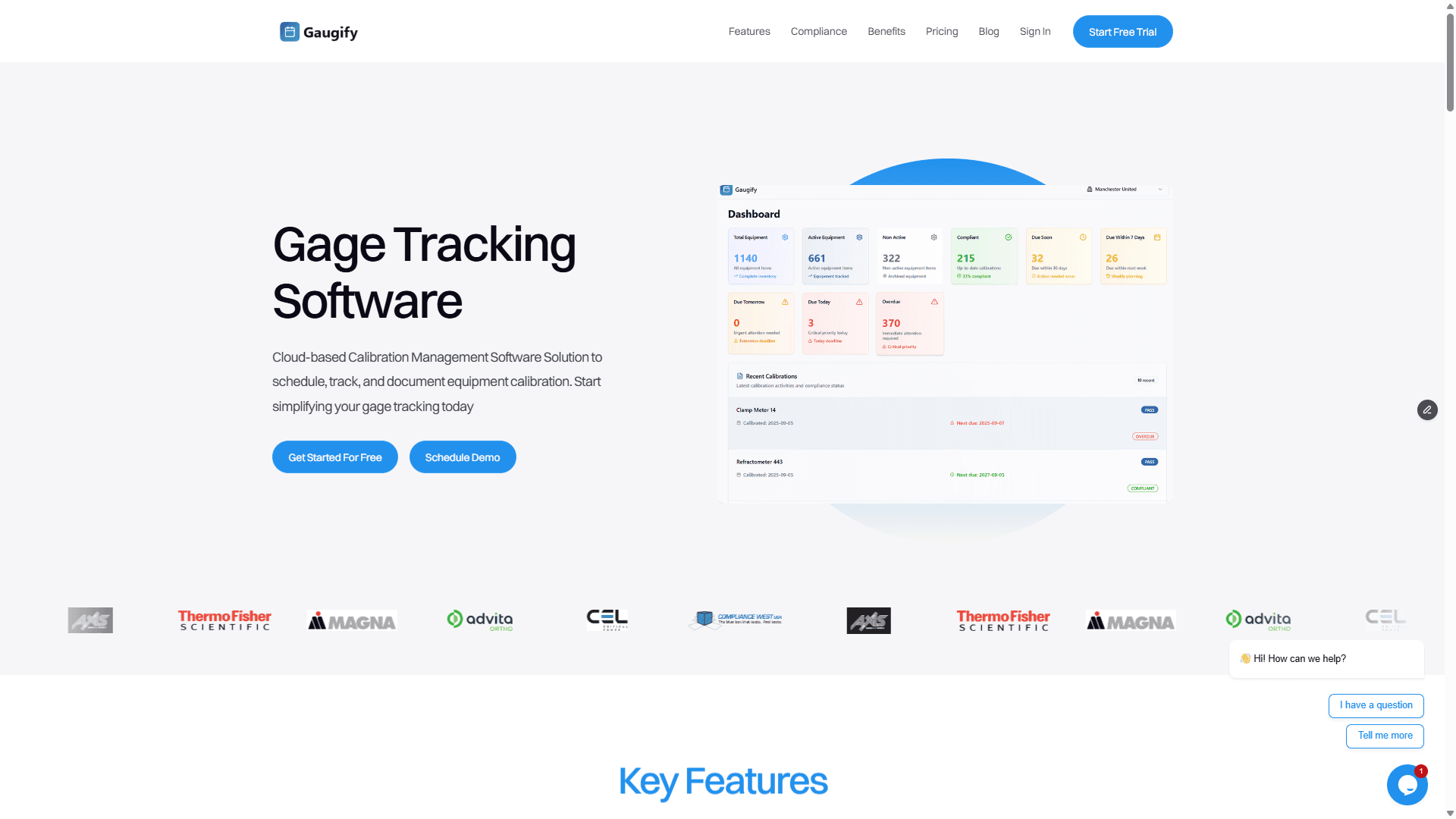
Gaugify's features include dashboard views showing budget utilization by month, department, and cost category. Alert systems notify managers when:
Monthly spending exceeds budget by predefined thresholds
Upcoming calibrations will impact cash flow
Vendor pricing changes affect contract budgets
Emergency calibrations threaten contingency reserves
Compliance-Ready Documentation
For organizations following ISO 17025 or other quality standards, automated systems maintain the detailed cost records required for:
Management review reporting (ISO 9001:2015 clause 9.3)
Resource adequacy demonstrations
Cost-benefit analysis documentation
Continuous improvement tracking
Implementation Roadmap for Better Calibration Budget Planning
Phase 1: Data Collection and Baseline (Weeks 1-4)
Gather 18 months of historical calibration invoices and records
Categorize costs using the framework outlined above
Identify seasonal patterns and cost drivers
Calculate current cost per instrument and per measurement point
Phase 2: Process Standardization (Weeks 5-8)
Implement consistent cost tracking procedures
Train staff on proper expense categorization
Establish monthly budget monitoring routines
Create standardized reporting templates
Phase 3: System Implementation (Weeks 9-12)
Deploy calibration management software with cost tracking capabilities
Migrate historical data and validate accuracy
Configure automated reporting and alert systems
Train users on new workflows and procedures
Measuring Success: Key Performance Indicators
Track these metrics to evaluate your calibration budget planning effectiveness:
Budget variance: Target ±5% variance from annual budget
Cost per instrument: Monitor trends and benchmark against industry standards
Emergency calibration percentage: Should remain below 10% of total calibrations
Vendor cost optimization: Track savings from contract negotiations and process improvements
Cash flow predictability: Measure monthly forecast accuracy
Ready to Transform Your Calibration Budget Planning?
Effective calibration budget planning transforms from a yearly guessing game into a data-driven process that supports both compliance requirements and business objectives. By implementing systematic cost tracking, leveraging historical data for predictions, and using modern calibration management tools, quality managers can achieve budget predictability while maintaining measurement accuracy and regulatory compliance.
The investment in proper budget planning pays dividends through reduced emergency costs, improved vendor negotiations, and elimination of production disruptions due to funding shortfalls. Organizations typically see 15-25% cost reductions within the first year of implementing structured calibration budget planning.
Gaugify's compliance features and automated cost tracking capabilities eliminate the manual effort traditionally required for calibration budget management while providing the detailed reporting needed for quality audits and management reviews. Schedule a demo to see how modern calibration management software can streamline your budget planning process and improve cost visibility across your entire measurement program.
Start Your Free Trial - Automate Calibration Cost Tracking Today
How to Track Calibration Costs for Budget Planning
Effective calibration budget planning can make the difference between a quality program that runs smoothly year-round and one that faces unexpected shutdowns due to funding shortfalls. Yet many quality managers struggle with tracking the true cost of their calibration programs, leading to budget overruns, delayed calibrations, and compliance headaches.
Without proper cost tracking, you might find yourself scrambling to explain why your annual calibration budget exceeded projections by 40%, or worse, having to delay critical measurements because funds ran dry in Q3. A precision manufacturer I worked with recently discovered they were spending $23,000 annually on external calibrations for instruments that could have been calibrated in-house for $8,500 – simply because they weren't tracking costs by service type.
Why Calibration Budget Planning Matters More Than Ever
Poor calibration cost tracking creates a cascade of problems that extend far beyond the quality department. When calibration budgets are based on guesswork rather than data, several critical issues emerge:
Compliance risks: ISO 9001:2015 clause 7.1.5 requires organizations to determine and provide resources needed for monitoring and measuring. Without cost visibility, you can't ensure adequate funding for compliance requirements.
Operational disruptions: A medical device manufacturer recently had to halt production for three days when their critical CMM calibration was delayed due to budget constraints – costing $180,000 in lost production.
Hidden inefficiencies: External calibration costs for a basic digital caliper might run $85-120 per instrument, while in-house calibration could cost $15-25 when properly tracked.
Audit failures: FDA inspectors and ISO auditors increasingly scrutinize calibration program sustainability, including budget adequacy and resource allocation.
The manufacturing sector averages 2-4% of total quality costs on calibration activities, but without proper tracking, this figure can balloon to 6-8% through inefficient vendor selection, emergency services, and expedited shipping fees.
Prerequisites for Effective Calibration Cost Tracking
Before diving into cost tracking methodologies, ensure you have these foundational elements in place:
Complete Instrument Inventory
Your inventory should include every instrument requiring calibration, from precision micrometers (±0.001" tolerance) to complex environmental chambers. Each record needs:
Unique identification number
Manufacturer, model, and serial number
Calibration frequency (annual, semi-annual, etc.)
Required measurement range and accuracy specifications
Current location and responsible department
Vendor Database and Service Options
Maintain detailed records for all calibration service providers, including:
Accreditation status (ISO/IEC 17025, NVLAP, A2LA)
Capabilities and measurement ranges
Standard pricing for common instruments
Turnaround times and expedite fees
Geographic coverage and pickup/delivery costs
Historical Calibration Data
Gather at least 12-18 months of calibration records to identify trends and seasonal variations. This baseline data reveals patterns like the 20-30% cost increase many labs experience during Q4 budget-flush periods.
Step-by-Step Guide to Calibration Budget Planning
Step 1: Categorize Your Calibration Costs
Break down calibration expenses into specific categories for better visibility:
Direct Calibration Services:
External vendor calibrations
In-house labor costs (technician time at $35-65/hour)
Reference standard maintenance and calibration
Consumables (calibration fluids, test leads, adapters)
Indirect Costs:
Transportation and shipping ($25-150 per shipment)
Expedite fees (typically 50-100% premium)
Calibration software and documentation systems
Training and certification maintenance
Opportunity Costs:
Production downtime during instrument removal
Backup instrument procurement or rental
Quality hold costs during calibration delays
Step 2: Calculate Instrument-Specific Costs
For each instrument category, determine the total annual cost including all relevant factors:
Example: Precision Digital Calipers (0-6", ±0.001" accuracy)
External calibration: $95 per unit
Shipping: $35 per batch (10 units)
Internal processing time: 2 hours at $45/hour
Annual frequency: 1x per year
Total cost per unit: $95 + $3.50 + $9 = $107.50
Compare this to in-house calibration costs:
Reference standard amortization: $8 per calibration
Technician time: 45 minutes at $45/hour = $33.75
Documentation and overhead: $12
Total in-house cost: $53.75 (50% savings)
Start Your Free Trial - Track Calibration Costs Automatically
Step 3: Map Calibration Schedules to Budget Periods
Create a monthly forecast showing when calibrations are due and their associated costs. Many organizations experience uneven cash flow because they don't account for calibration clustering:
January Calibration Budget Example:
CMM annual calibration: $4,500
Pressure gage semi-annual batch (15 units): $1,875
Torque wrench quarterly service (8 units): $960
Environmental chamber annual: $2,200
Monthly total: $9,535
This granular scheduling prevents the common scenario where 40% of annual calibrations fall due in the same quarter.
Step 4: Build in Contingency and Growth Factors
Professional calibration budget planning includes several buffer categories:
Emergency Calibrations (10-15% of budget):
Out-of-tolerance findings requiring immediate recalibration
Instrument damage or suspected accuracy issues
Audit-driven calibrations and compliance catches
Business Growth (5-20% depending on expansion plans):
New product line measurement requirements
Additional production equipment requiring calibration
Expanded quality testing capabilities
Inflation and Market Changes (3-8% annually):
Calibration service price increases
Enhanced accuracy requirements driving higher costs
New regulatory requirements (like FDA 21 CFR Part 820)
Best Practices from Experienced Calibration Professionals
Implement Activity-Based Costing
Rather than treating calibration as a single line item, successful quality managers break costs down by activity:
Routine calibrations: 60-70% of total budget
Non-conformance investigations: 15-25%
New instrument validations: 8-12%
System maintenance and upgrades: 5-10%
This approach helps identify which activities drive the highest costs and where efficiency improvements will have the greatest impact.
Leverage Multi-Year Service Contracts
Negotiating 2-3 year calibration contracts can reduce costs by 12-18% while providing budget predictability. Key contract terms include:
Fixed pricing with maximum annual increases (typically 3-5%)
Guaranteed turnaround times with penalties for delays
Volume discounts for batch processing
Included pickup/delivery services
Track Cost Per Measurement Point
Advanced calibration programs monitor costs per measurement point or per accuracy level. For example:
Basic dimensional measurements: $8-15 per point
Precision electrical measurements: $25-45 per point
Complex multi-parameter calibrations: $60-120 per point
This metric helps optimize calibration scope and identify opportunities for multi-point efficiencies.
Common Calibration Budget Planning Mistakes to Avoid
Underestimating Administrative Overhead
Many organizations focus solely on direct calibration costs while ignoring administrative expenses that can represent 25-35% of total program costs:
Work order creation and tracking
Certificate review and approval processes
Non-conformance documentation and investigation
Audit preparation and response activities
Ignoring Seasonal Variations
Calibration costs fluctuate throughout the year due to:
Budget-year-end rushes increasing prices 20-30%
Holiday periods limiting vendor availability
Annual maintenance shutdowns clustering calibrations
Regulatory submission deadlines driving urgent calibrations
Smart planners spread calibrations evenly and avoid peak-demand periods when possible.
Failing to Account for Technology Changes
Emerging measurement requirements can significantly impact budgets:
Tighter tolerances requiring higher-accuracy references
New product specifications demanding additional measurement parameters
Regulatory changes mandating more frequent calibrations
Industry 4.0 implementations requiring IoT sensor calibrations
Build 10-15% technology buffer into long-term budget projections.
How Modern Software Revolutionizes Calibration Budget Planning
Cloud-based calibration management systems like Gaugify automate many aspects of cost tracking and budget planning that traditionally required manual spreadsheet management.
Automated Cost Tracking and Reporting
Modern calibration software automatically captures and categorizes costs by:
Instrument type and calibration method
Service provider and contract terms
Department and cost center allocation
Direct vs. indirect cost classification
This eliminates the manual data entry that leads to 15-20% cost tracking errors in spreadsheet-based systems.
Predictive Budget Analytics
Advanced systems analyze historical patterns to predict future costs with 85-92% accuracy. Key capabilities include:
Seasonal adjustment algorithms
Inflation and price escalation modeling
Equipment lifecycle cost projections
Scenario planning for different growth assumptions
Real-Time Budget Monitoring
Gaugify's features include dashboard views showing budget utilization by month, department, and cost category. Alert systems notify managers when:
Monthly spending exceeds budget by predefined thresholds
Upcoming calibrations will impact cash flow
Vendor pricing changes affect contract budgets
Emergency calibrations threaten contingency reserves
Compliance-Ready Documentation
For organizations following ISO 17025 or other quality standards, automated systems maintain the detailed cost records required for:
Management review reporting (ISO 9001:2015 clause 9.3)
Resource adequacy demonstrations
Cost-benefit analysis documentation
Continuous improvement tracking
Implementation Roadmap for Better Calibration Budget Planning
Phase 1: Data Collection and Baseline (Weeks 1-4)
Gather 18 months of historical calibration invoices and records
Categorize costs using the framework outlined above
Identify seasonal patterns and cost drivers
Calculate current cost per instrument and per measurement point
Phase 2: Process Standardization (Weeks 5-8)
Implement consistent cost tracking procedures
Train staff on proper expense categorization
Establish monthly budget monitoring routines
Create standardized reporting templates
Phase 3: System Implementation (Weeks 9-12)
Deploy calibration management software with cost tracking capabilities
Migrate historical data and validate accuracy
Configure automated reporting and alert systems
Train users on new workflows and procedures
Measuring Success: Key Performance Indicators
Track these metrics to evaluate your calibration budget planning effectiveness:
Budget variance: Target ±5% variance from annual budget
Cost per instrument: Monitor trends and benchmark against industry standards
Emergency calibration percentage: Should remain below 10% of total calibrations
Vendor cost optimization: Track savings from contract negotiations and process improvements
Cash flow predictability: Measure monthly forecast accuracy
Ready to Transform Your Calibration Budget Planning?
Effective calibration budget planning transforms from a yearly guessing game into a data-driven process that supports both compliance requirements and business objectives. By implementing systematic cost tracking, leveraging historical data for predictions, and using modern calibration management tools, quality managers can achieve budget predictability while maintaining measurement accuracy and regulatory compliance.
The investment in proper budget planning pays dividends through reduced emergency costs, improved vendor negotiations, and elimination of production disruptions due to funding shortfalls. Organizations typically see 15-25% cost reductions within the first year of implementing structured calibration budget planning.
Gaugify's compliance features and automated cost tracking capabilities eliminate the manual effort traditionally required for calibration budget management while providing the detailed reporting needed for quality audits and management reviews. Schedule a demo to see how modern calibration management software can streamline your budget planning process and improve cost visibility across your entire measurement program.
Start Your Free Trial - Automate Calibration Cost Tracking Today