
Multi-Site Calibration Management: One Platform for All Locations
Multi-Site Calibration Management: One Platform for All Locations
David Bentley
Quality Assurance Engineer
9 min read
Multi-Site Calibration Management: One Platform for All Locations
Managing calibration programs across multiple facilities has traditionally been a logistical nightmare for quality managers. Whether you're overseeing manufacturing plants in three states or managing lab operations across international locations, coordinating calibration schedules, maintaining consistent procedures, and ensuring compliance visibility becomes exponentially complex. That's where a robust multi-site calibration platform transforms your operations from fragmented chaos into streamlined efficiency.
Modern manufacturing organizations can't afford the risks that come with disconnected calibration management. When your Michigan plant uses Excel spreadsheets, your Texas facility relies on paper logs, and your overseas operation tracks everything in a local database, you're not just managing inefficiency—you're courting disaster. Audit failures, compliance gaps, and production delays are inevitable consequences of this fractured approach.
The Hidden Costs of Fragmented Multi-Site Calibration Management
Without a unified multi-site calibration platform, organizations face a cascade of operational challenges that compound over time. Consider a medical device manufacturer with facilities in California, North Carolina, and Ireland. Each location manages their own calibration program independently:
The California facility tracks their Mitutoyo micrometers and Fluke multimeters in a custom Access database. When their quality manager needs to prepare for an FDA inspection, she spends three days manually compiling calibration records, only to discover that two critical torque wrenches (±0.05 Nm tolerance) were calibrated using different procedures than specified in their master work instructions.
Meanwhile, the North Carolina plant uses a basic spreadsheet system. Their production supervisor realizes during a customer audit that their temperature sensors haven't been calibrated in 13 months because the reminder system failed, and no one at headquarters had visibility into the oversight. The audit finding results in a $50,000 corrective action and threatens a major contract renewal.
The Irish facility operates with paper-based records, creating a communication black hole for corporate quality management. When headquarters needs to demonstrate calibration compliance across all sites for ISO 13485 certification, gathering and verifying records takes six weeks and requires multiple international calls to resolve discrepancies.
These scenarios aren't hypothetical—they represent daily reality for manufacturers operating with fragmented calibration management systems. The hidden costs include:
Administrative overhead: Quality managers spending 40+ hours monthly consolidating reports instead of improving processes
Compliance risks: Inconsistent procedures leading to audit findings and potential regulatory action
Production delays: Equipment sitting idle while sites coordinate calibration schedules independently
Knowledge silos: Best practices trapped at individual facilities instead of shared organization-wide
Duplicate costs: Multiple calibration software licenses, redundant vendor relationships, and inefficient resource allocation
How Gaugify's Multi-Site Calibration Platform Transforms Operations
Gaugify's advanced features eliminate these challenges through true multi-site integration that maintains local flexibility while ensuring corporate oversight. Here's how the platform works in practice:
Centralized Dashboard with Site-Specific Views
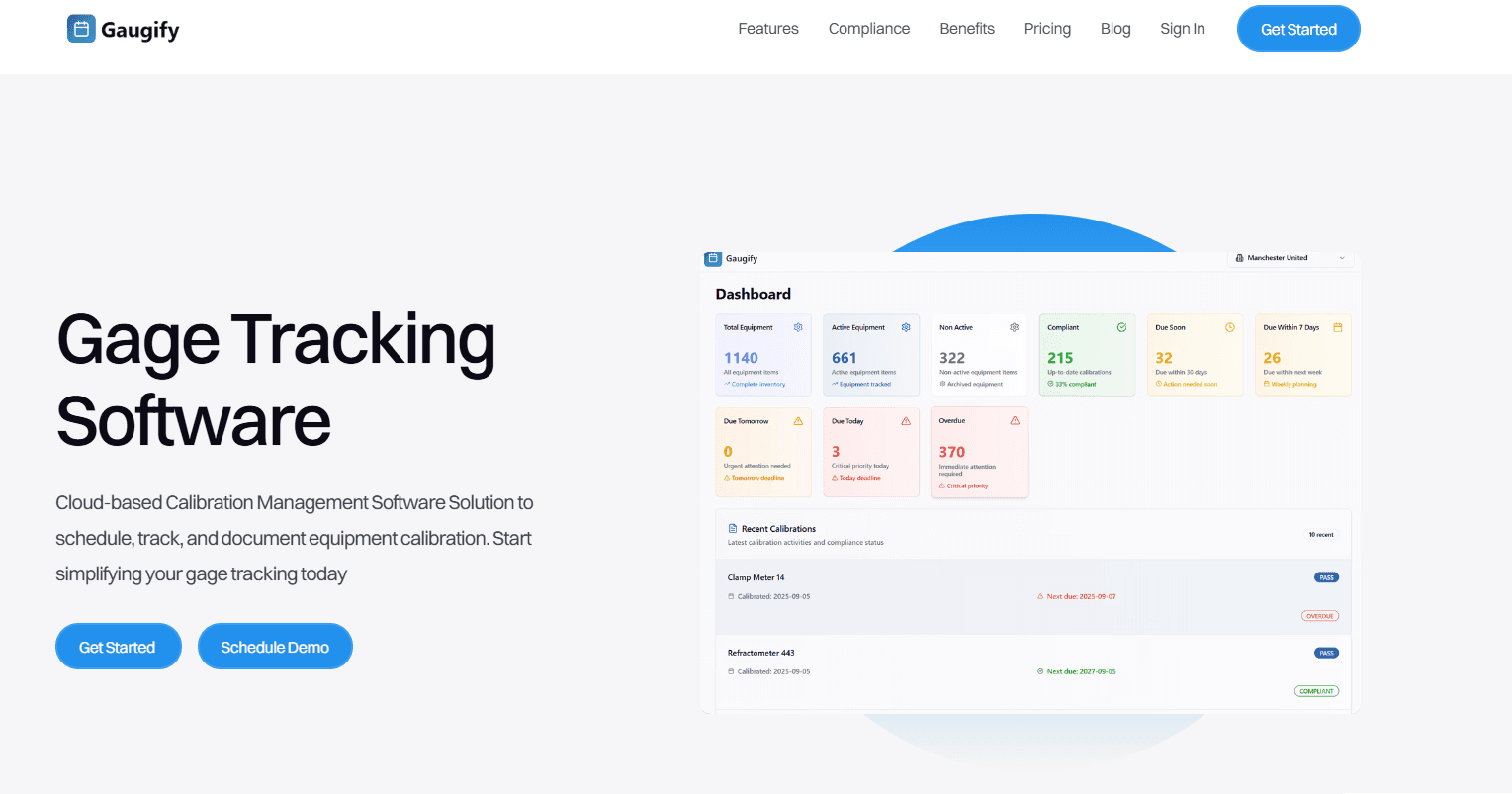
When you log into Gaugify, the dashboard immediately displays calibration status across all your locations. A automotive parts manufacturer with facilities in Detroit, Monterrey, and Shanghai sees real-time data for all 2,847 instruments across their network. The corporate quality director can instantly identify that 23 gages are due for calibration in the next 30 days, with 15 in Detroit (primarily coordinate measuring machines and height gages), 5 in Monterrey (torque wrenches and pressure gages), and 3 in Shanghai (temperature controllers).
Each site manager sees only their location's data by default, but can access cross-site information when needed for benchmarking or resource sharing. The Detroit facility manager notices that Shanghai has achieved 99.2% on-time calibration rates and can review their procedures to identify improvement opportunities.
Unified Procedures with Local Adaptations
Corporate headquarters establishes master calibration procedures that automatically deploy to all sites. For example, the procedure for calibrating Starrett outside micrometers (0-1", ±0.0001" tolerance) includes the same fundamental steps at every location, but allows for local variations in environmental controls or vendor selection.
When the quality team updates the procedure to include additional measurement points based on lessons learned from a supplier audit, the change propagates to all facilities instantly. Local quality technicians receive automatic notifications, and the system tracks acknowledgment to ensure consistent implementation.
Coordinated Scheduling and Resource Optimization
Gaugify's scheduling engine optimizes calibration timing across multiple sites to maximize efficiency. When the Monterrey facility's CMM coordinate measuring machine requires specialized calibration services, the system identifies that the Detroit location used the same vendor three months ago and automatically shares contact information and service history.
The platform also enables resource sharing between nearby facilities. If the Houston plant's pressure calibrator becomes available due to a production schedule change, facilities within a 200-mile radius receive notifications to accelerate their pressure gage calibrations if desired.
Real-Time Compliance Monitoring
Every calibration activity feeds into centralized compliance tracking. When an ISO 9001 auditor arrives at any facility, local staff can immediately access not only their site's calibration records, but also demonstrate corporate-wide calibration system consistency. The auditor can verify that the same Fluke 87V multimeter model follows identical calibration procedures whether it's in Tennessee or Thailand.
Start your free trial today to experience how multi-site calibration management transforms your quality operations from reactive fire-fighting to proactive system optimization.
Quantifiable Benefits and ROI of Multi-Site Calibration Platforms
Organizations implementing Gaugify's multi-site capabilities typically see measurable improvements within the first quarter. A precision machining company with seven locations documented these results after six months:
Administrative Efficiency Gains: Their corporate quality manager reduced monthly reporting time from 32 hours to 4 hours—a 87.5% improvement. Previously, she manually compiled Excel files from each site, cross-referenced calibration certificates, and created summary reports. With Gaugify's automated reporting, she generates comprehensive compliance reports with three clicks.
Calibration Timeliness Improvement: On-time calibration rates increased from 78% to 96% across all facilities. The automated reminder system ensures no instruments fall through cracks, while cross-site visibility enables proactive resource allocation. Their Phoenix facility, which previously struggled with 65% on-time rates due to limited local calibration resources, now achieves 94% by coordinating with their nearby Tucson location.
Vendor Consolidation Benefits: By coordinating calibration services across all sites, they reduced from 23 different calibration vendors to 8 strategic partners, negotiating volume discounts that decreased external calibration costs by 31%. The unified platform enabled them to standardize on preferred vendors who demonstrated consistent quality across multiple locations.
Audit Preparation Efficiency: Preparation time for regulatory audits dropped from 3-4 weeks to 2-3 days. When FDA inspectors arrived at their medical device facility, the quality team produced calibration records for all sites within 30 minutes, demonstrating system-wide compliance that impressed auditors and contributed to zero audit findings.
Compliance Support Across Multiple Regulatory Frameworks
Multi-site operations often face diverse regulatory requirements depending on geographic location and market segments. Gaugify's compliance capabilities support simultaneous adherence to multiple standards without creating administrative burden.
ISO 17025 Laboratory Accreditation
Testing laboratories with multiple locations must demonstrate consistent technical competence across all sites. Gaugify's ISO 17025 calibration software ensures that measurement traceability, uncertainty calculations, and calibration intervals align with accreditation requirements at every facility.
A materials testing laboratory with locations in Houston, Denver, and Minneapolis maintains ISO 17025 accreditation for all sites using Gaugify's centralized certificate management. When their accreditation body conducts surveillance audits, they can demonstrate that their universal testing machines (±0.5% accuracy requirement) follow identical calibration procedures and maintain consistent measurement uncertainty across all locations.
FDA 21 CFR Part 820 Medical Device Requirements
Medical device manufacturers must maintain calibration records that satisfy FDA inspection requirements regardless of facility location. Gaugify automatically generates the detailed documentation required for 21 CFR Part 820 compliance, including calibration procedures, schedules, and corrective actions.
When FDA investigators examine a cardiac catheter manufacturer's facilities in California and Puerto Rico, they find identical calibration documentation formats, consistent procedure implementation, and comprehensive traceability records that demonstrate corporate-wide quality system effectiveness.
AS9100 Aerospace Quality Management
Aerospace suppliers must demonstrate measurement system control across their entire supply chain. Gaugify enables aerospace manufacturers to maintain AS9100 compliance at primary facilities while extending calibration oversight to subsidiary locations and key suppliers.
A turbine blade manufacturer with facilities in Connecticut and South Carolina uses Gaugify to coordinate calibration of their coordinate measuring machines, surface roughness testers, and dimensional gages. When their prime contractor audits both locations, they observe consistent calibration practices that support confident measurement data for critical aerospace applications.
Comparison: Gaugify vs. Alternative Multi-Site Approaches
Organizations attempt various solutions for multi-site calibration management, each with significant limitations compared to Gaugify's integrated approach:
Multiple Software Instances
Some companies deploy separate calibration software at each location, creating digital silos instead of paper ones. While each site achieves local automation, corporate oversight remains manual and time-intensive. A pharmaceutical company using this approach discovered during a FDA inspection that their New Jersey and North Carolina facilities had calibrated identical analytical balances using different procedures, creating data integrity concerns that delayed product releases.
Shared Network Drives
Organizations often attempt coordination by storing calibration records on shared network drives accessible by all sites. This approach fails due to version control issues, access security concerns, and lack of automated workflow management. An electronics manufacturer using shared drives experienced a critical failure when their European facility unknowingly used outdated calibration procedures for six months, resulting in measurement data that couldn't support CE marking requirements.
Enterprise Resource Planning (ERP) Integration
Some companies add calibration modules to existing ERP systems, hoping to achieve integration through their existing infrastructure. These solutions typically lack the specialized functionality required for effective calibration management. A chemical processing company discovered that their ERP-based approach couldn't handle measurement uncertainty calculations required for ISO 17025 compliance, forcing them to maintain parallel documentation systems.
Manual Coordination Systems
The most common approach involves manual coordination between sites using email, phone calls, and periodic reports. This method guarantees inconsistency and creates enormous administrative overhead. A automotive supplier using manual coordination spent $180,000 annually on administrative costs alone before implementing Gaugify, achieving full return on investment within eight months.
Implementation Strategy for Multi-Site Success
Successful multi-site calibration platform deployment requires strategic planning that balances standardization with local operational needs. Gaugify's implementation approach ensures smooth transitions while minimizing disruption to ongoing calibration activities.
Phased Rollout Approach
Rather than attempting simultaneous deployment across all locations, Gaugify recommends starting with a pilot site that has strong local quality management and representative instrument populations. A semiconductor manufacturer began their implementation at their flagship California facility, which manages 400+ instruments including critical photomask inspection equipment and wafer metrology tools.
During the pilot phase, they refined calibration procedures, established user training protocols, and validated data migration processes. Success at the pilot site created internal champions who supported rollout to remaining facilities in Texas, Oregon, and Malaysia. The entire implementation completed within six months, compared to 18+ months typically required for simultaneous deployment approaches.
Data Migration and Historical Records
Gaugify's data import tools accommodate various source formats, from Excel spreadsheets to legacy database exports. During migration, the platform validates data consistency and identifies potential issues before going live. A medical device manufacturer discovered during data migration that their Boston facility had been using incorrect calibration intervals for certain pressure transducers, enabling corrective action before the next regulatory audit.
Advanced Multi-Site Features for Complex Operations
Beyond basic multi-site coordination, Gaugify provides advanced capabilities that support sophisticated organizational structures and operational requirements.
Hierarchical Permissions and Access Control
Large organizations require granular control over data access and modification rights. Gaugify supports complex permission structures that reflect organizational hierarchies while maintaining appropriate security boundaries. A global manufacturing company configured their system so that regional quality directors can access all facilities within their geographic area, site managers see only their location's data, and corporate executives have read-only access to summary information across all sites.
Cross-Site Benchmarking and Performance Analytics
Gaugify's analytics engine enables performance comparisons that identify best practices and improvement opportunities across multiple locations. A food processing company with twelve facilities uses cross-site benchmarking to identify why their Portland plant achieves 99.7% on-time calibration rates while their Atlanta facility struggles at 84%. Analysis revealed that Portland uses predictive maintenance data to optimize calibration scheduling, leading to corporate-wide adoption of this best practice.
Supply Chain Integration
Organizations with complex supply chains can extend Gaugify's multi-site capabilities to key suppliers and contract manufacturers. A aerospace prime contractor provides calibration oversight for critical suppliers by granting limited access to their Gaugify platform, ensuring that supplier measurement capabilities meet aerospace quality requirements without requiring separate software implementations.
Transform Your Multi-Site Calibration Management Today
Managing calibration programs across multiple locations doesn't have to be an exercise in crisis management and administrative overhead. Gaugify's comprehensive multi-site calibration platform transforms fragmented operations into integrated, efficient quality systems that support business growth while ensuring compliance confidence.
Whether you're managing two facilities or twenty, Gaugify provides the centralized oversight and local flexibility your organization needs to optimize calibration operations. From automated scheduling and procedure management to comprehensive compliance reporting and cross-site analytics, every feature is designed to eliminate the pain points that plague traditional multi-site calibration management.
Stop accepting the inefficiencies and risks of fragmented calibration management. Experience Gaugify's multi-site capabilities with a free 14-day trial and discover how unified calibration management transforms quality operations across all your locations. Join the hundreds of multi-site organizations that have already eliminated calibration chaos and achieved operational excellence with Gaugify.
Ready to see exactly how Gaugify will work for your specific multi-site challenges? Schedule a personalized demo where our calibration management experts will walk through your requirements and demonstrate how our platform addresses your unique operational needs.
Multi-Site Calibration Management: One Platform for All Locations
Managing calibration programs across multiple facilities has traditionally been a logistical nightmare for quality managers. Whether you're overseeing manufacturing plants in three states or managing lab operations across international locations, coordinating calibration schedules, maintaining consistent procedures, and ensuring compliance visibility becomes exponentially complex. That's where a robust multi-site calibration platform transforms your operations from fragmented chaos into streamlined efficiency.
Modern manufacturing organizations can't afford the risks that come with disconnected calibration management. When your Michigan plant uses Excel spreadsheets, your Texas facility relies on paper logs, and your overseas operation tracks everything in a local database, you're not just managing inefficiency—you're courting disaster. Audit failures, compliance gaps, and production delays are inevitable consequences of this fractured approach.
The Hidden Costs of Fragmented Multi-Site Calibration Management
Without a unified multi-site calibration platform, organizations face a cascade of operational challenges that compound over time. Consider a medical device manufacturer with facilities in California, North Carolina, and Ireland. Each location manages their own calibration program independently:
The California facility tracks their Mitutoyo micrometers and Fluke multimeters in a custom Access database. When their quality manager needs to prepare for an FDA inspection, she spends three days manually compiling calibration records, only to discover that two critical torque wrenches (±0.05 Nm tolerance) were calibrated using different procedures than specified in their master work instructions.
Meanwhile, the North Carolina plant uses a basic spreadsheet system. Their production supervisor realizes during a customer audit that their temperature sensors haven't been calibrated in 13 months because the reminder system failed, and no one at headquarters had visibility into the oversight. The audit finding results in a $50,000 corrective action and threatens a major contract renewal.
The Irish facility operates with paper-based records, creating a communication black hole for corporate quality management. When headquarters needs to demonstrate calibration compliance across all sites for ISO 13485 certification, gathering and verifying records takes six weeks and requires multiple international calls to resolve discrepancies.
These scenarios aren't hypothetical—they represent daily reality for manufacturers operating with fragmented calibration management systems. The hidden costs include:
Administrative overhead: Quality managers spending 40+ hours monthly consolidating reports instead of improving processes
Compliance risks: Inconsistent procedures leading to audit findings and potential regulatory action
Production delays: Equipment sitting idle while sites coordinate calibration schedules independently
Knowledge silos: Best practices trapped at individual facilities instead of shared organization-wide
Duplicate costs: Multiple calibration software licenses, redundant vendor relationships, and inefficient resource allocation
How Gaugify's Multi-Site Calibration Platform Transforms Operations
Gaugify's advanced features eliminate these challenges through true multi-site integration that maintains local flexibility while ensuring corporate oversight. Here's how the platform works in practice:
Centralized Dashboard with Site-Specific Views
When you log into Gaugify, the dashboard immediately displays calibration status across all your locations. A automotive parts manufacturer with facilities in Detroit, Monterrey, and Shanghai sees real-time data for all 2,847 instruments across their network. The corporate quality director can instantly identify that 23 gages are due for calibration in the next 30 days, with 15 in Detroit (primarily coordinate measuring machines and height gages), 5 in Monterrey (torque wrenches and pressure gages), and 3 in Shanghai (temperature controllers).
Each site manager sees only their location's data by default, but can access cross-site information when needed for benchmarking or resource sharing. The Detroit facility manager notices that Shanghai has achieved 99.2% on-time calibration rates and can review their procedures to identify improvement opportunities.
Unified Procedures with Local Adaptations
Corporate headquarters establishes master calibration procedures that automatically deploy to all sites. For example, the procedure for calibrating Starrett outside micrometers (0-1", ±0.0001" tolerance) includes the same fundamental steps at every location, but allows for local variations in environmental controls or vendor selection.
When the quality team updates the procedure to include additional measurement points based on lessons learned from a supplier audit, the change propagates to all facilities instantly. Local quality technicians receive automatic notifications, and the system tracks acknowledgment to ensure consistent implementation.
Coordinated Scheduling and Resource Optimization
Gaugify's scheduling engine optimizes calibration timing across multiple sites to maximize efficiency. When the Monterrey facility's CMM coordinate measuring machine requires specialized calibration services, the system identifies that the Detroit location used the same vendor three months ago and automatically shares contact information and service history.
The platform also enables resource sharing between nearby facilities. If the Houston plant's pressure calibrator becomes available due to a production schedule change, facilities within a 200-mile radius receive notifications to accelerate their pressure gage calibrations if desired.
Real-Time Compliance Monitoring
Every calibration activity feeds into centralized compliance tracking. When an ISO 9001 auditor arrives at any facility, local staff can immediately access not only their site's calibration records, but also demonstrate corporate-wide calibration system consistency. The auditor can verify that the same Fluke 87V multimeter model follows identical calibration procedures whether it's in Tennessee or Thailand.
Start your free trial today to experience how multi-site calibration management transforms your quality operations from reactive fire-fighting to proactive system optimization.
Quantifiable Benefits and ROI of Multi-Site Calibration Platforms
Organizations implementing Gaugify's multi-site capabilities typically see measurable improvements within the first quarter. A precision machining company with seven locations documented these results after six months:
Administrative Efficiency Gains: Their corporate quality manager reduced monthly reporting time from 32 hours to 4 hours—a 87.5% improvement. Previously, she manually compiled Excel files from each site, cross-referenced calibration certificates, and created summary reports. With Gaugify's automated reporting, she generates comprehensive compliance reports with three clicks.
Calibration Timeliness Improvement: On-time calibration rates increased from 78% to 96% across all facilities. The automated reminder system ensures no instruments fall through cracks, while cross-site visibility enables proactive resource allocation. Their Phoenix facility, which previously struggled with 65% on-time rates due to limited local calibration resources, now achieves 94% by coordinating with their nearby Tucson location.
Vendor Consolidation Benefits: By coordinating calibration services across all sites, they reduced from 23 different calibration vendors to 8 strategic partners, negotiating volume discounts that decreased external calibration costs by 31%. The unified platform enabled them to standardize on preferred vendors who demonstrated consistent quality across multiple locations.
Audit Preparation Efficiency: Preparation time for regulatory audits dropped from 3-4 weeks to 2-3 days. When FDA inspectors arrived at their medical device facility, the quality team produced calibration records for all sites within 30 minutes, demonstrating system-wide compliance that impressed auditors and contributed to zero audit findings.
Compliance Support Across Multiple Regulatory Frameworks
Multi-site operations often face diverse regulatory requirements depending on geographic location and market segments. Gaugify's compliance capabilities support simultaneous adherence to multiple standards without creating administrative burden.
ISO 17025 Laboratory Accreditation
Testing laboratories with multiple locations must demonstrate consistent technical competence across all sites. Gaugify's ISO 17025 calibration software ensures that measurement traceability, uncertainty calculations, and calibration intervals align with accreditation requirements at every facility.
A materials testing laboratory with locations in Houston, Denver, and Minneapolis maintains ISO 17025 accreditation for all sites using Gaugify's centralized certificate management. When their accreditation body conducts surveillance audits, they can demonstrate that their universal testing machines (±0.5% accuracy requirement) follow identical calibration procedures and maintain consistent measurement uncertainty across all locations.
FDA 21 CFR Part 820 Medical Device Requirements
Medical device manufacturers must maintain calibration records that satisfy FDA inspection requirements regardless of facility location. Gaugify automatically generates the detailed documentation required for 21 CFR Part 820 compliance, including calibration procedures, schedules, and corrective actions.
When FDA investigators examine a cardiac catheter manufacturer's facilities in California and Puerto Rico, they find identical calibration documentation formats, consistent procedure implementation, and comprehensive traceability records that demonstrate corporate-wide quality system effectiveness.
AS9100 Aerospace Quality Management
Aerospace suppliers must demonstrate measurement system control across their entire supply chain. Gaugify enables aerospace manufacturers to maintain AS9100 compliance at primary facilities while extending calibration oversight to subsidiary locations and key suppliers.
A turbine blade manufacturer with facilities in Connecticut and South Carolina uses Gaugify to coordinate calibration of their coordinate measuring machines, surface roughness testers, and dimensional gages. When their prime contractor audits both locations, they observe consistent calibration practices that support confident measurement data for critical aerospace applications.
Comparison: Gaugify vs. Alternative Multi-Site Approaches
Organizations attempt various solutions for multi-site calibration management, each with significant limitations compared to Gaugify's integrated approach:
Multiple Software Instances
Some companies deploy separate calibration software at each location, creating digital silos instead of paper ones. While each site achieves local automation, corporate oversight remains manual and time-intensive. A pharmaceutical company using this approach discovered during a FDA inspection that their New Jersey and North Carolina facilities had calibrated identical analytical balances using different procedures, creating data integrity concerns that delayed product releases.
Shared Network Drives
Organizations often attempt coordination by storing calibration records on shared network drives accessible by all sites. This approach fails due to version control issues, access security concerns, and lack of automated workflow management. An electronics manufacturer using shared drives experienced a critical failure when their European facility unknowingly used outdated calibration procedures for six months, resulting in measurement data that couldn't support CE marking requirements.
Enterprise Resource Planning (ERP) Integration
Some companies add calibration modules to existing ERP systems, hoping to achieve integration through their existing infrastructure. These solutions typically lack the specialized functionality required for effective calibration management. A chemical processing company discovered that their ERP-based approach couldn't handle measurement uncertainty calculations required for ISO 17025 compliance, forcing them to maintain parallel documentation systems.
Manual Coordination Systems
The most common approach involves manual coordination between sites using email, phone calls, and periodic reports. This method guarantees inconsistency and creates enormous administrative overhead. A automotive supplier using manual coordination spent $180,000 annually on administrative costs alone before implementing Gaugify, achieving full return on investment within eight months.
Implementation Strategy for Multi-Site Success
Successful multi-site calibration platform deployment requires strategic planning that balances standardization with local operational needs. Gaugify's implementation approach ensures smooth transitions while minimizing disruption to ongoing calibration activities.
Phased Rollout Approach
Rather than attempting simultaneous deployment across all locations, Gaugify recommends starting with a pilot site that has strong local quality management and representative instrument populations. A semiconductor manufacturer began their implementation at their flagship California facility, which manages 400+ instruments including critical photomask inspection equipment and wafer metrology tools.
During the pilot phase, they refined calibration procedures, established user training protocols, and validated data migration processes. Success at the pilot site created internal champions who supported rollout to remaining facilities in Texas, Oregon, and Malaysia. The entire implementation completed within six months, compared to 18+ months typically required for simultaneous deployment approaches.
Data Migration and Historical Records
Gaugify's data import tools accommodate various source formats, from Excel spreadsheets to legacy database exports. During migration, the platform validates data consistency and identifies potential issues before going live. A medical device manufacturer discovered during data migration that their Boston facility had been using incorrect calibration intervals for certain pressure transducers, enabling corrective action before the next regulatory audit.
Advanced Multi-Site Features for Complex Operations
Beyond basic multi-site coordination, Gaugify provides advanced capabilities that support sophisticated organizational structures and operational requirements.
Hierarchical Permissions and Access Control
Large organizations require granular control over data access and modification rights. Gaugify supports complex permission structures that reflect organizational hierarchies while maintaining appropriate security boundaries. A global manufacturing company configured their system so that regional quality directors can access all facilities within their geographic area, site managers see only their location's data, and corporate executives have read-only access to summary information across all sites.
Cross-Site Benchmarking and Performance Analytics
Gaugify's analytics engine enables performance comparisons that identify best practices and improvement opportunities across multiple locations. A food processing company with twelve facilities uses cross-site benchmarking to identify why their Portland plant achieves 99.7% on-time calibration rates while their Atlanta facility struggles at 84%. Analysis revealed that Portland uses predictive maintenance data to optimize calibration scheduling, leading to corporate-wide adoption of this best practice.
Supply Chain Integration
Organizations with complex supply chains can extend Gaugify's multi-site capabilities to key suppliers and contract manufacturers. A aerospace prime contractor provides calibration oversight for critical suppliers by granting limited access to their Gaugify platform, ensuring that supplier measurement capabilities meet aerospace quality requirements without requiring separate software implementations.
Transform Your Multi-Site Calibration Management Today
Managing calibration programs across multiple locations doesn't have to be an exercise in crisis management and administrative overhead. Gaugify's comprehensive multi-site calibration platform transforms fragmented operations into integrated, efficient quality systems that support business growth while ensuring compliance confidence.
Whether you're managing two facilities or twenty, Gaugify provides the centralized oversight and local flexibility your organization needs to optimize calibration operations. From automated scheduling and procedure management to comprehensive compliance reporting and cross-site analytics, every feature is designed to eliminate the pain points that plague traditional multi-site calibration management.
Stop accepting the inefficiencies and risks of fragmented calibration management. Experience Gaugify's multi-site capabilities with a free 14-day trial and discover how unified calibration management transforms quality operations across all your locations. Join the hundreds of multi-site organizations that have already eliminated calibration chaos and achieved operational excellence with Gaugify.
Ready to see exactly how Gaugify will work for your specific multi-site challenges? Schedule a personalized demo where our calibration management experts will walk through your requirements and demonstrate how our platform addresses your unique operational needs.