
Calibration Due Date Forecasting and Planning
Calibration Due Date Forecasting and Planning
David Bentley
Quality Assurance Engineer
8 min read
Calibration Due Date Forecasting and Planning
Managing hundreds or thousands of measurement instruments across multiple production lines, labs, and facilities requires more than just tracking when calibrations are due. Smart quality managers rely on calibration due date forecasting to proactively plan resources, prevent production disruptions, and maintain continuous compliance. This predictive capability transforms reactive calibration management into a strategic advantage that keeps operations running smoothly while optimizing technician workloads and budget allocation.
Modern calibration management software like Gaugify provides sophisticated forecasting tools that analyze your entire instrument population, identify upcoming due dates, and generate actionable planning insights. Instead of scrambling to handle overdue calibrations or facing surprise audit findings, you can anticipate needs weeks or months in advance.
The Hidden Costs of Reactive Calibration Due Date Management
Without proper calibration due date forecasting, quality departments face a cascade of operational problems that impact both compliance and profitability. Consider what happens at a typical automotive parts manufacturer managing 500+ gages across their facility.
On Monday morning, the quality manager discovers that twelve critical dimensional gages—including CMM touch probes, bore gages, and pin gages—expired over the weekend. These instruments measure tolerances as tight as ±0.002" on transmission components. Production lines halt while technicians scramble to find alternatives or rush instruments through emergency calibration.
The immediate costs are obvious: production downtime, expedited calibration fees, and stressed personnel. But the hidden costs run deeper. Parts manufactured with potentially out-of-tolerance instruments may need quarantine and re-inspection. Customer deliveries face delays. The annual ISO 9001 audit reveals gaps in preventive calibration scheduling, requiring corrective actions.
This reactive approach creates several critical problems:
Resource allocation inefficiencies: Technicians face feast-or-famine workloads, with periods of intense activity followed by underutilization
Budget unpredictability: Emergency calibrations cost 2-3x normal rates, and annual calibration budgets become guesswork
Compliance risks: Overdue instruments create nonconformances that auditors flag consistently
Production disruptions: Critical path instruments going overdue can shut down entire production lines
Vendor management chaos: External calibration labs receive last-minute requests, leading to longer turnaround times and priority fees
How Calibration Due Date Forecasting Works in Practice
Effective calibration due date forecasting transforms this chaos into organized, predictable workflows. Quality managers can visualize their entire calibration landscape weeks and months in advance, making informed decisions about resource allocation and scheduling.
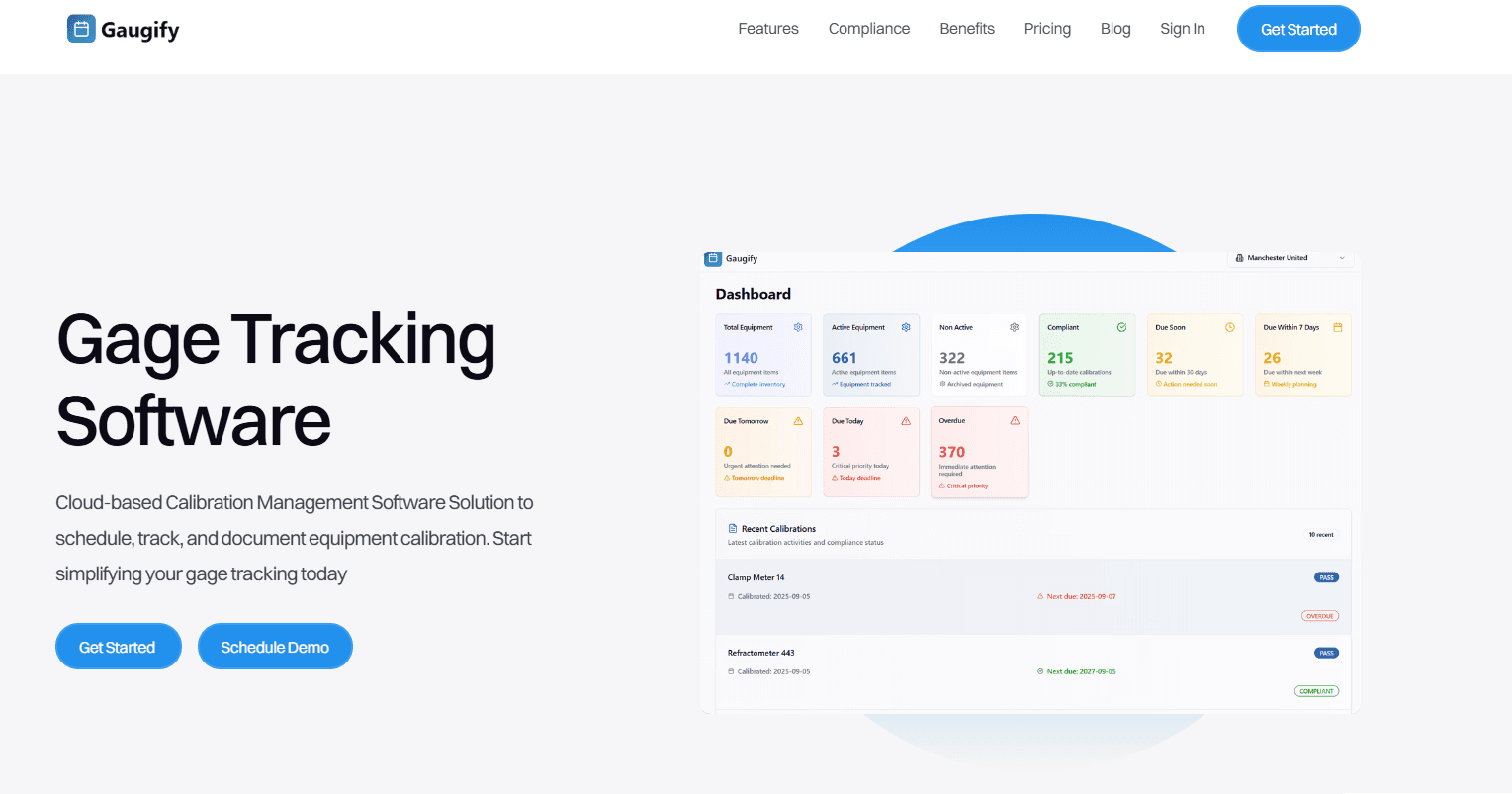
When you log into Gaugify's forecasting dashboard, you immediately see a comprehensive view of your calibration timeline. The system analyzes every instrument's calibration history, current due dates, and usage patterns to generate intelligent predictions.
30-Day Rolling Forecast View
The forecasting engine displays upcoming due dates in intuitive visual formats. A manufacturing lab managing analytical balances, pipettes, and spectrophotometers can see exactly which instruments need attention each week. For example, the forecast might show:
Week 1: Three Mettler Toledo analytical balances (0.1mg readability) due for calibration
Week 2: Five variable pipettes (10-100μL range) requiring annual verification
Week 3: Two UV-Vis spectrophotometers needing wavelength and photometric accuracy checks
Week 4: Eight digital calipers and micrometers from the production floor
This visibility allows the lab manager to schedule calibration technician time, coordinate with external service providers, and ensure backup instruments are available during calibration periods.
Workload Balancing and Resource Planning
The system identifies workload peaks and provides recommendations for optimizing schedules. If forty instruments are due in the same month, Gaugify suggests which calibrations can safely be performed early without compromising measurement integrity. This workload smoothing prevents technician burnout and reduces emergency situations.
For instruments with flexible calibration intervals—such as torque wrenches used for non-critical applications—the system recommends optimal timing based on usage history and workload distribution. A torque wrench with a 12-month interval might be calibrated at 11 months if it helps balance technician workloads.
Start your free trial today to experience how intelligent forecasting transforms your calibration planning from reactive fire-fighting to proactive resource optimization.
Budget Forecasting and Cost Analysis
Beyond scheduling, calibration due date forecasting provides crucial budget planning capabilities. The system tracks historical calibration costs for each instrument type and vendor, projecting quarterly and annual calibration expenses with remarkable accuracy.
A tool and die shop managing precision instruments might see projections showing $12,000 in external calibration costs for Q2, primarily driven by CMM annual certifications and gage block recertifications. This visibility enables proactive budget management and vendor negotiation opportunities.
Quantifiable Benefits and ROI of Proactive Due Date Planning
Organizations implementing systematic calibration due date forecasting typically see measurable improvements across multiple operational areas. The return on investment becomes apparent within the first few months of implementation.
Reduced Emergency Calibrations
A mid-sized electronics manufacturer reduced emergency calibrations by 85% after implementing Gaugify's forecasting capabilities. Previously averaging 15-20 rush calibrations monthly—each costing an additional $150-300 in expedite fees—they now maintain predictable schedules that keep instruments in compliance without premium costs.
Annual savings exceeded $45,000 in avoided emergency fees alone, while production downtime decreased by 60% due to better planning of backup instrument deployment.
Optimized Technician Utilization
Forecasting enables better staff planning and cross-training decisions. Instead of having three calibration technicians overwhelmed during peak periods while underutilized during slow periods, workload distribution becomes predictable.
Quality managers can identify when temporary staffing might be needed or when technicians can focus on improvement projects. This optimization typically improves technician productivity by 20-30% while reducing overtime costs.
Improved Vendor Relationships and Costs
External calibration providers offer significant discounts for planned, bulk shipments versus individual rush orders. Organizations using forecasting can negotiate annual contracts with predictable volumes, securing 15-25% cost reductions on external calibration services.
A pharmaceutical company managing hundreds of analytical instruments negotiated a 22% discount with their calibration provider by committing to monthly shipment schedules based on Gaugify's forecasting data.
Supporting Regulatory Compliance Through Proactive Due Date Management
Regulatory auditors consistently focus on calibration program effectiveness, and calibration due date forecasting demonstrates systematic preventive management that satisfies multiple compliance frameworks.
ISO 9001 Quality Management System Requirements
ISO 9001 clause 7.1.5 requires organizations to ensure measurement resources remain suitable for their purpose. Proactive forecasting demonstrates the systematic approach auditors expect to see. During management reviews, quality managers can present data showing 99%+ on-time calibration rates, predictable resource allocation, and continuous improvement in calibration program efficiency.
The compliance documentation generated through forecasting activities provides objective evidence of systematic calibration management that satisfies auditor requirements across multiple standards.
ISO 17025 Laboratory Accreditation Standards
Testing and calibration laboratories operating under ISO 17025 face strict requirements for equipment maintenance and calibration scheduling. Forecasting capabilities ensure laboratories can demonstrate proactive management of measurement uncertainty through timely calibrations.
Accreditation bodies expect to see evidence of systematic calibration planning that prevents measurement capability gaps. Gaugify's ISO 17025 compliance features include forecasting tools specifically designed to meet laboratory accreditation requirements.
FDA Regulated Industries
Medical device manufacturers and pharmaceutical companies face FDA scrutiny during 483 inspections. Investigators look for objective evidence that calibration programs prevent nonconforming product release. Forecasting demonstrates systematic preventive controls that reduce regulatory risk.
A medical device manufacturer recently passed an FDA inspection with zero calibration-related observations by demonstrating their proactive forecasting approach. The inspector noted their systematic prevention of overdue calibrations as evidence of robust quality systems.
Forecasting Capabilities: Gaugify vs. Traditional Approaches
Many organizations still rely on basic spreadsheet tracking or legacy calibration software with limited forecasting capabilities. Understanding the differences helps explain why modern cloud-based solutions deliver superior results.
Manual Spreadsheet Limitations
Excel-based calibration tracking requires manual updates and offers no automated forecasting. Quality managers spend hours updating due dates, calculating intervals, and trying to visualize workloads across multiple spreadsheets. Human errors in date calculations create compliance risks, while lack of automated notifications leads to overdue instruments.
A precision machining company tracked 300+ instruments across five Excel files before switching to Gaugify. Their quality manager estimated spending 8-10 hours weekly on manual updates and forecast preparation. Post-implementation, the same forecasting insights are available instantly with real-time accuracy.
Legacy Software Constraints
Older calibration management systems often provide basic due date lists without sophisticated forecasting analytics. They might show which instruments are due in the next 30 days but lack workload balancing, cost forecasting, or resource optimization recommendations.
These systems typically can't adapt to changing business needs or integrate with modern maintenance management systems. Reports are static rather than interactive, limiting their usefulness for dynamic planning.
Gaugify's Advanced Forecasting Approach
Modern cloud-based calibration management provides several forecasting advantages:
Real-time data synchronization: Changes update instantly across all users and locations
Intelligent workload balancing: Algorithm-driven recommendations for optimal scheduling
Integrated cost forecasting: Historical cost data drives accurate budget projections
Mobile accessibility: Technicians and managers access forecasts from any device
Automated notifications: Stakeholders receive proactive alerts about upcoming requirements
Custom reporting: Forecasting data integrates with management reporting and KPI dashboards
Implementation Strategy for Effective Due Date Forecasting
Successfully implementing calibration due date forecasting requires more than just selecting software—it demands systematic approach to data quality, process standardization, and stakeholder engagement.
Data Foundation Requirements
Accurate forecasting depends on clean, complete calibration data. Before implementing forecasting capabilities, organizations should audit their current data quality:
Verify all instruments have accurate calibration intervals based on usage, manufacturer recommendations, and measurement uncertainty requirements
Ensure historical calibration records are complete with actual performed dates, not just scheduled dates
Document standard calibration procedures and expected completion times for accurate workload forecasting
Identify critical path instruments where delays create the highest operational impact
Process Standardization
Effective forecasting requires standardized calibration processes across all locations and technicians. This includes establishing standard work instructions for common instrument types, defining escalation procedures for overdue instruments, and creating clear responsibilities for forecast review and action.
A multi-site manufacturer implemented Gaugify across twelve facilities by first standardizing their calibration intervals and procedures. This consistency enabled accurate forecasting that accounts for local workload variations while maintaining corporate oversight.
Transform Your Calibration Management with Intelligent Forecasting
Calibration due date forecasting represents the evolution from reactive maintenance to predictive quality management. Organizations that embrace this capability gain competitive advantages through reduced costs, improved compliance, and optimized resource utilization.
The difference between struggling with overdue calibrations and maintaining seamless compliance often comes down to visibility and planning. Quality managers who can see 30, 60, or 90 days into their calibration requirements make better decisions that benefit their entire organization.
Gaugify's comprehensive forecasting capabilities provide the insights you need to transform your calibration program from a compliance burden into a strategic advantage. Our cloud-based platform delivers real-time forecasting, intelligent recommendations, and actionable reporting that keeps your instruments calibrated and your operations running smoothly.
Ready to experience the power of intelligent calibration forecasting? Start your free trial today and discover how proactive due date management can transform your quality operations. See firsthand how leading manufacturers are using forecasting to reduce costs, improve compliance, and optimize their calibration programs.
Questions about implementing forecasting in your specific environment? Schedule a personalized demo to explore how Gaugify's forecasting capabilities address your unique calibration management challenges.
Calibration Due Date Forecasting and Planning
Managing hundreds or thousands of measurement instruments across multiple production lines, labs, and facilities requires more than just tracking when calibrations are due. Smart quality managers rely on calibration due date forecasting to proactively plan resources, prevent production disruptions, and maintain continuous compliance. This predictive capability transforms reactive calibration management into a strategic advantage that keeps operations running smoothly while optimizing technician workloads and budget allocation.
Modern calibration management software like Gaugify provides sophisticated forecasting tools that analyze your entire instrument population, identify upcoming due dates, and generate actionable planning insights. Instead of scrambling to handle overdue calibrations or facing surprise audit findings, you can anticipate needs weeks or months in advance.
The Hidden Costs of Reactive Calibration Due Date Management
Without proper calibration due date forecasting, quality departments face a cascade of operational problems that impact both compliance and profitability. Consider what happens at a typical automotive parts manufacturer managing 500+ gages across their facility.
On Monday morning, the quality manager discovers that twelve critical dimensional gages—including CMM touch probes, bore gages, and pin gages—expired over the weekend. These instruments measure tolerances as tight as ±0.002" on transmission components. Production lines halt while technicians scramble to find alternatives or rush instruments through emergency calibration.
The immediate costs are obvious: production downtime, expedited calibration fees, and stressed personnel. But the hidden costs run deeper. Parts manufactured with potentially out-of-tolerance instruments may need quarantine and re-inspection. Customer deliveries face delays. The annual ISO 9001 audit reveals gaps in preventive calibration scheduling, requiring corrective actions.
This reactive approach creates several critical problems:
Resource allocation inefficiencies: Technicians face feast-or-famine workloads, with periods of intense activity followed by underutilization
Budget unpredictability: Emergency calibrations cost 2-3x normal rates, and annual calibration budgets become guesswork
Compliance risks: Overdue instruments create nonconformances that auditors flag consistently
Production disruptions: Critical path instruments going overdue can shut down entire production lines
Vendor management chaos: External calibration labs receive last-minute requests, leading to longer turnaround times and priority fees
How Calibration Due Date Forecasting Works in Practice
Effective calibration due date forecasting transforms this chaos into organized, predictable workflows. Quality managers can visualize their entire calibration landscape weeks and months in advance, making informed decisions about resource allocation and scheduling.
When you log into Gaugify's forecasting dashboard, you immediately see a comprehensive view of your calibration timeline. The system analyzes every instrument's calibration history, current due dates, and usage patterns to generate intelligent predictions.
30-Day Rolling Forecast View
The forecasting engine displays upcoming due dates in intuitive visual formats. A manufacturing lab managing analytical balances, pipettes, and spectrophotometers can see exactly which instruments need attention each week. For example, the forecast might show:
Week 1: Three Mettler Toledo analytical balances (0.1mg readability) due for calibration
Week 2: Five variable pipettes (10-100μL range) requiring annual verification
Week 3: Two UV-Vis spectrophotometers needing wavelength and photometric accuracy checks
Week 4: Eight digital calipers and micrometers from the production floor
This visibility allows the lab manager to schedule calibration technician time, coordinate with external service providers, and ensure backup instruments are available during calibration periods.
Workload Balancing and Resource Planning
The system identifies workload peaks and provides recommendations for optimizing schedules. If forty instruments are due in the same month, Gaugify suggests which calibrations can safely be performed early without compromising measurement integrity. This workload smoothing prevents technician burnout and reduces emergency situations.
For instruments with flexible calibration intervals—such as torque wrenches used for non-critical applications—the system recommends optimal timing based on usage history and workload distribution. A torque wrench with a 12-month interval might be calibrated at 11 months if it helps balance technician workloads.
Start your free trial today to experience how intelligent forecasting transforms your calibration planning from reactive fire-fighting to proactive resource optimization.
Budget Forecasting and Cost Analysis
Beyond scheduling, calibration due date forecasting provides crucial budget planning capabilities. The system tracks historical calibration costs for each instrument type and vendor, projecting quarterly and annual calibration expenses with remarkable accuracy.
A tool and die shop managing precision instruments might see projections showing $12,000 in external calibration costs for Q2, primarily driven by CMM annual certifications and gage block recertifications. This visibility enables proactive budget management and vendor negotiation opportunities.
Quantifiable Benefits and ROI of Proactive Due Date Planning
Organizations implementing systematic calibration due date forecasting typically see measurable improvements across multiple operational areas. The return on investment becomes apparent within the first few months of implementation.
Reduced Emergency Calibrations
A mid-sized electronics manufacturer reduced emergency calibrations by 85% after implementing Gaugify's forecasting capabilities. Previously averaging 15-20 rush calibrations monthly—each costing an additional $150-300 in expedite fees—they now maintain predictable schedules that keep instruments in compliance without premium costs.
Annual savings exceeded $45,000 in avoided emergency fees alone, while production downtime decreased by 60% due to better planning of backup instrument deployment.
Optimized Technician Utilization
Forecasting enables better staff planning and cross-training decisions. Instead of having three calibration technicians overwhelmed during peak periods while underutilized during slow periods, workload distribution becomes predictable.
Quality managers can identify when temporary staffing might be needed or when technicians can focus on improvement projects. This optimization typically improves technician productivity by 20-30% while reducing overtime costs.
Improved Vendor Relationships and Costs
External calibration providers offer significant discounts for planned, bulk shipments versus individual rush orders. Organizations using forecasting can negotiate annual contracts with predictable volumes, securing 15-25% cost reductions on external calibration services.
A pharmaceutical company managing hundreds of analytical instruments negotiated a 22% discount with their calibration provider by committing to monthly shipment schedules based on Gaugify's forecasting data.
Supporting Regulatory Compliance Through Proactive Due Date Management
Regulatory auditors consistently focus on calibration program effectiveness, and calibration due date forecasting demonstrates systematic preventive management that satisfies multiple compliance frameworks.
ISO 9001 Quality Management System Requirements
ISO 9001 clause 7.1.5 requires organizations to ensure measurement resources remain suitable for their purpose. Proactive forecasting demonstrates the systematic approach auditors expect to see. During management reviews, quality managers can present data showing 99%+ on-time calibration rates, predictable resource allocation, and continuous improvement in calibration program efficiency.
The compliance documentation generated through forecasting activities provides objective evidence of systematic calibration management that satisfies auditor requirements across multiple standards.
ISO 17025 Laboratory Accreditation Standards
Testing and calibration laboratories operating under ISO 17025 face strict requirements for equipment maintenance and calibration scheduling. Forecasting capabilities ensure laboratories can demonstrate proactive management of measurement uncertainty through timely calibrations.
Accreditation bodies expect to see evidence of systematic calibration planning that prevents measurement capability gaps. Gaugify's ISO 17025 compliance features include forecasting tools specifically designed to meet laboratory accreditation requirements.
FDA Regulated Industries
Medical device manufacturers and pharmaceutical companies face FDA scrutiny during 483 inspections. Investigators look for objective evidence that calibration programs prevent nonconforming product release. Forecasting demonstrates systematic preventive controls that reduce regulatory risk.
A medical device manufacturer recently passed an FDA inspection with zero calibration-related observations by demonstrating their proactive forecasting approach. The inspector noted their systematic prevention of overdue calibrations as evidence of robust quality systems.
Forecasting Capabilities: Gaugify vs. Traditional Approaches
Many organizations still rely on basic spreadsheet tracking or legacy calibration software with limited forecasting capabilities. Understanding the differences helps explain why modern cloud-based solutions deliver superior results.
Manual Spreadsheet Limitations
Excel-based calibration tracking requires manual updates and offers no automated forecasting. Quality managers spend hours updating due dates, calculating intervals, and trying to visualize workloads across multiple spreadsheets. Human errors in date calculations create compliance risks, while lack of automated notifications leads to overdue instruments.
A precision machining company tracked 300+ instruments across five Excel files before switching to Gaugify. Their quality manager estimated spending 8-10 hours weekly on manual updates and forecast preparation. Post-implementation, the same forecasting insights are available instantly with real-time accuracy.
Legacy Software Constraints
Older calibration management systems often provide basic due date lists without sophisticated forecasting analytics. They might show which instruments are due in the next 30 days but lack workload balancing, cost forecasting, or resource optimization recommendations.
These systems typically can't adapt to changing business needs or integrate with modern maintenance management systems. Reports are static rather than interactive, limiting their usefulness for dynamic planning.
Gaugify's Advanced Forecasting Approach
Modern cloud-based calibration management provides several forecasting advantages:
Real-time data synchronization: Changes update instantly across all users and locations
Intelligent workload balancing: Algorithm-driven recommendations for optimal scheduling
Integrated cost forecasting: Historical cost data drives accurate budget projections
Mobile accessibility: Technicians and managers access forecasts from any device
Automated notifications: Stakeholders receive proactive alerts about upcoming requirements
Custom reporting: Forecasting data integrates with management reporting and KPI dashboards
Implementation Strategy for Effective Due Date Forecasting
Successfully implementing calibration due date forecasting requires more than just selecting software—it demands systematic approach to data quality, process standardization, and stakeholder engagement.
Data Foundation Requirements
Accurate forecasting depends on clean, complete calibration data. Before implementing forecasting capabilities, organizations should audit their current data quality:
Verify all instruments have accurate calibration intervals based on usage, manufacturer recommendations, and measurement uncertainty requirements
Ensure historical calibration records are complete with actual performed dates, not just scheduled dates
Document standard calibration procedures and expected completion times for accurate workload forecasting
Identify critical path instruments where delays create the highest operational impact
Process Standardization
Effective forecasting requires standardized calibration processes across all locations and technicians. This includes establishing standard work instructions for common instrument types, defining escalation procedures for overdue instruments, and creating clear responsibilities for forecast review and action.
A multi-site manufacturer implemented Gaugify across twelve facilities by first standardizing their calibration intervals and procedures. This consistency enabled accurate forecasting that accounts for local workload variations while maintaining corporate oversight.
Transform Your Calibration Management with Intelligent Forecasting
Calibration due date forecasting represents the evolution from reactive maintenance to predictive quality management. Organizations that embrace this capability gain competitive advantages through reduced costs, improved compliance, and optimized resource utilization.
The difference between struggling with overdue calibrations and maintaining seamless compliance often comes down to visibility and planning. Quality managers who can see 30, 60, or 90 days into their calibration requirements make better decisions that benefit their entire organization.
Gaugify's comprehensive forecasting capabilities provide the insights you need to transform your calibration program from a compliance burden into a strategic advantage. Our cloud-based platform delivers real-time forecasting, intelligent recommendations, and actionable reporting that keeps your instruments calibrated and your operations running smoothly.
Ready to experience the power of intelligent calibration forecasting? Start your free trial today and discover how proactive due date management can transform your quality operations. See firsthand how leading manufacturers are using forecasting to reduce costs, improve compliance, and optimize their calibration programs.
Questions about implementing forecasting in your specific environment? Schedule a personalized demo to explore how Gaugify's forecasting capabilities address your unique calibration management challenges.