
Predictive Calibration: Using Data to Optimize Intervals
Predictive Calibration: Using Data to Optimize Intervals
David Bentley
Quality Assurance Engineer
8 min read
Predictive Calibration: Using Data to Optimize Intervals
Your torque wrench was scheduled for calibration next month, but it failed during yesterday's production run. The entire batch of aerospace fasteners—$47,000 worth—now sits in quarantine while your quality team scrambles to determine if the tool was out of tolerance during assembly. Sound familiar? This scenario plays out in manufacturing facilities worldwide because traditional fixed-interval calibration schedules ignore the most important factor: actual equipment performance data. Predictive calibration data offers a smarter approach that prevents these costly surprises while optimizing your calibration budget and resources.
Most quality managers rely on manufacturer recommendations or industry standards to set calibration intervals—typically 12 months for most precision instruments. But here's the reality: your micrometer measuring critical automotive engine components experiences different wear patterns than one used occasionally in a prototype lab. Your environmental chambers running continuous thermal cycling need different attention than backup units used monthly. Yet both get calibrated on the same rigid schedule, wasting resources on stable equipment while potentially missing drift in heavily-used instruments.
Why Inadequate Calibration Scheduling Is More Common Than You Think
Walk through any manufacturing facility and you'll find the same pattern: rows of instruments with calibration stickers showing identical 12-month intervals. Quality managers inherit these schedules from previous personnel, calibration vendors push standardized intervals to simplify their logistics, and busy technicians don't have time to analyze individual instrument performance. The result? A one-size-fits-all approach that ignores equipment reality.
Consider these common scenarios:
A coordinate measuring machine (CMM) calibrated annually despite showing consistent stability over 18 months of measurement history
Pressure transducers in high-vibration applications scheduled for 12-month intervals when data shows significant drift after 8 months
Temperature probes in corrosive environments following standard schedules while similar probes in clean rooms could safely extend intervals to 15 months
Torque tools used daily for critical applications getting the same attention as backup instruments used weekly
The underlying problem is simple: most organizations lack the systematic approach to collect, analyze, and act on their calibration performance data. They're flying blind, making scheduling decisions based on calendar dates rather than equipment behavior.
The Data Collection Gap
Even organizations that recognize the value of data-driven calibration face practical challenges. Calibration certificates get filed away in folders or basic spreadsheets. Historical drift patterns remain buried in vendor reports. Usage data stays trapped in production systems. Without integrated analysis, identifying optimization opportunities becomes nearly impossible.
Quality technicians might notice that a particular gage block set consistently passes calibration with minimal adjustment, but this insight never translates into extended intervals. Meanwhile, a digital multimeter showing increasing drift goes unnoticed until it fails acceptance testing during a critical project.
Real-World Consequences That Impact Your Bottom Line
The cost of inadequate calibration scheduling extends far beyond the calibration budget itself. Here's what happens when your intervals don't match equipment reality:
Failed Audits and Customer Complaints
During an AS9100 audit, an aerospace supplier discovered their key torque wrench had drifted 8% beyond acceptable limits—three months before its scheduled calibration. The auditor flagged this as a major nonconformity, requiring expensive corrective actions and customer notifications. Two key contracts were delayed while the company validated product integrity and implemented new procedures.
In the medical device industry, an FDA inspection revealed that pH meters used for cleaning validation had extended drift patterns that weren't caught by annual calibrations. The resulting warning letter required comprehensive CAPA implementation and delayed new product launches by six months.
Scrap and Rework Costs
A precision machining shop discovered their bore gage had drifted beyond tolerance after producing 500 hydraulic valve bodies. Since the drift timing was unknown, they scrapped the entire batch—$78,000 in parts and labor. Post-analysis revealed the instrument typically showed drift signatures 2-3 months before failure, but no one was monitoring this pattern.
Unnecessary Calibration Expenses
On the flip side, over-calibration wastes significant resources. A pharmaceutical manufacturer analyzed five years of calibration data and found that 40% of their analytical balances showed rock-solid stability well beyond 12 months. By extending intervals for stable instruments to 18 months, they reduced annual calibration costs by $127,000 while maintaining measurement confidence.
Production Disruptions
Unexpected instrument failures create chaos on production lines. When critical gaging fails during production, you're forced into reactive mode: emergency calibrations, backup equipment searches, potential line shutdowns. These disruptions often cost more than the measurement error itself.
Root Causes: Why Traditional Approaches Fall Short
Understanding why conventional calibration scheduling creates these problems helps identify the solution. Several factors contribute to the disconnect between calendar-based intervals and equipment reality:
Static Thinking in Dynamic Environments
Manufacturing environments change constantly. Production volumes fluctuate, new processes get introduced, operating conditions shift, and equipment usage patterns evolve. Yet calibration intervals remain frozen in time, set when the instrument was first acquired or inherited from previous procedures.
A automotive supplier increased production 300% over two years but never adjusted calibration intervals for heavily-used dimensional gaging. Predictably, several instruments failed between calibrations as usage intensity exceeded original assumptions.
Limited Data Analysis Capabilities
Most calibration tracking systems focus on compliance—scheduling work orders and storing certificates. They don't provide analytical tools to identify trends, compare instrument families, or correlate performance with usage patterns. Quality managers know data analysis would help but lack practical tools to perform it.
Risk-Averse Culture
Many organizations default to conservative intervals because extending calibration schedules feels risky. Without quantitative confidence in equipment stability, the safe choice seems like more frequent calibration. This risk aversion prevents optimization even when data clearly supports longer intervals.
Vendor Influence
Calibration service providers often prefer standardized intervals for scheduling efficiency. They may resist interval optimization that reduces service frequency, even when data supports longer intervals. This creates a conflict between vendor convenience and customer optimization.
The Predictive Calibration Data Solution: A Step-by-Step Approach
Implementing predictive calibration data strategies transforms your calibration program from reactive compliance to proactive optimization. Here's how to build this capability systematically:
Step 1: Comprehensive Data Collection
Start by capturing detailed calibration history for every instrument. This includes:
As-Found vs. As-Left values: Document the actual measurement drift, not just pass/fail status
Environmental conditions: Temperature, humidity, vibration levels during use
Usage intensity: Daily measurements, operating hours, handling frequency
Maintenance events: Repairs, adjustments, component replacements
Process criticality: Impact level if the instrument fails or drifts
For example, track your Mitutoyo micrometers not just as "passed 12-month calibration" but as "measured 0.0002" high on the 1-inch standard, 0.0001" low on the 2-inch standard, used for 847 measurements since last calibration, stored in temperature-controlled environment."
Step 2: Drift Pattern Analysis
Once you have several calibration cycles of detailed data, analyze drift patterns for each instrument type. Look for:
Consistent stability: Instruments that remain well within tolerance across multiple intervals
Predictable drift: Linear degradation that can be anticipated and monitored
Usage correlation: Relationship between measurement frequency and drift rate
Environmental sensitivity: How operating conditions affect stability
Failure precursors: Early warning signs that predict impending problems
A precision grinding operation discovered their air gages showed consistent 0.0001" drift per 10,000 measurements—predictable enough to schedule calibration based on usage rather than time. Meanwhile, their surface roughness testers exhibited random drift unrelated to usage but strongly correlated with shop humidity levels.
Step 3: Risk-Based Interval Optimization
Use your drift analysis to optimize intervals based on actual risk rather than arbitrary time periods. Consider:
Measurement criticality: Instruments affecting safety or key product characteristics need tighter control
Drift predictability: Stable, predictable instruments can safely extend intervals
Detection capability: Whether you can catch problems through process monitoring or duplicate measurements
Failure consequences: Cost impact of undetected drift or unexpected failure
For stable instruments with low criticality, extend intervals confidently. For critical instruments with unpredictable behavior, consider shortened intervals or more frequent intermediate checks.
Step 4: Implement Predictive Monitoring
Develop early warning systems based on your analysis. This might include:
Usage-based scheduling: Calendar intervals adjusted by actual measurement frequency
Drift trending: Statistical analysis of recent calibration results to predict future behavior
Process monitoring: Control charts on check standard measurements to detect instrument drift
Automated alerts: System notifications when instruments exceed predicted drift rates
A medical device manufacturer implemented check standard monitoring for their critical dimensional gaging. When any instrument showed drift beyond expected patterns, the system automatically flagged it for early calibration, preventing two potential product recalls over 18 months.
Step 5: Continuous Improvement Loop
Treat interval optimization as an ongoing process, not a one-time project. Regularly review performance data, validate predictions against actual results, and refine your models. Document both successes and failures to build institutional knowledge.
Track key metrics like:
Percentage of instruments passing calibration on extended intervals
Cost savings from optimized scheduling
Reduction in unexpected failures
Improved production uptime
How Modern Calibration Software Enables Predictive Scheduling
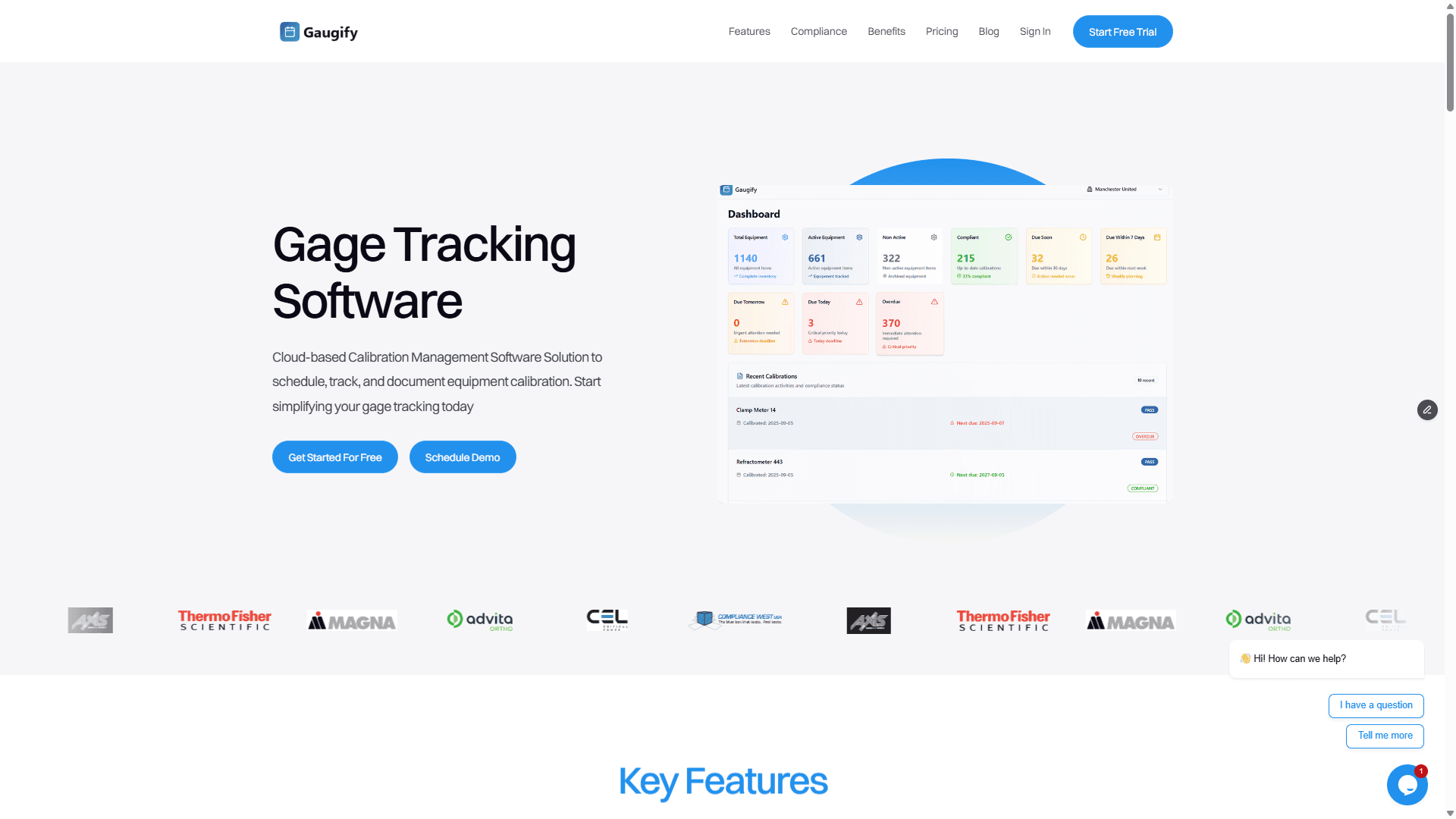
Manual analysis of predictive calibration data becomes impractical as your instrument inventory grows. Modern calibration management systems like Gaugify's advanced analytics platform automate the data collection, analysis, and optimization process.
Here's how the right software transforms predictive calibration from concept to reality:
Automated Data Integration
Instead of manually tracking calibration results in spreadsheets, cloud-based systems automatically capture detailed as-found/as-left data from calibration certificates. Usage data integrates from production systems, environmental conditions sync from facility monitoring, and maintenance events update automatically.
This comprehensive data collection happens in the background while technicians focus on actual calibration work rather than administrative tasks.
Intelligent Trend Analysis
Advanced algorithms analyze drift patterns across instrument families, identify statistical trends, and flag outliers automatically. The system learns which environmental factors correlate with instrument stability, how usage patterns affect calibration needs, and which early indicators predict failures.
For example, Gaugify's predictive analytics can automatically identify that your Fluke multimeters consistently remain stable for 15 months in controlled environments but show accelerated drift in high-EMI areas, then adjust scheduling recommendations accordingly.
Risk-Based Recommendations
The software combines drift analysis with criticality assessments to recommend optimal intervals for each instrument. High-risk measurements get conservative intervals even with stable instruments, while stable low-risk equipment can safely extend intervals for cost optimization.
These recommendations update continuously as new calibration data becomes available, ensuring your intervals evolve with actual equipment performance rather than remaining static.
Predictive Alerts and Early Warning
Real-time monitoring compares current instrument behavior against predicted patterns, triggering alerts when deviations suggest impending problems. This transforms calibration from reactive compliance to proactive maintenance.
Quality managers receive dashboard notifications when instruments exceed expected drift rates, usage patterns change significantly, or environmental conditions threaten measurement stability. This early warning capability prevents the surprise failures that disrupt production and compromise quality.
Ready to see how predictive calibration can optimize your program? Start your free trial and analyze your historical calibration data to identify immediate optimization opportunities.
Compliance Documentation
Auditors increasingly expect data-driven justification for calibration intervals rather than blind adherence to manufacturer recommendations. Modern calibration software automatically generates the statistical analysis, risk assessments, and performance documentation needed to satisfy ISO 17025 requirements and customer audits.
The system maintains detailed audit trails showing how intervals were determined, what data supported decisions, and how performance validated predictions. This documentation transforms interval justification from a compliance burden to a competitive advantage.
Implementation Success Stories
Organizations implementing predictive calibration strategies see measurable improvements in both cost efficiency and quality confidence:
An aerospace machining facility reduced calibration costs by 35% while improving equipment uptime by 12% through data-driven interval optimization. They extended intervals for 60% of their dimensional gaging while shortening intervals for critical torque tools showing environmental sensitivity.
A pharmaceutical manufacturer eliminated four potential product deviations over 18 months by implementing predictive monitoring of analytical balances and pH meters. Early detection of drift patterns prevented out-of-specification measurements that would have required expensive investigations and potential batch disposal.
A automotive supplier optimized calibration scheduling for over 800 instruments, reducing emergency calibrations by 78% while maintaining zero customer quality incidents. Predictive analytics identified usage patterns and environmental factors affecting different instrument families, enabling customized interval strategies.
Getting Started with Your Predictive Calibration Program
Implementing predictive calibration doesn't require a complete system overhaul. Start with your most critical or expensive-to-calibrate instruments, build confidence with data-driven decisions, then expand the approach across your entire program.
Focus first on instruments with either high calibration costs, frequent failures, or critical quality impact. These provide the clearest return on investment for predictive approaches while building experience with the methodology.
Begin collecting detailed calibration data immediately, even if analysis capabilities come later. The sooner you start capturing drift patterns, usage data, and environmental factors, the sooner you can begin optimization.
Consider partnering with calibration management software that specializes in predictive analytics rather than just compliance tracking. Modern platforms provide the analytical horsepower needed to transform calibration data into actionable insights.
Transform Your Calibration Program Today
Predictive calibration represents the evolution from reactive compliance to proactive optimization. By leveraging your calibration performance data, you can reduce costs, improve reliability, and gain competitive advantage through superior quality control.
The question isn't whether predictive calibration will become standard practice—it's whether your organization will lead this transformation or follow others who gain first-mover advantages.
Stop accepting surprise instrument failures, unnecessary calibration expenses, and rigid scheduling that ignores equipment reality. Your calibration data contains valuable insights waiting to optimize your program.
Start your free trial of Gaugify today and discover how predictive calibration data can transform your quality program. Upload your historical calibration records and see immediate optimization opportunities that could save thousands in unnecessary calibrations while preventing costly surprises. Your future self—and your CFO—will thank you.
Predictive Calibration: Using Data to Optimize Intervals
Your torque wrench was scheduled for calibration next month, but it failed during yesterday's production run. The entire batch of aerospace fasteners—$47,000 worth—now sits in quarantine while your quality team scrambles to determine if the tool was out of tolerance during assembly. Sound familiar? This scenario plays out in manufacturing facilities worldwide because traditional fixed-interval calibration schedules ignore the most important factor: actual equipment performance data. Predictive calibration data offers a smarter approach that prevents these costly surprises while optimizing your calibration budget and resources.
Most quality managers rely on manufacturer recommendations or industry standards to set calibration intervals—typically 12 months for most precision instruments. But here's the reality: your micrometer measuring critical automotive engine components experiences different wear patterns than one used occasionally in a prototype lab. Your environmental chambers running continuous thermal cycling need different attention than backup units used monthly. Yet both get calibrated on the same rigid schedule, wasting resources on stable equipment while potentially missing drift in heavily-used instruments.
Why Inadequate Calibration Scheduling Is More Common Than You Think
Walk through any manufacturing facility and you'll find the same pattern: rows of instruments with calibration stickers showing identical 12-month intervals. Quality managers inherit these schedules from previous personnel, calibration vendors push standardized intervals to simplify their logistics, and busy technicians don't have time to analyze individual instrument performance. The result? A one-size-fits-all approach that ignores equipment reality.
Consider these common scenarios:
A coordinate measuring machine (CMM) calibrated annually despite showing consistent stability over 18 months of measurement history
Pressure transducers in high-vibration applications scheduled for 12-month intervals when data shows significant drift after 8 months
Temperature probes in corrosive environments following standard schedules while similar probes in clean rooms could safely extend intervals to 15 months
Torque tools used daily for critical applications getting the same attention as backup instruments used weekly
The underlying problem is simple: most organizations lack the systematic approach to collect, analyze, and act on their calibration performance data. They're flying blind, making scheduling decisions based on calendar dates rather than equipment behavior.
The Data Collection Gap
Even organizations that recognize the value of data-driven calibration face practical challenges. Calibration certificates get filed away in folders or basic spreadsheets. Historical drift patterns remain buried in vendor reports. Usage data stays trapped in production systems. Without integrated analysis, identifying optimization opportunities becomes nearly impossible.
Quality technicians might notice that a particular gage block set consistently passes calibration with minimal adjustment, but this insight never translates into extended intervals. Meanwhile, a digital multimeter showing increasing drift goes unnoticed until it fails acceptance testing during a critical project.
Real-World Consequences That Impact Your Bottom Line
The cost of inadequate calibration scheduling extends far beyond the calibration budget itself. Here's what happens when your intervals don't match equipment reality:
Failed Audits and Customer Complaints
During an AS9100 audit, an aerospace supplier discovered their key torque wrench had drifted 8% beyond acceptable limits—three months before its scheduled calibration. The auditor flagged this as a major nonconformity, requiring expensive corrective actions and customer notifications. Two key contracts were delayed while the company validated product integrity and implemented new procedures.
In the medical device industry, an FDA inspection revealed that pH meters used for cleaning validation had extended drift patterns that weren't caught by annual calibrations. The resulting warning letter required comprehensive CAPA implementation and delayed new product launches by six months.
Scrap and Rework Costs
A precision machining shop discovered their bore gage had drifted beyond tolerance after producing 500 hydraulic valve bodies. Since the drift timing was unknown, they scrapped the entire batch—$78,000 in parts and labor. Post-analysis revealed the instrument typically showed drift signatures 2-3 months before failure, but no one was monitoring this pattern.
Unnecessary Calibration Expenses
On the flip side, over-calibration wastes significant resources. A pharmaceutical manufacturer analyzed five years of calibration data and found that 40% of their analytical balances showed rock-solid stability well beyond 12 months. By extending intervals for stable instruments to 18 months, they reduced annual calibration costs by $127,000 while maintaining measurement confidence.
Production Disruptions
Unexpected instrument failures create chaos on production lines. When critical gaging fails during production, you're forced into reactive mode: emergency calibrations, backup equipment searches, potential line shutdowns. These disruptions often cost more than the measurement error itself.
Root Causes: Why Traditional Approaches Fall Short
Understanding why conventional calibration scheduling creates these problems helps identify the solution. Several factors contribute to the disconnect between calendar-based intervals and equipment reality:
Static Thinking in Dynamic Environments
Manufacturing environments change constantly. Production volumes fluctuate, new processes get introduced, operating conditions shift, and equipment usage patterns evolve. Yet calibration intervals remain frozen in time, set when the instrument was first acquired or inherited from previous procedures.
A automotive supplier increased production 300% over two years but never adjusted calibration intervals for heavily-used dimensional gaging. Predictably, several instruments failed between calibrations as usage intensity exceeded original assumptions.
Limited Data Analysis Capabilities
Most calibration tracking systems focus on compliance—scheduling work orders and storing certificates. They don't provide analytical tools to identify trends, compare instrument families, or correlate performance with usage patterns. Quality managers know data analysis would help but lack practical tools to perform it.
Risk-Averse Culture
Many organizations default to conservative intervals because extending calibration schedules feels risky. Without quantitative confidence in equipment stability, the safe choice seems like more frequent calibration. This risk aversion prevents optimization even when data clearly supports longer intervals.
Vendor Influence
Calibration service providers often prefer standardized intervals for scheduling efficiency. They may resist interval optimization that reduces service frequency, even when data supports longer intervals. This creates a conflict between vendor convenience and customer optimization.
The Predictive Calibration Data Solution: A Step-by-Step Approach
Implementing predictive calibration data strategies transforms your calibration program from reactive compliance to proactive optimization. Here's how to build this capability systematically:
Step 1: Comprehensive Data Collection
Start by capturing detailed calibration history for every instrument. This includes:
As-Found vs. As-Left values: Document the actual measurement drift, not just pass/fail status
Environmental conditions: Temperature, humidity, vibration levels during use
Usage intensity: Daily measurements, operating hours, handling frequency
Maintenance events: Repairs, adjustments, component replacements
Process criticality: Impact level if the instrument fails or drifts
For example, track your Mitutoyo micrometers not just as "passed 12-month calibration" but as "measured 0.0002" high on the 1-inch standard, 0.0001" low on the 2-inch standard, used for 847 measurements since last calibration, stored in temperature-controlled environment."
Step 2: Drift Pattern Analysis
Once you have several calibration cycles of detailed data, analyze drift patterns for each instrument type. Look for:
Consistent stability: Instruments that remain well within tolerance across multiple intervals
Predictable drift: Linear degradation that can be anticipated and monitored
Usage correlation: Relationship between measurement frequency and drift rate
Environmental sensitivity: How operating conditions affect stability
Failure precursors: Early warning signs that predict impending problems
A precision grinding operation discovered their air gages showed consistent 0.0001" drift per 10,000 measurements—predictable enough to schedule calibration based on usage rather than time. Meanwhile, their surface roughness testers exhibited random drift unrelated to usage but strongly correlated with shop humidity levels.
Step 3: Risk-Based Interval Optimization
Use your drift analysis to optimize intervals based on actual risk rather than arbitrary time periods. Consider:
Measurement criticality: Instruments affecting safety or key product characteristics need tighter control
Drift predictability: Stable, predictable instruments can safely extend intervals
Detection capability: Whether you can catch problems through process monitoring or duplicate measurements
Failure consequences: Cost impact of undetected drift or unexpected failure
For stable instruments with low criticality, extend intervals confidently. For critical instruments with unpredictable behavior, consider shortened intervals or more frequent intermediate checks.
Step 4: Implement Predictive Monitoring
Develop early warning systems based on your analysis. This might include:
Usage-based scheduling: Calendar intervals adjusted by actual measurement frequency
Drift trending: Statistical analysis of recent calibration results to predict future behavior
Process monitoring: Control charts on check standard measurements to detect instrument drift
Automated alerts: System notifications when instruments exceed predicted drift rates
A medical device manufacturer implemented check standard monitoring for their critical dimensional gaging. When any instrument showed drift beyond expected patterns, the system automatically flagged it for early calibration, preventing two potential product recalls over 18 months.
Step 5: Continuous Improvement Loop
Treat interval optimization as an ongoing process, not a one-time project. Regularly review performance data, validate predictions against actual results, and refine your models. Document both successes and failures to build institutional knowledge.
Track key metrics like:
Percentage of instruments passing calibration on extended intervals
Cost savings from optimized scheduling
Reduction in unexpected failures
Improved production uptime
How Modern Calibration Software Enables Predictive Scheduling
Manual analysis of predictive calibration data becomes impractical as your instrument inventory grows. Modern calibration management systems like Gaugify's advanced analytics platform automate the data collection, analysis, and optimization process.
Here's how the right software transforms predictive calibration from concept to reality:
Automated Data Integration
Instead of manually tracking calibration results in spreadsheets, cloud-based systems automatically capture detailed as-found/as-left data from calibration certificates. Usage data integrates from production systems, environmental conditions sync from facility monitoring, and maintenance events update automatically.
This comprehensive data collection happens in the background while technicians focus on actual calibration work rather than administrative tasks.
Intelligent Trend Analysis
Advanced algorithms analyze drift patterns across instrument families, identify statistical trends, and flag outliers automatically. The system learns which environmental factors correlate with instrument stability, how usage patterns affect calibration needs, and which early indicators predict failures.
For example, Gaugify's predictive analytics can automatically identify that your Fluke multimeters consistently remain stable for 15 months in controlled environments but show accelerated drift in high-EMI areas, then adjust scheduling recommendations accordingly.
Risk-Based Recommendations
The software combines drift analysis with criticality assessments to recommend optimal intervals for each instrument. High-risk measurements get conservative intervals even with stable instruments, while stable low-risk equipment can safely extend intervals for cost optimization.
These recommendations update continuously as new calibration data becomes available, ensuring your intervals evolve with actual equipment performance rather than remaining static.
Predictive Alerts and Early Warning
Real-time monitoring compares current instrument behavior against predicted patterns, triggering alerts when deviations suggest impending problems. This transforms calibration from reactive compliance to proactive maintenance.
Quality managers receive dashboard notifications when instruments exceed expected drift rates, usage patterns change significantly, or environmental conditions threaten measurement stability. This early warning capability prevents the surprise failures that disrupt production and compromise quality.
Ready to see how predictive calibration can optimize your program? Start your free trial and analyze your historical calibration data to identify immediate optimization opportunities.
Compliance Documentation
Auditors increasingly expect data-driven justification for calibration intervals rather than blind adherence to manufacturer recommendations. Modern calibration software automatically generates the statistical analysis, risk assessments, and performance documentation needed to satisfy ISO 17025 requirements and customer audits.
The system maintains detailed audit trails showing how intervals were determined, what data supported decisions, and how performance validated predictions. This documentation transforms interval justification from a compliance burden to a competitive advantage.
Implementation Success Stories
Organizations implementing predictive calibration strategies see measurable improvements in both cost efficiency and quality confidence:
An aerospace machining facility reduced calibration costs by 35% while improving equipment uptime by 12% through data-driven interval optimization. They extended intervals for 60% of their dimensional gaging while shortening intervals for critical torque tools showing environmental sensitivity.
A pharmaceutical manufacturer eliminated four potential product deviations over 18 months by implementing predictive monitoring of analytical balances and pH meters. Early detection of drift patterns prevented out-of-specification measurements that would have required expensive investigations and potential batch disposal.
A automotive supplier optimized calibration scheduling for over 800 instruments, reducing emergency calibrations by 78% while maintaining zero customer quality incidents. Predictive analytics identified usage patterns and environmental factors affecting different instrument families, enabling customized interval strategies.
Getting Started with Your Predictive Calibration Program
Implementing predictive calibration doesn't require a complete system overhaul. Start with your most critical or expensive-to-calibrate instruments, build confidence with data-driven decisions, then expand the approach across your entire program.
Focus first on instruments with either high calibration costs, frequent failures, or critical quality impact. These provide the clearest return on investment for predictive approaches while building experience with the methodology.
Begin collecting detailed calibration data immediately, even if analysis capabilities come later. The sooner you start capturing drift patterns, usage data, and environmental factors, the sooner you can begin optimization.
Consider partnering with calibration management software that specializes in predictive analytics rather than just compliance tracking. Modern platforms provide the analytical horsepower needed to transform calibration data into actionable insights.
Transform Your Calibration Program Today
Predictive calibration represents the evolution from reactive compliance to proactive optimization. By leveraging your calibration performance data, you can reduce costs, improve reliability, and gain competitive advantage through superior quality control.
The question isn't whether predictive calibration will become standard practice—it's whether your organization will lead this transformation or follow others who gain first-mover advantages.
Stop accepting surprise instrument failures, unnecessary calibration expenses, and rigid scheduling that ignores equipment reality. Your calibration data contains valuable insights waiting to optimize your program.
Start your free trial of Gaugify today and discover how predictive calibration data can transform your quality program. Upload your historical calibration records and see immediate optimization opportunities that could save thousands in unnecessary calibrations while preventing costly surprises. Your future self—and your CFO—will thank you.