
The State of Calibration Management in 2026
The State of Calibration Management in 2026
David Bentley
Quality Assurance Engineer
8 min read
The State of Calibration Management in 2026
The state of calibration management in 2026 reveals a troubling reality: despite decades of technological advancement, most manufacturing and laboratory operations are still drowning in spreadsheets, sticky notes, and reactive maintenance approaches that put product quality and regulatory compliance at serious risk. While Industry 4.0 technologies have transformed production lines, calibration management remains stuck in the past for far too many organizations.
Picture this scenario: It's 7:30 AM on a Tuesday when quality manager Sarah Martinez discovers that her facility's critical Mitutoyo digital height gage—used to verify ±0.0005" tolerance components for aerospace customers—expired its calibration window three weeks ago. The production team has been using it to approve parts worth $2.3 million in customer orders. Now she faces a devastating choice: quarantine three weeks of production or risk a customer audit finding that could terminate their AS9100 certification.
This isn't an isolated incident. It's the reality facing quality professionals every day as calibration management systems fail to keep pace with modern manufacturing demands.
Why Calibration Management Failures Are More Common Than Organizations Admit
Industry surveys consistently show that 73% of manufacturing facilities experience at least one significant calibration oversight annually, yet most quality managers believe their systems are adequate. This disconnect stems from several factors that make calibration management failures both predictable and largely invisible until they become catastrophic.
The complexity of modern measurement systems compounds the problem exponentially. A typical automotive supplier might manage 400+ measurement devices across multiple locations—from basic dial indicators requiring annual calibration to sophisticated coordinate measuring machines (CMMs) with quarterly requirements and environmental controls. Each device has unique calibration intervals, different service providers, varying documentation requirements, and specific traceability chains back to NIST standards.
Consider the calibration requirements for a single production line manufacturing medical device components:
Torque wrenches (6-month intervals) for assembly operations
Digital calipers (annual calibration) for incoming inspection
Surface roughness testers (6-month intervals) for critical finish verification
Optical comparators (quarterly calibration) for complex geometric features
Environmental monitoring equipment (annual calibration) for cleanroom validation
Pressure transducers (6-month intervals) for leak testing stations
Multiply this complexity across multiple product lines, shifts, and locations, and it becomes clear why traditional tracking methods fail. Excel spreadsheets that worked adequately for 50 instruments become unmanageable death traps when scaled to enterprise levels.
The Real-World Consequences of Poor Calibration Management in 2026
The financial and operational impact of calibration management failures has intensified dramatically as supply chains tighten and customer quality requirements become more stringent. Modern consequences extend far beyond simple compliance violations.
Failed Customer Audits and Lost Business
When Boeing auditors discovered that a key supplier had been using expired calibration certificates for measurement equipment verifying wing component tolerances, the result was immediate: termination of a $47 million annual contract and mandatory re-inspection of six months of delivered parts. The supplier's attempt to maintain calibration records in multiple Excel files had created gaps that went unnoticed until the audit.
Product Liability and Safety Incidents
A medical device manufacturer faced a $12 million product recall when investigators traced patient safety incidents back to improperly calibrated torque measurement equipment. The devices had been operating outside calibration windows for four months, resulting in inconsistent assembly torques that allowed critical components to loosen during use. The FDA investigation revealed that their paper-based calibration tracking system had failed to trigger timely recalibration notices.
Scrap and Rework Costs
Modern manufacturing tolerances leave no margin for measurement uncertainty from uncalibrated equipment. An electronics manufacturer discovered that an expired calibration on their wire bond pull tester had resulted in accepting marginal connections that later failed during customer reliability testing. The rework costs exceeded $800,000, not including the damage to customer relationships and delayed product launches.
Regulatory Compliance Violations
FDA inspections in 2026 increasingly focus on calibration management as a key indicator of overall quality system effectiveness. Facilities operating under 21 CFR Part 820 face immediate corrective action requests when calibration gaps are discovered, often requiring expensive third-party remediation and extended regulatory oversight.
Root Causes: Why Traditional Calibration Management Systems Fail
The fundamental problem isn't a lack of awareness about calibration importance—most quality professionals understand the risks. Instead, failures stem from systemic issues with traditional management approaches that were never designed for modern operational complexity.
Disconnected Information Systems
Most organizations manage calibration data in isolation from other quality processes. Maintenance schedules live in CMMS systems, calibration certificates exist in filing cabinets or network folders, and measurement records reside in inspection databases. This fragmentation creates blind spots where critical connections between equipment condition, measurement capability, and product quality are lost.
Reactive Rather Than Predictive Approaches
Traditional calibration management operates on fixed intervals established years ago, regardless of actual equipment usage, environmental conditions, or measurement criticality. A precision gage used once per week receives the same calibration frequency as identical equipment running 24/7 in harsh production environments. This one-size-fits-all approach wastes resources on stable equipment while leaving heavily-used instruments vulnerable to drift.
Manual Process Dependencies
Critical calibration processes still depend on human memory and manual intervention. Technicians must remember to check calibration status before using equipment. Supervisors rely on calendar reminders to schedule service appointments. Quality managers manually compile compliance reports from multiple data sources. These dependencies guarantee eventual failures as workloads increase and staff turnover occurs.
Inadequate Traceability and Documentation
Proving measurement traceability during audits requires clear documentation chains from individual measurements back through calibration certificates to national standards. Traditional systems struggle to maintain these connections, especially when equipment moves between locations, receives emergency repairs, or undergoes configuration changes.
The Modern Solution: Integrated Digital Calibration Management
Addressing the current state of calibration management in 2026 requires a fundamental shift from reactive, manual approaches to proactive, integrated digital systems that connect calibration status with real-time operational decisions.
Ready to eliminate calibration management risks from your operations? Start your free trial of Gaugify and experience how modern cloud-based calibration management prevents the costly oversights that plague traditional approaches.
Step 1: Centralized Equipment Registration and Classification
Begin by establishing a comprehensive digital inventory of all measurement equipment, regardless of current tracking status. Modern calibration management systems like Gaugify enable rapid equipment registration using mobile devices to scan existing asset tags or create new identification systems.
Classify equipment based on measurement criticality, not just calibration intervals. Critical equipment affecting customer specifications, safety requirements, or regulatory compliance receives priority scheduling and expedited handling. Non-critical equipment used for reference or troubleshooting operates on extended intervals with appropriate documentation.
Step 2: Risk-Based Calibration Interval Optimization
Replace fixed calibration schedules with dynamic intervals based on actual equipment usage, historical drift patterns, and measurement requirements. Equipment demonstrating consistent stability can safely operate on extended intervals, while instruments showing drift patterns require more frequent verification.
Implement measurement system analysis (MSA) data to guide calibration decisions. Equipment contributing excessive measurement uncertainty requires immediate attention, regardless of calibration due dates. Conversely, stable systems with demonstrated capability can defer non-critical calibrations during peak production periods.
Step 3: Automated Workflow and Notification Systems
Eliminate manual tracking through automated workflows that monitor calibration status continuously and trigger appropriate actions based on configurable business rules. Advanced systems integrate with production schedules to prevent use of expired equipment and automatically generate work orders for upcoming calibrations.
Configure escalation procedures that ensure critical equipment receives priority attention while providing flexibility for non-critical items during resource constraints. Supervisors receive early warnings about approaching due dates, while technicians get daily task lists prioritized by operational impact.
Step 4: Digital Certificate Management and Traceability
Establish digital certificate repositories that link calibration documentation directly to equipment records and measurement data. Modern systems maintain complete audit trails showing equipment usage history, calibration results, and corrective actions in chronological order.
Implement QR code or RFID tagging to enable instant access to current calibration status from the shop floor. Technicians can verify equipment condition before use, while quality inspectors can confirm measurement validity during product approvals.
Step 5: Integration with Quality Management Systems
Connect calibration management with broader quality processes to enable informed decision-making about product disposition when calibration issues arise. Integrated systems can identify all products measured with specific equipment during any time period, enabling precise corrective actions when problems are discovered.
How Modern Calibration Management Software Prevents System Failures
Cloud-based calibration management platforms like Gaugify address the root causes of traditional system failures through integrated approaches that connect equipment management with operational workflows and regulatory requirements.
Real-Time Status Monitoring
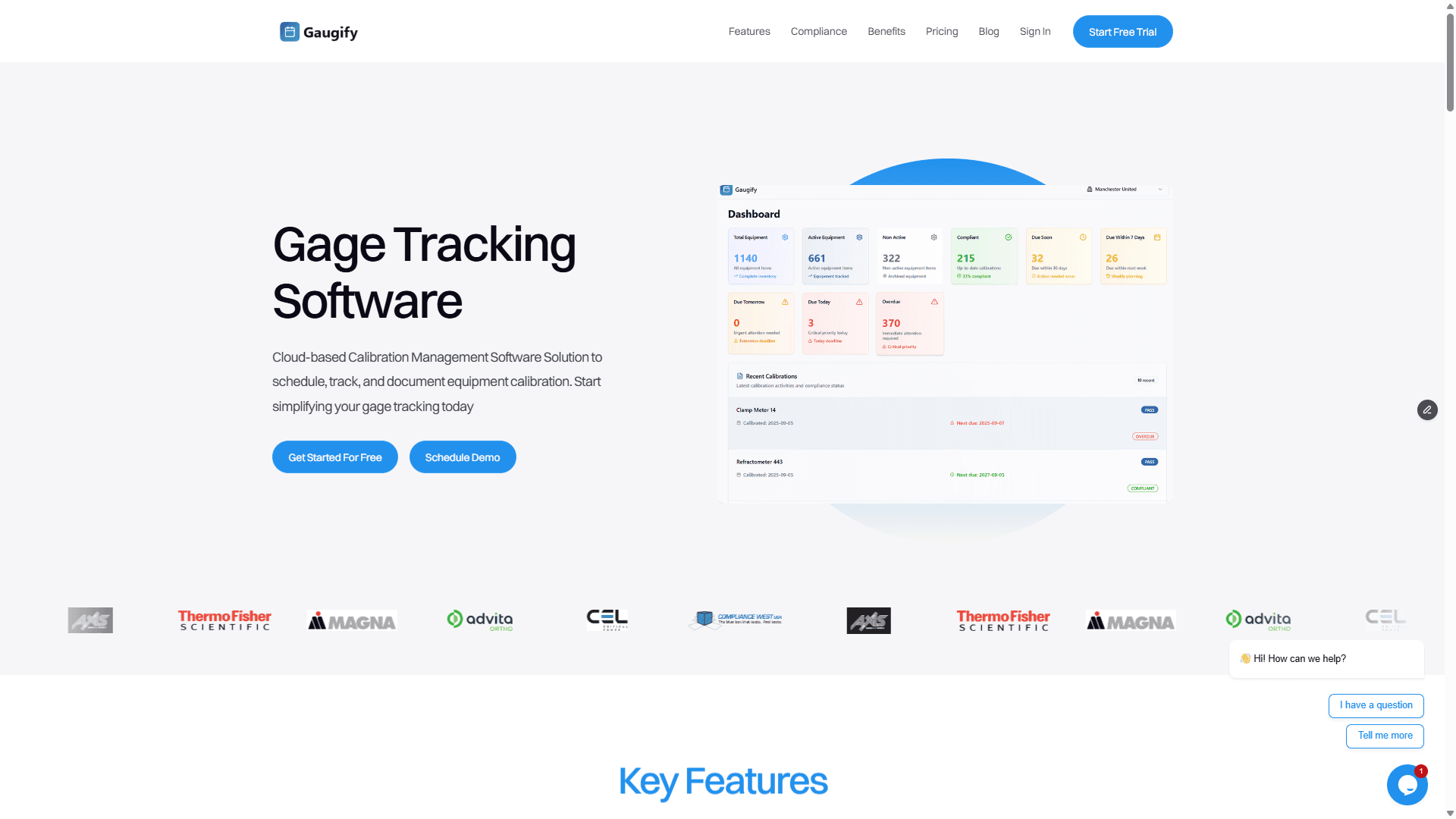
Advanced calibration management features provide dashboard visibility into fleet-wide calibration status, highlighting equipment approaching due dates, items requiring immediate attention, and systems demonstrating concerning drift patterns. Quality managers can assess overall compliance status instantly rather than compiling manual reports from multiple sources.
Preventive Scheduling and Resource Management
Intelligent scheduling algorithms balance calibration requirements with operational priorities, automatically generating optimized service schedules that minimize production disruption while maintaining compliance. The system considers equipment criticality, service provider availability, and seasonal demand patterns to prevent calibration backlogs during peak periods.
Comprehensive Compliance Documentation
Modern platforms maintain complete documentation packages required for regulatory compliance, including calibration certificates, measurement uncertainty calculations, traceability chains, and corrective action records. Compliance management tools generate audit-ready reports demonstrating adherence to ISO 9001, AS9100, ISO 13485, and other quality standards.
Mobile Accessibility and Workflow Integration
Mobile applications enable technicians to verify calibration status, access procedures, and document results directly from production areas. Integration with existing quality management systems ensures calibration data flows seamlessly into broader quality processes without duplicate data entry or system switching.
Predictive Analytics and Continuous Improvement
Advanced analytics identify patterns in calibration data that indicate equipment degradation, environmental impacts, or process changes affecting measurement system performance. These insights enable proactive interventions that prevent quality issues before they impact production or customer satisfaction.
The Business Case for Modern Calibration Management in 2026
Organizations implementing comprehensive digital calibration management systems typically realize returns on investment within six months through reduced administrative overhead, prevented quality incidents, and improved audit performance.
Cost Reduction Through Automation
Automated workflows eliminate manual tracking activities that consume 15-20 hours weekly for typical quality departments. Certificate management, compliance reporting, and status monitoring become background processes rather than dedicated administrative tasks.
Risk Mitigation and Insurance Benefits
Documented calibration management systems reduce product liability exposure and may qualify organizations for reduced insurance premiums. The ability to demonstrate proactive quality management during incident investigations can significantly limit financial exposure and regulatory penalties.
Enhanced Customer Confidence
Customers increasingly require suppliers to demonstrate measurement system control as part of supplier qualification processes. Organizations with advanced calibration management capabilities gain competitive advantages in bidding processes and customer audits.
For organizations ready to modernize their calibration management approaches, ISO 17025-compliant calibration software provides the foundation for comprehensive quality system improvement that extends far beyond basic compliance requirements.
Taking Action: Implementing Modern Calibration Management
The current state of calibration management in 2026 demands immediate action from organizations serious about quality, compliance, and operational excellence. Traditional approaches have reached their functional limits, and continued reliance on manual systems guarantees eventual failures with increasingly severe consequences.
Start by conducting a honest assessment of your current calibration management effectiveness. Count the number of systems involved in tracking equipment, managing certificates, and generating compliance reports. Calculate the administrative time spent on manual processes each week. Identify the last time calibration oversights created quality issues or compliance concerns.
For most organizations, this assessment reveals systemic vulnerabilities that justify immediate modernization efforts. The question isn't whether to upgrade calibration management systems, but how quickly implementation can begin and what level of functionality will best serve operational requirements.
Modern cloud-based solutions offer implementation paths that minimize disruption while delivering immediate benefits. Pilot programs can demonstrate value within 30 days, while full enterprise deployments typically complete within 90 days depending on organizational complexity.
Don't wait for the next calibration crisis to drive change in your organization. The tools and processes needed to eliminate calibration management risks are available today, proven in thousands of implementations, and accessible at price points that deliver clear returns on investment.
Transform your calibration management from a compliance burden into a competitive advantage. Start your free trial of Gaugify today and discover how modern calibration management software eliminates the risks, costs, and administrative overhead that plague traditional approaches. Your future self—and your customers—will thank you for taking action before problems occur rather than scrambling to recover after preventable failures damage your reputation and bottom line.
The State of Calibration Management in 2026
The state of calibration management in 2026 reveals a troubling reality: despite decades of technological advancement, most manufacturing and laboratory operations are still drowning in spreadsheets, sticky notes, and reactive maintenance approaches that put product quality and regulatory compliance at serious risk. While Industry 4.0 technologies have transformed production lines, calibration management remains stuck in the past for far too many organizations.
Picture this scenario: It's 7:30 AM on a Tuesday when quality manager Sarah Martinez discovers that her facility's critical Mitutoyo digital height gage—used to verify ±0.0005" tolerance components for aerospace customers—expired its calibration window three weeks ago. The production team has been using it to approve parts worth $2.3 million in customer orders. Now she faces a devastating choice: quarantine three weeks of production or risk a customer audit finding that could terminate their AS9100 certification.
This isn't an isolated incident. It's the reality facing quality professionals every day as calibration management systems fail to keep pace with modern manufacturing demands.
Why Calibration Management Failures Are More Common Than Organizations Admit
Industry surveys consistently show that 73% of manufacturing facilities experience at least one significant calibration oversight annually, yet most quality managers believe their systems are adequate. This disconnect stems from several factors that make calibration management failures both predictable and largely invisible until they become catastrophic.
The complexity of modern measurement systems compounds the problem exponentially. A typical automotive supplier might manage 400+ measurement devices across multiple locations—from basic dial indicators requiring annual calibration to sophisticated coordinate measuring machines (CMMs) with quarterly requirements and environmental controls. Each device has unique calibration intervals, different service providers, varying documentation requirements, and specific traceability chains back to NIST standards.
Consider the calibration requirements for a single production line manufacturing medical device components:
Torque wrenches (6-month intervals) for assembly operations
Digital calipers (annual calibration) for incoming inspection
Surface roughness testers (6-month intervals) for critical finish verification
Optical comparators (quarterly calibration) for complex geometric features
Environmental monitoring equipment (annual calibration) for cleanroom validation
Pressure transducers (6-month intervals) for leak testing stations
Multiply this complexity across multiple product lines, shifts, and locations, and it becomes clear why traditional tracking methods fail. Excel spreadsheets that worked adequately for 50 instruments become unmanageable death traps when scaled to enterprise levels.
The Real-World Consequences of Poor Calibration Management in 2026
The financial and operational impact of calibration management failures has intensified dramatically as supply chains tighten and customer quality requirements become more stringent. Modern consequences extend far beyond simple compliance violations.
Failed Customer Audits and Lost Business
When Boeing auditors discovered that a key supplier had been using expired calibration certificates for measurement equipment verifying wing component tolerances, the result was immediate: termination of a $47 million annual contract and mandatory re-inspection of six months of delivered parts. The supplier's attempt to maintain calibration records in multiple Excel files had created gaps that went unnoticed until the audit.
Product Liability and Safety Incidents
A medical device manufacturer faced a $12 million product recall when investigators traced patient safety incidents back to improperly calibrated torque measurement equipment. The devices had been operating outside calibration windows for four months, resulting in inconsistent assembly torques that allowed critical components to loosen during use. The FDA investigation revealed that their paper-based calibration tracking system had failed to trigger timely recalibration notices.
Scrap and Rework Costs
Modern manufacturing tolerances leave no margin for measurement uncertainty from uncalibrated equipment. An electronics manufacturer discovered that an expired calibration on their wire bond pull tester had resulted in accepting marginal connections that later failed during customer reliability testing. The rework costs exceeded $800,000, not including the damage to customer relationships and delayed product launches.
Regulatory Compliance Violations
FDA inspections in 2026 increasingly focus on calibration management as a key indicator of overall quality system effectiveness. Facilities operating under 21 CFR Part 820 face immediate corrective action requests when calibration gaps are discovered, often requiring expensive third-party remediation and extended regulatory oversight.
Root Causes: Why Traditional Calibration Management Systems Fail
The fundamental problem isn't a lack of awareness about calibration importance—most quality professionals understand the risks. Instead, failures stem from systemic issues with traditional management approaches that were never designed for modern operational complexity.
Disconnected Information Systems
Most organizations manage calibration data in isolation from other quality processes. Maintenance schedules live in CMMS systems, calibration certificates exist in filing cabinets or network folders, and measurement records reside in inspection databases. This fragmentation creates blind spots where critical connections between equipment condition, measurement capability, and product quality are lost.
Reactive Rather Than Predictive Approaches
Traditional calibration management operates on fixed intervals established years ago, regardless of actual equipment usage, environmental conditions, or measurement criticality. A precision gage used once per week receives the same calibration frequency as identical equipment running 24/7 in harsh production environments. This one-size-fits-all approach wastes resources on stable equipment while leaving heavily-used instruments vulnerable to drift.
Manual Process Dependencies
Critical calibration processes still depend on human memory and manual intervention. Technicians must remember to check calibration status before using equipment. Supervisors rely on calendar reminders to schedule service appointments. Quality managers manually compile compliance reports from multiple data sources. These dependencies guarantee eventual failures as workloads increase and staff turnover occurs.
Inadequate Traceability and Documentation
Proving measurement traceability during audits requires clear documentation chains from individual measurements back through calibration certificates to national standards. Traditional systems struggle to maintain these connections, especially when equipment moves between locations, receives emergency repairs, or undergoes configuration changes.
The Modern Solution: Integrated Digital Calibration Management
Addressing the current state of calibration management in 2026 requires a fundamental shift from reactive, manual approaches to proactive, integrated digital systems that connect calibration status with real-time operational decisions.
Ready to eliminate calibration management risks from your operations? Start your free trial of Gaugify and experience how modern cloud-based calibration management prevents the costly oversights that plague traditional approaches.
Step 1: Centralized Equipment Registration and Classification
Begin by establishing a comprehensive digital inventory of all measurement equipment, regardless of current tracking status. Modern calibration management systems like Gaugify enable rapid equipment registration using mobile devices to scan existing asset tags or create new identification systems.
Classify equipment based on measurement criticality, not just calibration intervals. Critical equipment affecting customer specifications, safety requirements, or regulatory compliance receives priority scheduling and expedited handling. Non-critical equipment used for reference or troubleshooting operates on extended intervals with appropriate documentation.
Step 2: Risk-Based Calibration Interval Optimization
Replace fixed calibration schedules with dynamic intervals based on actual equipment usage, historical drift patterns, and measurement requirements. Equipment demonstrating consistent stability can safely operate on extended intervals, while instruments showing drift patterns require more frequent verification.
Implement measurement system analysis (MSA) data to guide calibration decisions. Equipment contributing excessive measurement uncertainty requires immediate attention, regardless of calibration due dates. Conversely, stable systems with demonstrated capability can defer non-critical calibrations during peak production periods.
Step 3: Automated Workflow and Notification Systems
Eliminate manual tracking through automated workflows that monitor calibration status continuously and trigger appropriate actions based on configurable business rules. Advanced systems integrate with production schedules to prevent use of expired equipment and automatically generate work orders for upcoming calibrations.
Configure escalation procedures that ensure critical equipment receives priority attention while providing flexibility for non-critical items during resource constraints. Supervisors receive early warnings about approaching due dates, while technicians get daily task lists prioritized by operational impact.
Step 4: Digital Certificate Management and Traceability
Establish digital certificate repositories that link calibration documentation directly to equipment records and measurement data. Modern systems maintain complete audit trails showing equipment usage history, calibration results, and corrective actions in chronological order.
Implement QR code or RFID tagging to enable instant access to current calibration status from the shop floor. Technicians can verify equipment condition before use, while quality inspectors can confirm measurement validity during product approvals.
Step 5: Integration with Quality Management Systems
Connect calibration management with broader quality processes to enable informed decision-making about product disposition when calibration issues arise. Integrated systems can identify all products measured with specific equipment during any time period, enabling precise corrective actions when problems are discovered.
How Modern Calibration Management Software Prevents System Failures
Cloud-based calibration management platforms like Gaugify address the root causes of traditional system failures through integrated approaches that connect equipment management with operational workflows and regulatory requirements.
Real-Time Status Monitoring
Advanced calibration management features provide dashboard visibility into fleet-wide calibration status, highlighting equipment approaching due dates, items requiring immediate attention, and systems demonstrating concerning drift patterns. Quality managers can assess overall compliance status instantly rather than compiling manual reports from multiple sources.
Preventive Scheduling and Resource Management
Intelligent scheduling algorithms balance calibration requirements with operational priorities, automatically generating optimized service schedules that minimize production disruption while maintaining compliance. The system considers equipment criticality, service provider availability, and seasonal demand patterns to prevent calibration backlogs during peak periods.
Comprehensive Compliance Documentation
Modern platforms maintain complete documentation packages required for regulatory compliance, including calibration certificates, measurement uncertainty calculations, traceability chains, and corrective action records. Compliance management tools generate audit-ready reports demonstrating adherence to ISO 9001, AS9100, ISO 13485, and other quality standards.
Mobile Accessibility and Workflow Integration
Mobile applications enable technicians to verify calibration status, access procedures, and document results directly from production areas. Integration with existing quality management systems ensures calibration data flows seamlessly into broader quality processes without duplicate data entry or system switching.
Predictive Analytics and Continuous Improvement
Advanced analytics identify patterns in calibration data that indicate equipment degradation, environmental impacts, or process changes affecting measurement system performance. These insights enable proactive interventions that prevent quality issues before they impact production or customer satisfaction.
The Business Case for Modern Calibration Management in 2026
Organizations implementing comprehensive digital calibration management systems typically realize returns on investment within six months through reduced administrative overhead, prevented quality incidents, and improved audit performance.
Cost Reduction Through Automation
Automated workflows eliminate manual tracking activities that consume 15-20 hours weekly for typical quality departments. Certificate management, compliance reporting, and status monitoring become background processes rather than dedicated administrative tasks.
Risk Mitigation and Insurance Benefits
Documented calibration management systems reduce product liability exposure and may qualify organizations for reduced insurance premiums. The ability to demonstrate proactive quality management during incident investigations can significantly limit financial exposure and regulatory penalties.
Enhanced Customer Confidence
Customers increasingly require suppliers to demonstrate measurement system control as part of supplier qualification processes. Organizations with advanced calibration management capabilities gain competitive advantages in bidding processes and customer audits.
For organizations ready to modernize their calibration management approaches, ISO 17025-compliant calibration software provides the foundation for comprehensive quality system improvement that extends far beyond basic compliance requirements.
Taking Action: Implementing Modern Calibration Management
The current state of calibration management in 2026 demands immediate action from organizations serious about quality, compliance, and operational excellence. Traditional approaches have reached their functional limits, and continued reliance on manual systems guarantees eventual failures with increasingly severe consequences.
Start by conducting a honest assessment of your current calibration management effectiveness. Count the number of systems involved in tracking equipment, managing certificates, and generating compliance reports. Calculate the administrative time spent on manual processes each week. Identify the last time calibration oversights created quality issues or compliance concerns.
For most organizations, this assessment reveals systemic vulnerabilities that justify immediate modernization efforts. The question isn't whether to upgrade calibration management systems, but how quickly implementation can begin and what level of functionality will best serve operational requirements.
Modern cloud-based solutions offer implementation paths that minimize disruption while delivering immediate benefits. Pilot programs can demonstrate value within 30 days, while full enterprise deployments typically complete within 90 days depending on organizational complexity.
Don't wait for the next calibration crisis to drive change in your organization. The tools and processes needed to eliminate calibration management risks are available today, proven in thousands of implementations, and accessible at price points that deliver clear returns on investment.
Transform your calibration management from a compliance burden into a competitive advantage. Start your free trial of Gaugify today and discover how modern calibration management software eliminates the risks, costs, and administrative overhead that plague traditional approaches. Your future self—and your customers—will thank you for taking action before problems occur rather than scrambling to recover after preventable failures damage your reputation and bottom line.