
Why New Employees Keep Breaking Your Calibration Process
Why New Employees Keep Breaking Your Calibration Process
David Bentley
Quality Assurance Engineer
8 min read
Why New Employees Keep Breaking Your Calibration Process
You hired a qualified technician, walked them through the calibration lab, showed them the equipment, and handed them your procedures manual. Three weeks later, you're scrambling to explain to your quality manager why critical micrometers weren't calibrated on schedule, customer gauges were returned with incorrect certificates, and your latest ISO 17025 surveillance audit found two major nonconformities. Sound familiar? Calibration onboarding problems are silently sabotaging quality systems across every industry, turning competent new hires into compliance nightmares.
The frustrating truth is that calibration onboarding problems aren't just about inexperienced technicians—they're about systemic gaps in how we transfer critical knowledge and maintain process control when our teams change. Whether you're running a small in-house lab or managing a multi-site calibration operation, every new employee represents both an opportunity to strengthen your capabilities and a risk that could derail months of compliance work.
The Hidden Scale of Calibration Onboarding Problems
Most quality managers underestimate how frequently calibration onboarding problems occur because the symptoms often appear weeks or months after a new employee starts. Unlike a machinist who creates an obviously out-of-spec part on day one, calibration errors compound silently until they surface during audits, customer complaints, or measurement system analyses.
Consider these scenarios that happen in calibration labs every month:
A new technician calibrates digital calipers using the wrong reference standard, not realizing the primary gauge block set is reserved for critical automotive tooling with ±0.0002" tolerances
An experienced metrologist joins from another company and applies 4:1 uncertainty ratios from their previous lab, unaware that your customer contracts require 10:1 ratios for Class A measuring equipment
A temp worker covering vacation schedules follows outdated procedures from the shared drive instead of the current revision, invalidating an entire week of torque wrench calibrations
A lab supervisor assumes the new hire understands environmental requirements and doesn't explain why CMM measurements must stabilize for 2+ hours at 68°F ± 2°F before starting calibration sequences
The National Institute of Standards and Technology estimates that measurement errors cost U.S. manufacturers over $60 billion annually. While not all of these costs stem from onboarding issues, calibration labs with high employee turnover consistently report 2-3x higher rates of customer complaints, audit findings, and internal quality escapes.
Real-World Consequences That Keep Quality Managers Awake
Calibration onboarding problems don't just create paperwork headaches—they generate measurable business risks that can threaten your organization's reputation, customer relationships, and bottom line.
Failed Audits and Compliance Violations
Last year, a Midwest automotive supplier lost their ISO/TS 16949 certification after auditors discovered that newly hired technicians had been using expired reference standards for three months. The root cause? No formal onboarding process existed to verify that new employees could identify calibration due dates and understand the lab's recall system. The resulting supplier audit failures, customer notifications, and re-certification costs exceeded $180,000.
Similarly, a pharmaceutical contract manufacturer faced FDA warnings after inspection teams found that temporary calibration staff had been documenting environmental conditions incorrectly on analytical balance certifications. The deviation required full investigation of all affected test results and delayed two product launches.
Customer Complaints and Lost Business
Nothing damages calibration lab credibility faster than delivering certificates with obvious errors or missing critical information. A precision machining shop recently lost a long-term aerospace customer after their new technician provided calibration certificates showing measurement uncertainties larger than the customer's part tolerances—a fundamental error that called into question the lab's technical competence.
These mistakes aren't just embarrassing; they're expensive. Customer complaint investigations typically require 8-15 hours of engineering time, expedited re-calibrations, and often trigger broader reviews of recent work performed by the same technician.
Liability and Insurance Implications
When calibration errors contribute to product failures or safety incidents, the legal and insurance implications can be severe. Manufacturing companies rely on calibration certificates as legal documentation that their measuring equipment was functioning correctly when critical parts were produced. Errors in these certificates—especially those caused by inadequate training—can void insurance coverage and create significant liability exposure.
The Root Causes Behind Calibration Onboarding Failures
Most calibration onboarding problems stem from five fundamental issues that plague even well-intentioned quality organizations:
Over-Reliance on Tribal Knowledge
Experienced calibration technicians develop intuitive understanding of equipment quirks, environmental factors, and customer requirements that never gets documented in formal procedures. They know that the Mitutoyo height gauge drifts if not warmed up for 30 minutes, that Customer A requires certificates in metric units while Customer B demands English units, and that the pressure calibrator's pump needs to cycle twice before taking readings above 500 PSI.
When veteran employees retire or change jobs, this tribal knowledge disappears, leaving new hires to rediscover critical information through trial and error—often during live customer work.
Inconsistent Documentation and Procedures
Many calibration labs struggle with document control, maintaining multiple versions of procedures across shared drives, physical binders, and email attachments. New employees frequently work from outdated instructions while supervisors assume they're following current procedures.
This problem intensifies in labs that service diverse industries with different requirements. A technician might successfully calibrate dial indicators for general manufacturing applications while unknowingly violating pharmaceutical industry requirements for the same equipment type.
Inadequate Competency Verification
Traditional calibration onboarding often focuses on showing new employees where equipment is located and reviewing written procedures, but fails to verify actual competency through hands-on evaluation. Supervisors assume that experienced technicians can adapt their skills to new environments without formal verification.
ISO/IEC 17025 specifically requires laboratories to ensure personnel are competent to perform assigned tasks, but many labs interpret this requirement loosely during busy periods when new hires are desperately needed on the floor.
A Step-by-Step Solution for Effective Calibration Onboarding
Solving calibration onboarding problems requires a systematic approach that combines standardized knowledge transfer, hands-on competency verification, and ongoing monitoring. Here's a proven framework that quality-focused organizations use to eliminate onboarding-related errors:
Phase 1: Pre-Boarding Preparation (Before Day 1)
Create a comprehensive onboarding checklist that covers your lab's specific requirements, customer expectations, and regulatory obligations. This checklist should include:
Customer-specific requirements and tolerances
Environmental monitoring and control procedures
Equipment-specific calibration sequences and warm-up requirements
Uncertainty calculation methods and acceptance criteria
Documentation standards and certificate formatting requirements
Emergency procedures and escalation paths
Prepare calibration workstations with reference materials, current procedures, and practice exercises that new employees can complete under supervision.
Phase 2: Structured Knowledge Transfer (Days 1-5)
Instead of overwhelming new hires with generic lab tours, structure the first week around specific learning objectives. Start with fundamental concepts like measurement uncertainty, traceability requirements, and your lab's quality policy, then progress to hands-on equipment familiarization.
Assign an experienced mentor who can provide real-time feedback and answer questions. This mentor should be formally trained on your onboarding process and temporarily relieved of other duties to focus on knowledge transfer.
Document all training activities and require both the new employee and mentor to sign off on completed modules.
Phase 3: Supervised Practice and Competency Assessment (Days 6-15)
New employees should perform actual calibrations under direct supervision, starting with simple equipment types and progressing to more complex systems. The supervising technician should verify that proper procedures are followed, environmental requirements are understood, and documentation is completed correctly.
Create formal competency assessments for each equipment type or calibration family. For example, before independently calibrating micrometers, a new technician should demonstrate proper handling techniques, correct gauge block selection, appropriate environmental controls, and accurate uncertainty calculations.
These assessments should be documented and maintained as part of personnel qualification records required by ISO/IEC 17025 and other quality standards.
Phase 4: Independent Work with Monitoring (Days 16-30)
Gradually transition new employees to independent work while maintaining higher-than-normal review frequencies. All certificates and documentation should be reviewed by qualified supervisors before release to customers.
Implement a formal feedback loop where new employees can report confusion, ask questions, and suggest improvements to onboarding materials. Often, fresh perspectives identify gaps in procedures that experienced staff have learned to work around.
Phase 5: Ongoing Competency Maintenance (Continuous)
Establish regular competency reviews and refresher training to ensure skills remain current. This is especially important when introducing new equipment, changing customer requirements, or updating regulatory standards.
Monitor key performance indicators like certificate accuracy rates, customer complaints, and internal quality findings to identify potential skill gaps before they become compliance issues.
How Modern Calibration Software Prevents Onboarding Problems
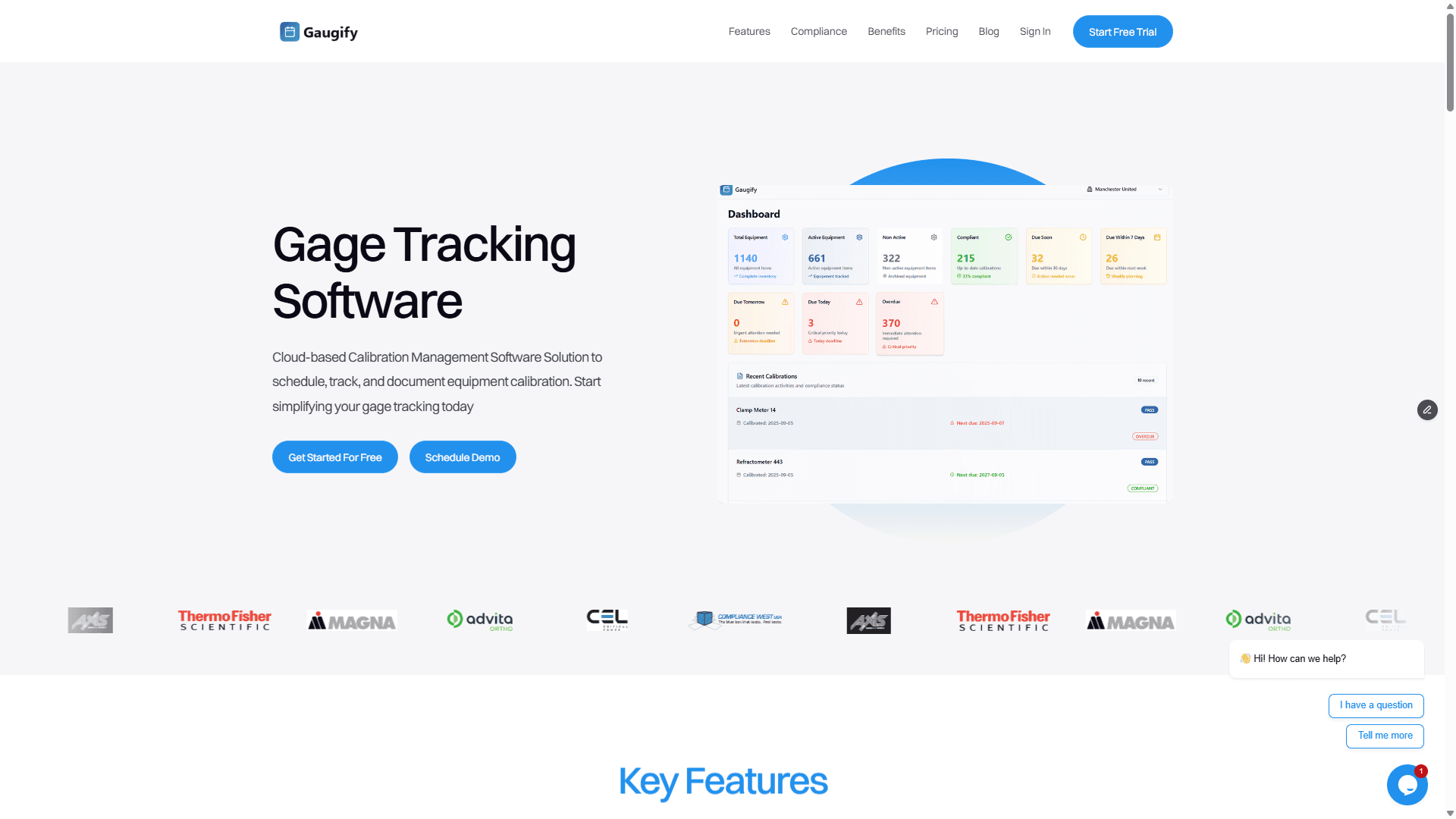
While structured onboarding processes are essential, modern calibration management software can eliminate many common onboarding pitfalls by automating critical tasks and providing built-in guidance for new technicians.
Gaugify's cloud-based calibration management platform specifically addresses calibration onboarding problems through several key capabilities:
Automated Procedure Delivery
Instead of requiring new employees to locate and verify current procedures, Gaugify's system automatically delivers the correct calibration procedure based on equipment type, customer requirements, and regulatory standards. This eliminates confusion about document versions and ensures consistent execution regardless of technician experience level.
Built-in Competency Tracking
The software maintains detailed records of each technician's training status, competency assessments, and authorization levels. Supervisors can instantly verify whether a specific employee is qualified to perform particular calibrations, and the system prevents unauthorized work through role-based access controls.
Real-time Guidance and Error Prevention
During calibration execution, Gaugify provides step-by-step guidance, automatically calculates measurement uncertainties, and validates data entry against predefined acceptance criteria. New technicians receive immediate feedback if measurements fall outside expected ranges or if required environmental conditions aren't met.
Customer-Specific Workflows
The platform automatically applies customer-specific requirements, certificate formats, and reporting standards based on work order details. New employees don't need to memorize dozens of customer preferences—the software ensures compliance automatically.
For organizations subject to ISO/IEC 17025 or other regulatory requirements, this automated compliance reduces audit risk while accelerating new employee productivity.
Comprehensive Audit Trails
Every calibration activity is automatically documented with timestamps, environmental conditions, and technician identification. This detailed audit trail supports competency verification and provides objective evidence of proper training execution.
Transform Your Calibration Onboarding Process Today
Calibration onboarding problems are expensive, risky, and completely preventable with the right systems and processes. Whether you're struggling with high employee turnover, facing audit findings related to personnel competency, or simply want to reduce the time it takes new hires to become productive, addressing these issues should be a top priority.
The most successful calibration labs combine structured onboarding processes with modern software tools that automate routine tasks and provide real-time guidance. This approach not only eliminates common onboarding errors but also creates a more engaging experience for new employees who can focus on developing technical skills rather than navigating complex administrative requirements.
Don't let your next new hire become another calibration onboarding casualty. Start your free Gaugify trial today and discover how modern calibration management software can transform your onboarding process while improving overall lab efficiency and compliance. Your quality manager—and your customers—will thank you.
Why New Employees Keep Breaking Your Calibration Process
You hired a qualified technician, walked them through the calibration lab, showed them the equipment, and handed them your procedures manual. Three weeks later, you're scrambling to explain to your quality manager why critical micrometers weren't calibrated on schedule, customer gauges were returned with incorrect certificates, and your latest ISO 17025 surveillance audit found two major nonconformities. Sound familiar? Calibration onboarding problems are silently sabotaging quality systems across every industry, turning competent new hires into compliance nightmares.
The frustrating truth is that calibration onboarding problems aren't just about inexperienced technicians—they're about systemic gaps in how we transfer critical knowledge and maintain process control when our teams change. Whether you're running a small in-house lab or managing a multi-site calibration operation, every new employee represents both an opportunity to strengthen your capabilities and a risk that could derail months of compliance work.
The Hidden Scale of Calibration Onboarding Problems
Most quality managers underestimate how frequently calibration onboarding problems occur because the symptoms often appear weeks or months after a new employee starts. Unlike a machinist who creates an obviously out-of-spec part on day one, calibration errors compound silently until they surface during audits, customer complaints, or measurement system analyses.
Consider these scenarios that happen in calibration labs every month:
A new technician calibrates digital calipers using the wrong reference standard, not realizing the primary gauge block set is reserved for critical automotive tooling with ±0.0002" tolerances
An experienced metrologist joins from another company and applies 4:1 uncertainty ratios from their previous lab, unaware that your customer contracts require 10:1 ratios for Class A measuring equipment
A temp worker covering vacation schedules follows outdated procedures from the shared drive instead of the current revision, invalidating an entire week of torque wrench calibrations
A lab supervisor assumes the new hire understands environmental requirements and doesn't explain why CMM measurements must stabilize for 2+ hours at 68°F ± 2°F before starting calibration sequences
The National Institute of Standards and Technology estimates that measurement errors cost U.S. manufacturers over $60 billion annually. While not all of these costs stem from onboarding issues, calibration labs with high employee turnover consistently report 2-3x higher rates of customer complaints, audit findings, and internal quality escapes.
Real-World Consequences That Keep Quality Managers Awake
Calibration onboarding problems don't just create paperwork headaches—they generate measurable business risks that can threaten your organization's reputation, customer relationships, and bottom line.
Failed Audits and Compliance Violations
Last year, a Midwest automotive supplier lost their ISO/TS 16949 certification after auditors discovered that newly hired technicians had been using expired reference standards for three months. The root cause? No formal onboarding process existed to verify that new employees could identify calibration due dates and understand the lab's recall system. The resulting supplier audit failures, customer notifications, and re-certification costs exceeded $180,000.
Similarly, a pharmaceutical contract manufacturer faced FDA warnings after inspection teams found that temporary calibration staff had been documenting environmental conditions incorrectly on analytical balance certifications. The deviation required full investigation of all affected test results and delayed two product launches.
Customer Complaints and Lost Business
Nothing damages calibration lab credibility faster than delivering certificates with obvious errors or missing critical information. A precision machining shop recently lost a long-term aerospace customer after their new technician provided calibration certificates showing measurement uncertainties larger than the customer's part tolerances—a fundamental error that called into question the lab's technical competence.
These mistakes aren't just embarrassing; they're expensive. Customer complaint investigations typically require 8-15 hours of engineering time, expedited re-calibrations, and often trigger broader reviews of recent work performed by the same technician.
Liability and Insurance Implications
When calibration errors contribute to product failures or safety incidents, the legal and insurance implications can be severe. Manufacturing companies rely on calibration certificates as legal documentation that their measuring equipment was functioning correctly when critical parts were produced. Errors in these certificates—especially those caused by inadequate training—can void insurance coverage and create significant liability exposure.
The Root Causes Behind Calibration Onboarding Failures
Most calibration onboarding problems stem from five fundamental issues that plague even well-intentioned quality organizations:
Over-Reliance on Tribal Knowledge
Experienced calibration technicians develop intuitive understanding of equipment quirks, environmental factors, and customer requirements that never gets documented in formal procedures. They know that the Mitutoyo height gauge drifts if not warmed up for 30 minutes, that Customer A requires certificates in metric units while Customer B demands English units, and that the pressure calibrator's pump needs to cycle twice before taking readings above 500 PSI.
When veteran employees retire or change jobs, this tribal knowledge disappears, leaving new hires to rediscover critical information through trial and error—often during live customer work.
Inconsistent Documentation and Procedures
Many calibration labs struggle with document control, maintaining multiple versions of procedures across shared drives, physical binders, and email attachments. New employees frequently work from outdated instructions while supervisors assume they're following current procedures.
This problem intensifies in labs that service diverse industries with different requirements. A technician might successfully calibrate dial indicators for general manufacturing applications while unknowingly violating pharmaceutical industry requirements for the same equipment type.
Inadequate Competency Verification
Traditional calibration onboarding often focuses on showing new employees where equipment is located and reviewing written procedures, but fails to verify actual competency through hands-on evaluation. Supervisors assume that experienced technicians can adapt their skills to new environments without formal verification.
ISO/IEC 17025 specifically requires laboratories to ensure personnel are competent to perform assigned tasks, but many labs interpret this requirement loosely during busy periods when new hires are desperately needed on the floor.
A Step-by-Step Solution for Effective Calibration Onboarding
Solving calibration onboarding problems requires a systematic approach that combines standardized knowledge transfer, hands-on competency verification, and ongoing monitoring. Here's a proven framework that quality-focused organizations use to eliminate onboarding-related errors:
Phase 1: Pre-Boarding Preparation (Before Day 1)
Create a comprehensive onboarding checklist that covers your lab's specific requirements, customer expectations, and regulatory obligations. This checklist should include:
Customer-specific requirements and tolerances
Environmental monitoring and control procedures
Equipment-specific calibration sequences and warm-up requirements
Uncertainty calculation methods and acceptance criteria
Documentation standards and certificate formatting requirements
Emergency procedures and escalation paths
Prepare calibration workstations with reference materials, current procedures, and practice exercises that new employees can complete under supervision.
Phase 2: Structured Knowledge Transfer (Days 1-5)
Instead of overwhelming new hires with generic lab tours, structure the first week around specific learning objectives. Start with fundamental concepts like measurement uncertainty, traceability requirements, and your lab's quality policy, then progress to hands-on equipment familiarization.
Assign an experienced mentor who can provide real-time feedback and answer questions. This mentor should be formally trained on your onboarding process and temporarily relieved of other duties to focus on knowledge transfer.
Document all training activities and require both the new employee and mentor to sign off on completed modules.
Phase 3: Supervised Practice and Competency Assessment (Days 6-15)
New employees should perform actual calibrations under direct supervision, starting with simple equipment types and progressing to more complex systems. The supervising technician should verify that proper procedures are followed, environmental requirements are understood, and documentation is completed correctly.
Create formal competency assessments for each equipment type or calibration family. For example, before independently calibrating micrometers, a new technician should demonstrate proper handling techniques, correct gauge block selection, appropriate environmental controls, and accurate uncertainty calculations.
These assessments should be documented and maintained as part of personnel qualification records required by ISO/IEC 17025 and other quality standards.
Phase 4: Independent Work with Monitoring (Days 16-30)
Gradually transition new employees to independent work while maintaining higher-than-normal review frequencies. All certificates and documentation should be reviewed by qualified supervisors before release to customers.
Implement a formal feedback loop where new employees can report confusion, ask questions, and suggest improvements to onboarding materials. Often, fresh perspectives identify gaps in procedures that experienced staff have learned to work around.
Phase 5: Ongoing Competency Maintenance (Continuous)
Establish regular competency reviews and refresher training to ensure skills remain current. This is especially important when introducing new equipment, changing customer requirements, or updating regulatory standards.
Monitor key performance indicators like certificate accuracy rates, customer complaints, and internal quality findings to identify potential skill gaps before they become compliance issues.
How Modern Calibration Software Prevents Onboarding Problems
While structured onboarding processes are essential, modern calibration management software can eliminate many common onboarding pitfalls by automating critical tasks and providing built-in guidance for new technicians.
Gaugify's cloud-based calibration management platform specifically addresses calibration onboarding problems through several key capabilities:
Automated Procedure Delivery
Instead of requiring new employees to locate and verify current procedures, Gaugify's system automatically delivers the correct calibration procedure based on equipment type, customer requirements, and regulatory standards. This eliminates confusion about document versions and ensures consistent execution regardless of technician experience level.
Built-in Competency Tracking
The software maintains detailed records of each technician's training status, competency assessments, and authorization levels. Supervisors can instantly verify whether a specific employee is qualified to perform particular calibrations, and the system prevents unauthorized work through role-based access controls.
Real-time Guidance and Error Prevention
During calibration execution, Gaugify provides step-by-step guidance, automatically calculates measurement uncertainties, and validates data entry against predefined acceptance criteria. New technicians receive immediate feedback if measurements fall outside expected ranges or if required environmental conditions aren't met.
Customer-Specific Workflows
The platform automatically applies customer-specific requirements, certificate formats, and reporting standards based on work order details. New employees don't need to memorize dozens of customer preferences—the software ensures compliance automatically.
For organizations subject to ISO/IEC 17025 or other regulatory requirements, this automated compliance reduces audit risk while accelerating new employee productivity.
Comprehensive Audit Trails
Every calibration activity is automatically documented with timestamps, environmental conditions, and technician identification. This detailed audit trail supports competency verification and provides objective evidence of proper training execution.
Transform Your Calibration Onboarding Process Today
Calibration onboarding problems are expensive, risky, and completely preventable with the right systems and processes. Whether you're struggling with high employee turnover, facing audit findings related to personnel competency, or simply want to reduce the time it takes new hires to become productive, addressing these issues should be a top priority.
The most successful calibration labs combine structured onboarding processes with modern software tools that automate routine tasks and provide real-time guidance. This approach not only eliminates common onboarding errors but also creates a more engaging experience for new employees who can focus on developing technical skills rather than navigating complex administrative requirements.
Don't let your next new hire become another calibration onboarding casualty. Start your free Gaugify trial today and discover how modern calibration management software can transform your onboarding process while improving overall lab efficiency and compliance. Your quality manager—and your customers—will thank you.