
Best Calibration Software for Audit Readiness
Best Calibration Software for Audit Readiness
David Bentley
Quality Assurance Engineer
12 min read
Best Calibration Software for Audit Readiness
When auditors arrive at your facility, the last thing you want is to scramble through filing cabinets searching for calibration certificates or explaining why your torque wrench is three months overdue for calibration. The best calibration software audit readiness solution ensures you're always prepared with complete documentation, automated compliance tracking, and instant access to every calibration record they need to see.
Quality managers know that audit preparation isn't just about passing inspections—it's about maintaining operational excellence year-round. Whether you're facing an ISO 9001 surveillance audit, FDA inspection, or customer quality review, your calibration management system becomes your first line of defense. The right software transforms what used to be weeks of preparation into a few clicks of comprehensive reporting.
Why Calibration Software Audit Readiness Matters More Than Ever
Modern quality standards have raised the bar significantly. Auditors expect to see not just current calibration certificates, but complete traceability chains, uncertainty calculations, and documented evidence that your measurement systems are under statistical control. Consider a typical aerospace manufacturer maintaining 2,500 gages across multiple locations—manually tracking calibration due dates, certificates, and audit trails for instruments ranging from basic pin gages to complex coordinate measuring machines (CMMs) is simply not scalable.
The consequences of poor calibration management extend beyond failed audits. A single out-of-tolerance micrometer could invalidate months of production data, while missing calibration records can trigger costly re-inspections of shipped products. Smart organizations invest in robust calibration management software that maintains audit readiness as a continuous state, not a periodic scramble.
Real-World Audit Scenarios
During a recent AS9100 audit at a precision machining shop, auditors requested calibration records for all dimensional gages used to verify a critical aircraft component with ±0.0005" tolerances. The facility's cloud-based calibration management system instantly generated a comprehensive report showing calibration status, uncertainty ratios, and traceability for every instrument—turning what could have been hours of document hunting into a five-minute demonstration of compliance excellence.
Essential Features for Calibration Software Audit Readiness
Not all calibration management systems are created equal when it comes to audit preparation. The most effective solutions combine automated compliance tracking with comprehensive documentation capabilities, ensuring you maintain detailed records without drowning in administrative overhead.
Automated Scheduling and Notification Systems
The foundation of audit readiness is ensuring no instrument ever falls through the cracks. Advanced calibration software should automatically generate calibration schedules based on manufacturer recommendations, regulatory requirements, and your facility's specific risk assessment. For example, critical measurement equipment supporting statistical process control might require monthly calibration, while less critical instruments operate on annual cycles.
Effective notification systems go beyond simple email reminders. They should escalate overdue items through management hierarchies, provide dashboard visibility of upcoming calibrations, and integrate with maintenance management systems to coordinate scheduling. The best systems also account for lead times—if your pressure calibrator requires three weeks at an accredited lab, notifications should trigger well in advance of the due date.
Comprehensive Certificate Management
Digital certificate storage with searchable metadata transforms audit preparation from a nightmare into a routine task. Modern systems should automatically capture calibration data, store certificates in industry-standard formats, and maintain version control for all documentation. When an auditor asks for the calibration history of your reference standard torque wrench, you should be able to pull up five years of records in seconds.
Advanced certificate management includes automatic parsing of calibration data to extract key information like measurement values, uncertainties, and pass/fail status. This enables trending analysis and helps identify instruments requiring more frequent calibration or potential replacement.
Measurement Uncertainty Analysis
Sophisticated calibration software automatically calculates measurement uncertainty ratios and flags instruments that don't meet your quality requirements. For precision applications requiring test uncertainty ratios (TUR) of 4:1 or better, the system should continuously monitor these ratios and alert you when equipment specifications drift outside acceptable ranges.
This capability becomes crucial during audits when assessors probe your understanding of measurement system capability. Being able to demonstrate that your 0.0001" indicator has sufficient accuracy to measure parts with ±0.001" tolerances—complete with documented uncertainty analysis—separates professional operations from those just "getting by."
Complete Audit Trail Documentation
Every interaction with your calibration system should be logged with user identification, timestamps, and change descriptions. This includes calibration data entry, certificate uploads, due date modifications, and even simple record views. During audits, this trail demonstrates the integrity of your measurement data and provides evidence that your system hasn't been manipulated.
The audit trail should be immutable—once created, records cannot be deleted or modified without creating additional trail entries. This level of data integrity is essential for regulated industries where measurement traceability directly impacts product safety and compliance.
Top Calibration Management Software Solutions
The calibration software market offers several robust options, each with distinct strengths for different organizational needs. Understanding these differences helps you select a solution that aligns with your audit requirements and operational constraints.
Gaugify: Modern Cloud-Based Excellence
Gaugify represents the next generation of calibration management, designed specifically for organizations that demand both simplicity and sophistication. Its cloud-native architecture ensures your calibration data is always accessible, automatically backed up, and protected by enterprise-grade security measures.
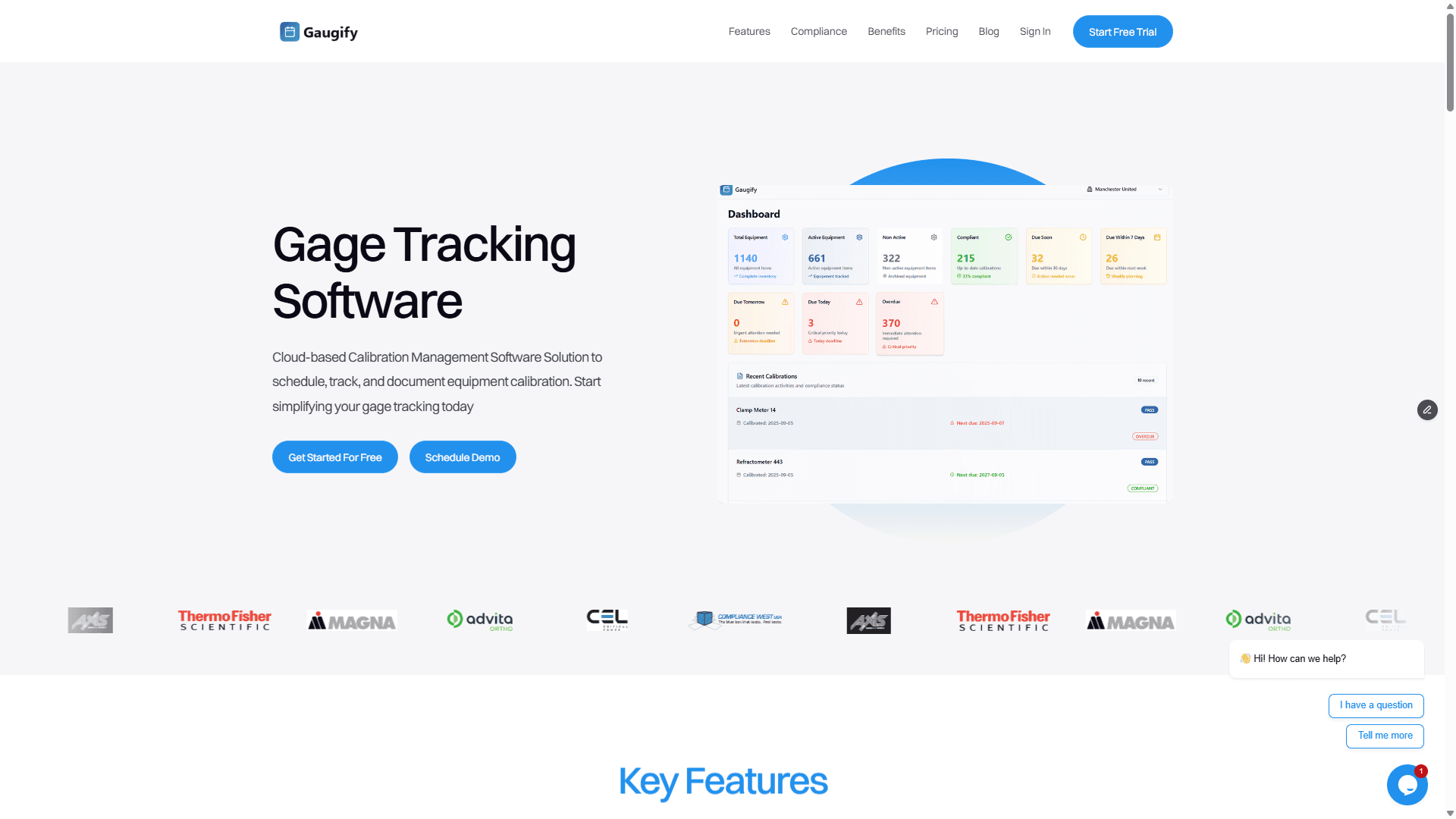
What sets Gaugify apart for audit readiness is its intuitive reporting engine that generates compliance reports with just a few clicks. Whether you need a comprehensive audit package covering all instruments or a focused report on your dimensional measurement equipment, the system adapts to your specific requirements. The advanced features include automated uncertainty calculations, customizable workflows, and integration capabilities that connect seamlessly with your existing quality management systems.
For multi-location operations, Gaugify's centralized database provides corporate visibility while maintaining site-specific control. This means your quality manager can monitor calibration compliance across facilities while local technicians maintain day-to-day operational control.
Traditional Enterprise Solutions
Established players like GAGEtrak and CyberMetrics offer comprehensive functionality with decades of industry experience. These systems excel in complex environments with extensive customization requirements and deep integration needs. However, they often require significant IT infrastructure and ongoing maintenance that can strain smaller organizations.
Many traditional solutions were designed before cloud computing became standard, resulting in architectures that can feel dated compared to modern alternatives. While they provide robust functionality, the learning curve and implementation complexity often exceed what growing organizations require.
Specialized Industry Solutions
Certain industries have spawned specialized calibration software designed around specific regulatory requirements. Pharmaceutical companies might gravitate toward systems with built-in 21 CFR Part 11 compliance, while aerospace manufacturers need solutions optimized for AS9100 and NADCAP requirements.
These specialized systems often excel in their target markets but can be overly rigid for organizations with diverse compliance requirements. They also tend to carry premium pricing that reflects their specialized nature.
Start your free trial today to experience how modern calibration management software can transform your audit readiness from a periodic challenge into an ongoing competitive advantage.
Calibration Software Pricing and Investment Considerations
Understanding calibration software pricing helps you budget appropriately and evaluate the return on investment. Most modern solutions follow subscription pricing models that scale with your organization's size and complexity.
Typical Pricing Structures
Entry-level calibration software typically starts around $100-200 per month for small operations managing 100-500 instruments. Mid-tier solutions supporting 1,000-5,000 instruments generally range from $500-1,500 monthly, while enterprise systems can exceed $5,000 monthly for complex multi-site operations.
However, focusing solely on subscription costs misses the broader financial picture. Consider the hidden costs of manual calibration management: administrative time, audit preparation overhead, potential compliance failures, and the risk of measurement-related quality issues. A precision manufacturing facility spending $40,000 annually on calibration software often saves multiples of that investment through improved efficiency and reduced compliance risk.
Gaugify's transparent pricing structure eliminates surprises while providing scalability for growing organizations. The platform includes all core features without the nickel-and-diming common in legacy solutions.
Return on Investment Calculation
Calculate your potential ROI by quantifying current calibration management inefficiencies. If your quality manager spends eight hours monthly preparing for audits, that's $5,000 annually in labor costs alone (assuming a $75/hour fully-loaded rate). Add the cost of maintaining paper records, potential compliance findings, and customer audit preparation, and most organizations see payback within 6-12 months.
More importantly, consider the strategic value of always being audit-ready. Organizations with robust calibration management systems can schedule audits on their terms, respond quickly to customer requests, and avoid the operational disruption of frantic preparation periods.
Implementation Strategy for Maximum Audit Readiness
Successful calibration software implementation requires more than just data migration—it demands a strategic approach that considers your audit requirements from day one. The most successful implementations begin with a clear understanding of what auditors will expect to see and work backward to ensure the system captures all necessary information.
Data Migration and System Setup
Start your implementation by auditing your current calibration records. Many organizations discover significant gaps during this process—missing certificates, unclear calibration histories, or instruments that haven't been properly tracked. Address these issues before migrating to your new system to avoid perpetuating existing problems.
During setup, configure your calibration intervals based on a combination of manufacturer recommendations, regulatory requirements, and risk analysis. Critical measurement equipment supporting key product characteristics might require more frequent calibration than general-purpose instruments. Document your rationale for these decisions, as auditors often probe the technical basis for calibration frequencies.
User Training and Adoption
The best calibration software becomes useless if your team doesn't embrace it. Invest in comprehensive training that goes beyond basic system operation to include the "why" behind proper calibration management. Help users understand how their daily activities contribute to overall audit readiness and compliance excellence.
Create role-based training programs that focus on relevant functionality. Shop floor technicians need to understand how to record calibration data and generate certificates, while quality managers require expertise in reporting and analytics capabilities. Gaugify's compliance features are designed with intuitive interfaces that minimize training requirements while maintaining comprehensive functionality.
Process Integration and Workflow Optimization
Effective calibration management extends beyond the software itself to encompass your entire measurement system lifecycle. Integrate calibration scheduling with production planning to minimize disruption, coordinate with purchasing to ensure calibration supplies are available, and establish clear escalation procedures for overdue items.
Consider how your calibration software will interact with other quality systems. Can it export data to your statistical process control software? Does it integrate with your corrective action tracking system? These connections become crucial during audits when assessors examine how measurement system problems trigger appropriate responses.
Evaluating Calibration Software During Your Free Trial
A well-structured evaluation process helps you identify the best calibration software for your specific audit requirements. Don't waste your trial period on basic functionality demos—instead, focus on scenarios that mirror your real-world audit challenges.
Critical Test Scenarios
Begin your evaluation by uploading a representative sample of your calibration data, including different instrument types with varying complexity levels. Test how the system handles basic dimensional gages like micrometers and dial indicators alongside sophisticated equipment such as coordinate measuring machines or environmental chambers.
Create a mock audit scenario where you need to quickly generate reports for all instruments used to measure a critical product characteristic. Can the system filter records based on specific criteria? Does it automatically include uncertainty calculations and traceability information? How quickly can you produce a comprehensive audit package?
Test the system's scheduling and notification capabilities by setting up calibrations with various intervals and lead times. Verify that overdue notifications escalate appropriately and that the system prevents use of expired instruments if your procedures require such controls.
Integration and Compatibility Testing
Evaluate how well the calibration software integrates with your existing systems. Can it import data from your current solution? Does it export reports in formats compatible with your quality management system? Test mobile accessibility if your technicians need field access to calibration records.
For organizations with multiple locations, verify that the system provides appropriate visibility and control across sites. Corporate quality managers should be able to monitor compliance while maintaining local operational flexibility.
Support and Documentation Assessment
During your trial, evaluate the vendor's support responsiveness and documentation quality. Submit several support requests to gauge response times and solution quality. Review available training materials and help documentation to ensure your team can effectively use the system.
Pay particular attention to compliance-related support. Does the vendor understand your industry's specific requirements? Can they provide guidance on best practices for audit preparation? The best calibration software vendors become trusted partners in your compliance journey, not just technology suppliers.
Making the Right Choice for Long-Term Success
Selecting calibration software is ultimately about choosing a partner for your quality journey. The right solution grows with your organization, adapts to changing requirements, and provides the confidence that comes from knowing you're always audit-ready.
Gaugify stands out in this evaluation because it combines enterprise-grade functionality with modern usability and transparent pricing. The platform's ISO 17025 compliance features ensure your calibration laboratory meets the highest international standards, while its intuitive design minimizes training requirements and maximizes user adoption.
More importantly, Gaugify's cloud-native architecture ensures your calibration data is always secure, accessible, and automatically backed up. This reliability becomes crucial during audits when system downtime or data loss could derail your entire compliance demonstration.
Beyond Basic Compliance
The best calibration software audit readiness solutions provide value beyond simple compliance checking. They enable data-driven decisions about instrument replacement, calibration frequency optimization, and measurement system improvement. When your torque wrench consistently drifts in the same direction, the system should flag this trend and suggest corrective action before it becomes an audit finding.
This analytical capability transforms calibration management from a reactive compliance activity into a proactive quality improvement tool. Organizations using advanced calibration software often discover opportunities to reduce calibration costs, improve measurement system capability, and enhance overall product quality.
Ready to experience the difference that modern calibration management can make for your audit readiness? Schedule a personalized demo to see how Gaugify can transform your calibration management from a compliance burden into a competitive advantage. Our team will configure a demonstration using your specific instruments and audit requirements, showing exactly how the platform addresses your unique challenges.
Don't wait for your next audit to discover gaps in your calibration management system. The organizations that excel in today's quality-focused marketplace are those that maintain audit readiness as a continuous state, not a periodic crisis. Make the smart choice for your calibration management future—your auditors, customers, and bottom line will thank you.
Best Calibration Software for Audit Readiness
When auditors arrive at your facility, the last thing you want is to scramble through filing cabinets searching for calibration certificates or explaining why your torque wrench is three months overdue for calibration. The best calibration software audit readiness solution ensures you're always prepared with complete documentation, automated compliance tracking, and instant access to every calibration record they need to see.
Quality managers know that audit preparation isn't just about passing inspections—it's about maintaining operational excellence year-round. Whether you're facing an ISO 9001 surveillance audit, FDA inspection, or customer quality review, your calibration management system becomes your first line of defense. The right software transforms what used to be weeks of preparation into a few clicks of comprehensive reporting.
Why Calibration Software Audit Readiness Matters More Than Ever
Modern quality standards have raised the bar significantly. Auditors expect to see not just current calibration certificates, but complete traceability chains, uncertainty calculations, and documented evidence that your measurement systems are under statistical control. Consider a typical aerospace manufacturer maintaining 2,500 gages across multiple locations—manually tracking calibration due dates, certificates, and audit trails for instruments ranging from basic pin gages to complex coordinate measuring machines (CMMs) is simply not scalable.
The consequences of poor calibration management extend beyond failed audits. A single out-of-tolerance micrometer could invalidate months of production data, while missing calibration records can trigger costly re-inspections of shipped products. Smart organizations invest in robust calibration management software that maintains audit readiness as a continuous state, not a periodic scramble.
Real-World Audit Scenarios
During a recent AS9100 audit at a precision machining shop, auditors requested calibration records for all dimensional gages used to verify a critical aircraft component with ±0.0005" tolerances. The facility's cloud-based calibration management system instantly generated a comprehensive report showing calibration status, uncertainty ratios, and traceability for every instrument—turning what could have been hours of document hunting into a five-minute demonstration of compliance excellence.
Essential Features for Calibration Software Audit Readiness
Not all calibration management systems are created equal when it comes to audit preparation. The most effective solutions combine automated compliance tracking with comprehensive documentation capabilities, ensuring you maintain detailed records without drowning in administrative overhead.
Automated Scheduling and Notification Systems
The foundation of audit readiness is ensuring no instrument ever falls through the cracks. Advanced calibration software should automatically generate calibration schedules based on manufacturer recommendations, regulatory requirements, and your facility's specific risk assessment. For example, critical measurement equipment supporting statistical process control might require monthly calibration, while less critical instruments operate on annual cycles.
Effective notification systems go beyond simple email reminders. They should escalate overdue items through management hierarchies, provide dashboard visibility of upcoming calibrations, and integrate with maintenance management systems to coordinate scheduling. The best systems also account for lead times—if your pressure calibrator requires three weeks at an accredited lab, notifications should trigger well in advance of the due date.
Comprehensive Certificate Management
Digital certificate storage with searchable metadata transforms audit preparation from a nightmare into a routine task. Modern systems should automatically capture calibration data, store certificates in industry-standard formats, and maintain version control for all documentation. When an auditor asks for the calibration history of your reference standard torque wrench, you should be able to pull up five years of records in seconds.
Advanced certificate management includes automatic parsing of calibration data to extract key information like measurement values, uncertainties, and pass/fail status. This enables trending analysis and helps identify instruments requiring more frequent calibration or potential replacement.
Measurement Uncertainty Analysis
Sophisticated calibration software automatically calculates measurement uncertainty ratios and flags instruments that don't meet your quality requirements. For precision applications requiring test uncertainty ratios (TUR) of 4:1 or better, the system should continuously monitor these ratios and alert you when equipment specifications drift outside acceptable ranges.
This capability becomes crucial during audits when assessors probe your understanding of measurement system capability. Being able to demonstrate that your 0.0001" indicator has sufficient accuracy to measure parts with ±0.001" tolerances—complete with documented uncertainty analysis—separates professional operations from those just "getting by."
Complete Audit Trail Documentation
Every interaction with your calibration system should be logged with user identification, timestamps, and change descriptions. This includes calibration data entry, certificate uploads, due date modifications, and even simple record views. During audits, this trail demonstrates the integrity of your measurement data and provides evidence that your system hasn't been manipulated.
The audit trail should be immutable—once created, records cannot be deleted or modified without creating additional trail entries. This level of data integrity is essential for regulated industries where measurement traceability directly impacts product safety and compliance.
Top Calibration Management Software Solutions
The calibration software market offers several robust options, each with distinct strengths for different organizational needs. Understanding these differences helps you select a solution that aligns with your audit requirements and operational constraints.
Gaugify: Modern Cloud-Based Excellence
Gaugify represents the next generation of calibration management, designed specifically for organizations that demand both simplicity and sophistication. Its cloud-native architecture ensures your calibration data is always accessible, automatically backed up, and protected by enterprise-grade security measures.
What sets Gaugify apart for audit readiness is its intuitive reporting engine that generates compliance reports with just a few clicks. Whether you need a comprehensive audit package covering all instruments or a focused report on your dimensional measurement equipment, the system adapts to your specific requirements. The advanced features include automated uncertainty calculations, customizable workflows, and integration capabilities that connect seamlessly with your existing quality management systems.
For multi-location operations, Gaugify's centralized database provides corporate visibility while maintaining site-specific control. This means your quality manager can monitor calibration compliance across facilities while local technicians maintain day-to-day operational control.
Traditional Enterprise Solutions
Established players like GAGEtrak and CyberMetrics offer comprehensive functionality with decades of industry experience. These systems excel in complex environments with extensive customization requirements and deep integration needs. However, they often require significant IT infrastructure and ongoing maintenance that can strain smaller organizations.
Many traditional solutions were designed before cloud computing became standard, resulting in architectures that can feel dated compared to modern alternatives. While they provide robust functionality, the learning curve and implementation complexity often exceed what growing organizations require.
Specialized Industry Solutions
Certain industries have spawned specialized calibration software designed around specific regulatory requirements. Pharmaceutical companies might gravitate toward systems with built-in 21 CFR Part 11 compliance, while aerospace manufacturers need solutions optimized for AS9100 and NADCAP requirements.
These specialized systems often excel in their target markets but can be overly rigid for organizations with diverse compliance requirements. They also tend to carry premium pricing that reflects their specialized nature.
Start your free trial today to experience how modern calibration management software can transform your audit readiness from a periodic challenge into an ongoing competitive advantage.
Calibration Software Pricing and Investment Considerations
Understanding calibration software pricing helps you budget appropriately and evaluate the return on investment. Most modern solutions follow subscription pricing models that scale with your organization's size and complexity.
Typical Pricing Structures
Entry-level calibration software typically starts around $100-200 per month for small operations managing 100-500 instruments. Mid-tier solutions supporting 1,000-5,000 instruments generally range from $500-1,500 monthly, while enterprise systems can exceed $5,000 monthly for complex multi-site operations.
However, focusing solely on subscription costs misses the broader financial picture. Consider the hidden costs of manual calibration management: administrative time, audit preparation overhead, potential compliance failures, and the risk of measurement-related quality issues. A precision manufacturing facility spending $40,000 annually on calibration software often saves multiples of that investment through improved efficiency and reduced compliance risk.
Gaugify's transparent pricing structure eliminates surprises while providing scalability for growing organizations. The platform includes all core features without the nickel-and-diming common in legacy solutions.
Return on Investment Calculation
Calculate your potential ROI by quantifying current calibration management inefficiencies. If your quality manager spends eight hours monthly preparing for audits, that's $5,000 annually in labor costs alone (assuming a $75/hour fully-loaded rate). Add the cost of maintaining paper records, potential compliance findings, and customer audit preparation, and most organizations see payback within 6-12 months.
More importantly, consider the strategic value of always being audit-ready. Organizations with robust calibration management systems can schedule audits on their terms, respond quickly to customer requests, and avoid the operational disruption of frantic preparation periods.
Implementation Strategy for Maximum Audit Readiness
Successful calibration software implementation requires more than just data migration—it demands a strategic approach that considers your audit requirements from day one. The most successful implementations begin with a clear understanding of what auditors will expect to see and work backward to ensure the system captures all necessary information.
Data Migration and System Setup
Start your implementation by auditing your current calibration records. Many organizations discover significant gaps during this process—missing certificates, unclear calibration histories, or instruments that haven't been properly tracked. Address these issues before migrating to your new system to avoid perpetuating existing problems.
During setup, configure your calibration intervals based on a combination of manufacturer recommendations, regulatory requirements, and risk analysis. Critical measurement equipment supporting key product characteristics might require more frequent calibration than general-purpose instruments. Document your rationale for these decisions, as auditors often probe the technical basis for calibration frequencies.
User Training and Adoption
The best calibration software becomes useless if your team doesn't embrace it. Invest in comprehensive training that goes beyond basic system operation to include the "why" behind proper calibration management. Help users understand how their daily activities contribute to overall audit readiness and compliance excellence.
Create role-based training programs that focus on relevant functionality. Shop floor technicians need to understand how to record calibration data and generate certificates, while quality managers require expertise in reporting and analytics capabilities. Gaugify's compliance features are designed with intuitive interfaces that minimize training requirements while maintaining comprehensive functionality.
Process Integration and Workflow Optimization
Effective calibration management extends beyond the software itself to encompass your entire measurement system lifecycle. Integrate calibration scheduling with production planning to minimize disruption, coordinate with purchasing to ensure calibration supplies are available, and establish clear escalation procedures for overdue items.
Consider how your calibration software will interact with other quality systems. Can it export data to your statistical process control software? Does it integrate with your corrective action tracking system? These connections become crucial during audits when assessors examine how measurement system problems trigger appropriate responses.
Evaluating Calibration Software During Your Free Trial
A well-structured evaluation process helps you identify the best calibration software for your specific audit requirements. Don't waste your trial period on basic functionality demos—instead, focus on scenarios that mirror your real-world audit challenges.
Critical Test Scenarios
Begin your evaluation by uploading a representative sample of your calibration data, including different instrument types with varying complexity levels. Test how the system handles basic dimensional gages like micrometers and dial indicators alongside sophisticated equipment such as coordinate measuring machines or environmental chambers.
Create a mock audit scenario where you need to quickly generate reports for all instruments used to measure a critical product characteristic. Can the system filter records based on specific criteria? Does it automatically include uncertainty calculations and traceability information? How quickly can you produce a comprehensive audit package?
Test the system's scheduling and notification capabilities by setting up calibrations with various intervals and lead times. Verify that overdue notifications escalate appropriately and that the system prevents use of expired instruments if your procedures require such controls.
Integration and Compatibility Testing
Evaluate how well the calibration software integrates with your existing systems. Can it import data from your current solution? Does it export reports in formats compatible with your quality management system? Test mobile accessibility if your technicians need field access to calibration records.
For organizations with multiple locations, verify that the system provides appropriate visibility and control across sites. Corporate quality managers should be able to monitor compliance while maintaining local operational flexibility.
Support and Documentation Assessment
During your trial, evaluate the vendor's support responsiveness and documentation quality. Submit several support requests to gauge response times and solution quality. Review available training materials and help documentation to ensure your team can effectively use the system.
Pay particular attention to compliance-related support. Does the vendor understand your industry's specific requirements? Can they provide guidance on best practices for audit preparation? The best calibration software vendors become trusted partners in your compliance journey, not just technology suppliers.
Making the Right Choice for Long-Term Success
Selecting calibration software is ultimately about choosing a partner for your quality journey. The right solution grows with your organization, adapts to changing requirements, and provides the confidence that comes from knowing you're always audit-ready.
Gaugify stands out in this evaluation because it combines enterprise-grade functionality with modern usability and transparent pricing. The platform's ISO 17025 compliance features ensure your calibration laboratory meets the highest international standards, while its intuitive design minimizes training requirements and maximizes user adoption.
More importantly, Gaugify's cloud-native architecture ensures your calibration data is always secure, accessible, and automatically backed up. This reliability becomes crucial during audits when system downtime or data loss could derail your entire compliance demonstration.
Beyond Basic Compliance
The best calibration software audit readiness solutions provide value beyond simple compliance checking. They enable data-driven decisions about instrument replacement, calibration frequency optimization, and measurement system improvement. When your torque wrench consistently drifts in the same direction, the system should flag this trend and suggest corrective action before it becomes an audit finding.
This analytical capability transforms calibration management from a reactive compliance activity into a proactive quality improvement tool. Organizations using advanced calibration software often discover opportunities to reduce calibration costs, improve measurement system capability, and enhance overall product quality.
Ready to experience the difference that modern calibration management can make for your audit readiness? Schedule a personalized demo to see how Gaugify can transform your calibration management from a compliance burden into a competitive advantage. Our team will configure a demonstration using your specific instruments and audit requirements, showing exactly how the platform addresses your unique challenges.
Don't wait for your next audit to discover gaps in your calibration management system. The organizations that excel in today's quality-focused marketplace are those that maintain audit readiness as a continuous state, not a periodic crisis. Make the smart choice for your calibration management future—your auditors, customers, and bottom line will thank you.