
How to Calibrate a Coordinate Measuring Arm
How to Calibrate a Coordinate Measuring Arm
David Bentley
Quality Assurance Engineer
12 min read
How to Calibrate a Coordinate Measuring Arm
Coordinate measuring arms (CMAs) are versatile portable measurement devices that have revolutionized quality control in manufacturing environments. These articulated arm coordinate measuring machines deliver precision measurements directly on the shop floor, but their accuracy depends entirely on proper coordinate measuring arm calibration procedures. Without regular calibration, your FARO Arm, Hexagon ROMER, or Creaform MCA II could be providing measurements with errors exceeding ±0.050mm, potentially leading to costly quality failures and rejected parts.
As a quality manager or technician responsible for measurement equipment, understanding the complete calibration process for your coordinate measuring arm isn't just recommended—it's essential for maintaining ISO 9001 compliance and ensuring measurement reliability. This comprehensive guide covers everything from pre-calibration setup to final documentation, helping you maintain your CMA's specified accuracy throughout its service life.
Understanding Coordinate Measuring Arms and Their Measurement Capabilities
A coordinate measuring arm is a portable coordinate measuring machine consisting of multiple articulated joints connected by rigid carbon fiber or steel segments. The arm typically features six or seven rotary encoders at each joint, allowing it to determine the precise 3D coordinates of any point within its spherical measurement volume.
These instruments excel at measuring complex geometries that would be challenging for traditional CMMs. Common applications include:
Dimensional inspection of automotive components like engine blocks and transmission housings
Reverse engineering of legacy parts requiring replacement tooling
Assembly verification of large aerospace structures
Tool and fixture validation with tolerances as tight as ±0.025mm
In-process measurement during machining operations
Most coordinate measuring arms offer measurement accuracies ranging from ±0.025mm to ±0.080mm depending on the model, with measurement volumes spanning 1.2 to 4.5 meters in diameter. The FARO Edge, for example, delivers ±0.027mm accuracy across a 2.4-meter diameter sphere, while larger models like the ROMER Absolute Arm AS1 extend to 4.2 meters with ±0.059mm accuracy.
Key Components Affecting Measurement Accuracy
Several critical components within a coordinate measuring arm directly impact measurement accuracy and must be verified during calibration:
Joint encoders - High-resolution rotary encoders at each articulation point
Arm segments - Rigid links connecting joints with precisely known lengths
Base mounting interface - Magnetic or mechanical base ensuring stable reference
Probe stylus system - Touch trigger or scanning probe with calibrated tip geometry
Environmental compensation - Temperature sensors for thermal expansion correction
Why Coordinate Measuring Arm Calibration is Critical
Coordinate measuring arms operate in challenging shop floor environments where temperature fluctuations, vibration, and handling stress can affect measurement accuracy over time. Unlike laboratory-based CMMs in controlled environments, CMAs must maintain precision despite exposure to coolant mist, temperature variations of ±5°C, and frequent transport between measurement locations.
Several factors make regular coordinate measuring arm calibration essential:
Encoder Drift and Wear
The rotary encoders at each joint gradually drift due to mechanical wear and environmental exposure. A joint encoder experiencing 0.001° of drift might seem negligible, but when multiplied across a 2-meter arm length, this translates to a 0.035mm error at the probe tip—potentially exceeding your measurement uncertainty budget for critical dimensions.
Thermal Effects
Carbon fiber arm segments exhibit thermal expansion coefficients around 1-2 µm/m/°C. For a coordinate measuring arm with 1.8-meter reach, a 10°C temperature change could introduce length errors up to 0.036mm without proper compensation. Calibration verifies that thermal compensation algorithms remain accurate across the operating temperature range.
Mechanical Stress and Damage
Portable measurement arms experience mechanical stress during transport and setup. Joint assemblies can develop backlash, arm segments may suffer impact damage, and base connections can loosen. These issues directly affect measurement accuracy and require detection through systematic calibration procedures.
Regulatory Compliance Requirements
Industries like aerospace, automotive, and medical devices mandate documented calibration for all measurement equipment. AS9100 requires calibration intervals based on stability data, while ISO/TS 16949 demands calibration certificates traceable to national standards. Compliance management systems help maintain these requirements systematically.
Step-by-Step Coordinate Measuring Arm Calibration Procedure
Proper calibration of a coordinate measuring arm requires certified reference standards, controlled environmental conditions, and systematic measurement procedures. The following procedure applies to most commercial CMAs, though specific requirements may vary by manufacturer.
Pre-Calibration Setup and Environmental Requirements
Before beginning coordinate measuring arm calibration, establish proper environmental conditions:
Temperature stability: ±2°C throughout calibration period (minimum 4 hours)
Vibration isolation: Stable surface with minimal foot traffic nearby
Air circulation: Avoid direct airflow from HVAC systems
Lighting: Consistent illumination to prevent thermal gradients
Warm-up period: Allow 30-60 minutes for electronic stabilization
Position your certified ball bar or step gauge reference standard on a stable granite surface plate within the CMA's measurement volume. The reference standard should possess calibration certificates traceable to NIST with uncertainties at least 3:1 better than the CMA's specified accuracy.
Joint Zero and Home Position Verification
Most coordinate measuring arms utilize absolute encoders that maintain position reference when powered down. However, joint zero positions require periodic verification:
Power on the CMA and complete self-diagnostics
Move each joint through its full range of motion
Return to the manufacturer-specified home position
Verify joint angle readings match documented home values (typically within ±0.001°)
Record any deviations exceeding acceptable limits
Length Standard Measurement
The primary calibration measurement involves comparing the CMA's length measurements against certified reference standards:
Step 1: Ball Bar Measurements
Using a certified ball bar with nominal length 300mm and expanded uncertainty ±0.003mm:
Position ball bar at five locations throughout measurement volume
Measure each ball center using at least 10 probe points
Calculate center-to-center distance using best-fit sphere algorithms
Compare measured length against certified value
Acceptable deviation typically ±0.010mm for high-accuracy arms
Step 2: Step Gauge Verification
Using a certified step gauge with multiple lengths (50mm, 100mm, 200mm, 400mm):
Measure each step length in three orientations (X, Y, Z axes)
Probe each gauge block surface with minimum five points
Calculate length using least-squares plane fitting
Document measurement repeatability (typically ≤0.008mm)
Verify all measurements within specified uncertainty limits
Volumetric Accuracy Assessment
Coordinate measuring arm calibration must verify accuracy throughout the entire measurement volume:
Near field measurements: Within 500mm of base (highest accuracy zone)
Mid-range measurements: 50-80% of maximum reach
Far field measurements: Maximum reach positions (typically lowest accuracy)
Angular positions: Various arm configurations to test joint combinations
Record all as-found measurements before any adjustments. If errors exceed specification limits, document findings and proceed with calibration adjustments according to manufacturer procedures.
Probe System Calibration
The probe stylus system requires separate calibration to establish accurate tip geometry:
Mount certified calibration sphere (typically 25mm diameter, Grade 5)
Probe sphere surface at minimum 25 points distributed uniformly
Software calculates effective probe tip radius and offset vectors
Verify probe qualification repeatability ≤0.005mm (2σ)
Document probe parameters in CMA software configuration
Relevant Standards Governing Coordinate Measuring Arm Calibration
Several international standards provide specific requirements for coordinate measuring arm calibration procedures and acceptance criteria.
ASME B89.4.22 Standard
ASME B89.4.22 "Methods for Performance Evaluation of Articulated Arm Coordinate Measuring Machines (CMM)" establishes comprehensive test procedures for CMA calibration. Key requirements include:
Single point articulation test: Measures repeatability at fixed point
Length measurement test: Verifies accuracy using certified ball bars
Volumetric performance test: Assesses accuracy throughout measurement volume
Environmental conditions: Temperature stability and vibration limits
The standard specifies that length measurement errors should not exceed the manufacturer's stated accuracy specification, typically verified at the 95% confidence level.
ISO 10360 Series
While primarily focused on traditional CMMs, ISO 10360 Parts 1-12 provide foundational measurement principles applicable to coordinate measuring arms. Most relevant sections include:
ISO 10360-2: Length measurement accuracy verification
ISO 10360-5: Probe system performance evaluation
ISO 10360-8: CMM equipped with optical distance sensors
Manufacturer Specifications
Leading CMA manufacturers provide detailed calibration procedures specific to their instruments:
FARO Arm calibration: Requires FARO-certified reference artifacts and CAM2 software
Hexagon ROMER procedures: Utilizes PC-DMIS software with specific calibration routines
Creaform protocols: Employs VXelements software with integrated calibration wizards
Always consult manufacturer documentation for instrument-specific requirements, as calibration procedures may vary significantly between models and software versions.
Recommended Calibration Intervals for Coordinate Measuring Arms
Determining appropriate calibration intervals for coordinate measuring arms requires balancing measurement risk against calibration costs. Unlike fixed CMMs in controlled environments, portable arms experience greater environmental stress and typically require more frequent calibration.
Industry Standard Intervals
Most quality systems establish coordinate measuring arm calibration intervals based on manufacturer recommendations and historical stability data:
Initial interval: 12 months for new instruments
Adjusted intervals: 6-18 months based on drift analysis
High-precision applications: 6-9 months for tolerances <±0.050mm
General inspection: 12-18 months for tolerances >±0.100mm
Factors Affecting Calibration Frequency
Several operational factors influence how often coordinate measuring arm calibration should be performed:
Usage Intensity
Arms used multiple shifts daily require more frequent calibration than occasional-use instruments. High-volume production measurement can accelerate encoder wear and joint backlash development.
Environmental Conditions
Shop floor environments with temperature swings >±5°C, high humidity, or contamination require shortened intervals. Clean room applications may extend intervals to 18-24 months.
Transportation Frequency
Frequently transported arms experience greater mechanical stress. Consider 6-month intervals for arms moved daily versus 12-18 months for stationary installations.
Measurement Criticality
Safety-critical aerospace components or medical device measurements may warrant 6-month intervals regardless of stability history.
Implementing Risk-Based Calibration Intervals
Modern calibration management approaches use statistical analysis of calibration history to optimize intervals:
Track as-found versus as-left data over multiple calibration cycles
Calculate drift rates for key performance parameters
Adjust intervals when drift patterns become predictable
Implement interim checks for high-risk measurements
Advanced calibration software can automate this analysis and recommend optimal intervals based on your specific usage patterns.
Common Coordinate Measuring Arm Calibration Mistakes and Prevention
Even experienced technicians encounter challenges during coordinate measuring arm calibration. Understanding common pitfalls helps ensure successful calibration outcomes and maintains measurement confidence.
Inadequate Thermal Stabilization
The Mistake: Beginning calibration before achieving thermal equilibrium, resulting in measurement drift during the procedure.
Prevention Strategy: Allow minimum 60 minutes warm-up time after moving the CMA to a new environment. Monitor temperature stability using calibrated thermometers placed near the instrument. Temperature variations >±1°C during calibration invalidate results.
Real Example: A quality lab measured their FARO Edge immediately after transport from a 15°C storage area to a 22°C measurement room. Length measurements drifted 0.035mm over the first 45 minutes, exceeding the arm's ±0.027mm accuracy specification.
Improper Reference Standard Handling
The Mistake: Using reference standards with expired calibration certificates or handling certified artifacts without proper temperature equilibration.
Prevention Strategy: Verify all reference standard certificates are current before beginning calibration. Allow ball bars and step gauges to reach thermal equilibrium (minimum 2 hours in measurement environment). Handle standards using insulated gloves to prevent thermal disturbance.
Insufficient Measurement Point Density
The Mistake: Probing reference features with too few points, leading to poor geometry fitting and inaccurate calibration results.
Prevention Strategy: Use minimum point densities specified in ASME B89.4.22: 25 points for sphere qualification, 10 points per ball for ball bar measurements, 5 points per surface for step gauge measurements. Distribute points uniformly across features.
Neglecting Joint Configuration Diversity
The Mistake: Performing all calibration measurements in similar arm configurations, missing accuracy problems in specific joint combinations.
Prevention Strategy: Vary arm configurations systematically during calibration. Test measurements with joints at different angles, including extended reach positions and configurations that stress individual encoders.
Documentation and Traceability Errors
The Mistake: Incomplete calibration records, missing uncertainty calculations, or broken traceability chains to national standards.
Prevention Strategy: Use standardized calibration report templates that capture all required data. Document measurement uncertainties using GUM methodology. Maintain complete traceability records for all reference standards used.
Managing Coordinate Measuring Arm Calibration with Modern Software
Traditional paper-based calibration management creates numerous challenges for coordinate measuring arm tracking. Manual scheduling leads to missed calibrations, paper certificates get lost, and trending analysis becomes nearly impossible with multiple instruments across different locations.
Modern calibration management software transforms how organizations handle CMA calibration by automating scheduling, centralizing documentation, and providing powerful analytics capabilities.
Automated Calibration Scheduling and Reminders
Gaugify's intelligent scheduling system eliminates missed calibrations by automatically tracking due dates for each coordinate measuring arm in your inventory. The system accounts for:
Individual calibration intervals based on usage patterns
Lead times for external calibration services
Production schedules to minimize measurement disruptions
Backup instrument availability for seamless operations
Customizable reminder notifications alert quality managers weeks in advance, ensuring adequate planning time for calibration activities. Email alerts can be sent to multiple stakeholders, including department supervisors and maintenance coordinators.
Comprehensive As-Found and As-Left Data Management
Tracking calibration results over time reveals important trends about coordinate measuring arm performance and helps optimize calibration intervals. Gaugify captures detailed calibration data including:
As-found measurements for each length standard and reference artifact
As-left results after calibration adjustments
Environmental conditions during calibration (temperature, humidity)
Measurement uncertainty calculations using proper statistical methods
Pass/fail status against acceptance criteria
Historical trending charts help identify gradual drift patterns that might indicate pending maintenance needs or opportunities to extend calibration intervals for stable instruments.
Digital Certificate Management and Compliance
Centralized certificate storage ensures calibration documents remain accessible and organized throughout the instrument's service life. Key features include:
Secure cloud storage with automatic backup and version control
Instant certificate retrieval during audits or customer inquiries
Integration with quality management systems (ISO 9001, AS9100, ISO 17025)
Automated compliance reporting for regulatory submissions
Digital certificates include embedded QR codes linking to complete calibration history, providing auditors immediate access to traceability documentation.
Multi-Location Inventory Management
Organizations with coordinate measuring arms across multiple facilities benefit from Gaugify's centralized inventory management. Track instrument locations, transfer dates, and calibration status regardless of geographic distribution. This capability proves especially valuable for:
Contract manufacturing operations with multiple sites
Aerospace companies with distributed production facilities
Automotive suppliers managing tier-level operations
Service organizations maintaining client-site equipment
Advanced Analytics and Reporting
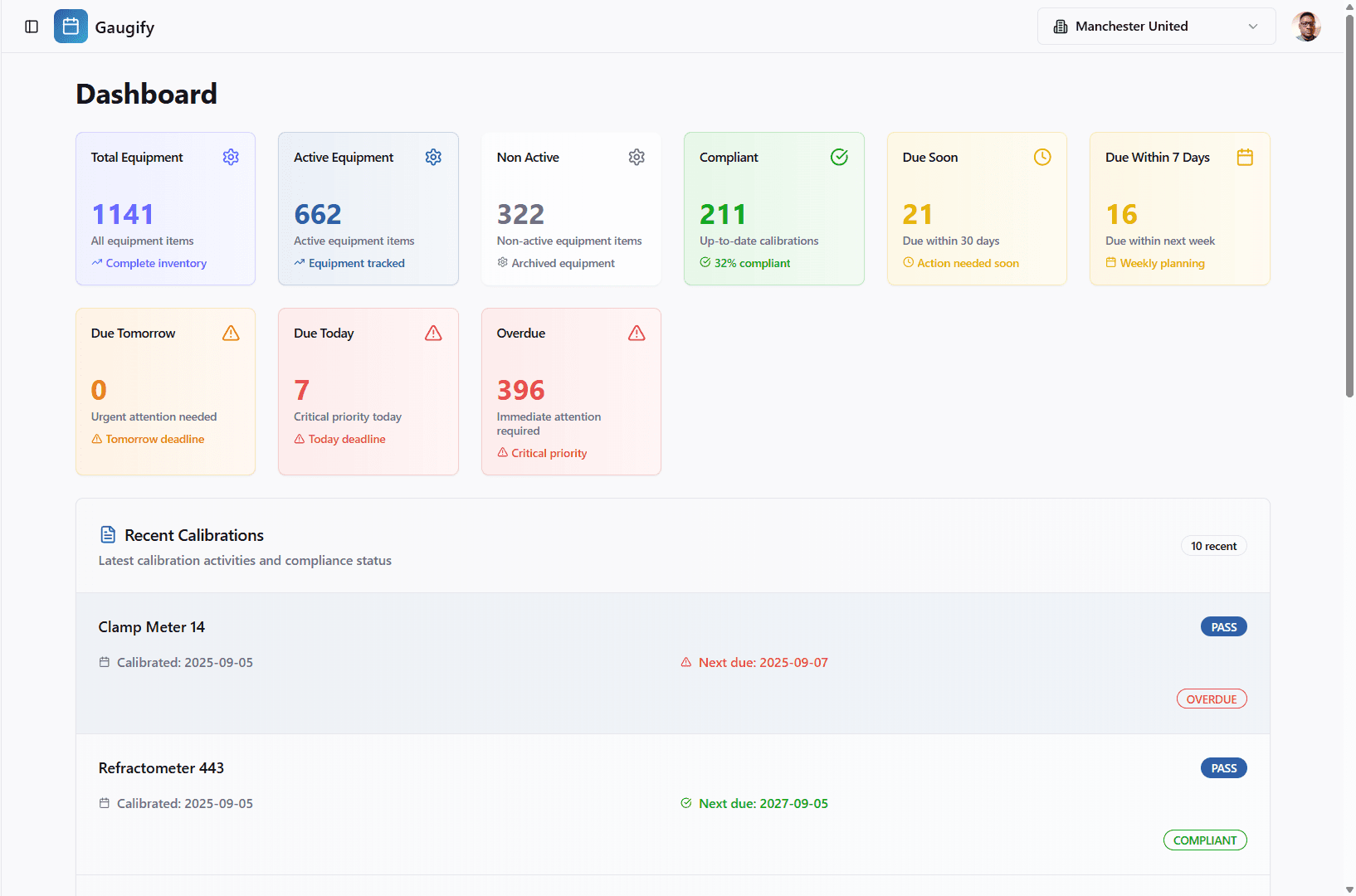
Gaugify's analytics dashboard provides quality managers with actionable insights about their coordinate measuring arm calibration programs:
Calibration compliance rates across departments and locations
Cost analysis comparing internal versus external calibration services
Instrument utilization tracking to optimize asset deployment
Maintenance correlation analysis linking calibration results to repair needs
Custom reports support management reviews, customer audits, and continuous improvement initiatives.
Start Optimizing Your Coordinate Measuring Arm Calibration Program
Effective coordinate measuring arm calibration requires systematic procedures, proper documentation, and proactive management to ensure measurement reliability. Whether you're managing a single CMA or a fleet of portable measurement devices across multiple locations, implementing robust calibration practices protects product quality and maintains regulatory compliance.
The complexity of modern quality systems demands more than spreadsheets and paper files. Advanced calibration management capabilities help organizations reduce administrative burden while improving calibration program effectiveness through automated scheduling, comprehensive data management, and powerful analytics.
Ready to modernize your coordinate measuring arm calibration management? Start your free trial of Gaugify today and experience how cloud-based calibration management transforms your quality operations. Join hundreds of quality professionals who have streamlined their calibration programs with intelligent automation and comprehensive compliance tools.
Take the first step toward better calibration management—your measurement accuracy and peace of mind depend on it.
How to Calibrate a Coordinate Measuring Arm
Coordinate measuring arms (CMAs) are versatile portable measurement devices that have revolutionized quality control in manufacturing environments. These articulated arm coordinate measuring machines deliver precision measurements directly on the shop floor, but their accuracy depends entirely on proper coordinate measuring arm calibration procedures. Without regular calibration, your FARO Arm, Hexagon ROMER, or Creaform MCA II could be providing measurements with errors exceeding ±0.050mm, potentially leading to costly quality failures and rejected parts.
As a quality manager or technician responsible for measurement equipment, understanding the complete calibration process for your coordinate measuring arm isn't just recommended—it's essential for maintaining ISO 9001 compliance and ensuring measurement reliability. This comprehensive guide covers everything from pre-calibration setup to final documentation, helping you maintain your CMA's specified accuracy throughout its service life.
Understanding Coordinate Measuring Arms and Their Measurement Capabilities
A coordinate measuring arm is a portable coordinate measuring machine consisting of multiple articulated joints connected by rigid carbon fiber or steel segments. The arm typically features six or seven rotary encoders at each joint, allowing it to determine the precise 3D coordinates of any point within its spherical measurement volume.
These instruments excel at measuring complex geometries that would be challenging for traditional CMMs. Common applications include:
Dimensional inspection of automotive components like engine blocks and transmission housings
Reverse engineering of legacy parts requiring replacement tooling
Assembly verification of large aerospace structures
Tool and fixture validation with tolerances as tight as ±0.025mm
In-process measurement during machining operations
Most coordinate measuring arms offer measurement accuracies ranging from ±0.025mm to ±0.080mm depending on the model, with measurement volumes spanning 1.2 to 4.5 meters in diameter. The FARO Edge, for example, delivers ±0.027mm accuracy across a 2.4-meter diameter sphere, while larger models like the ROMER Absolute Arm AS1 extend to 4.2 meters with ±0.059mm accuracy.
Key Components Affecting Measurement Accuracy
Several critical components within a coordinate measuring arm directly impact measurement accuracy and must be verified during calibration:
Joint encoders - High-resolution rotary encoders at each articulation point
Arm segments - Rigid links connecting joints with precisely known lengths
Base mounting interface - Magnetic or mechanical base ensuring stable reference
Probe stylus system - Touch trigger or scanning probe with calibrated tip geometry
Environmental compensation - Temperature sensors for thermal expansion correction
Why Coordinate Measuring Arm Calibration is Critical
Coordinate measuring arms operate in challenging shop floor environments where temperature fluctuations, vibration, and handling stress can affect measurement accuracy over time. Unlike laboratory-based CMMs in controlled environments, CMAs must maintain precision despite exposure to coolant mist, temperature variations of ±5°C, and frequent transport between measurement locations.
Several factors make regular coordinate measuring arm calibration essential:
Encoder Drift and Wear
The rotary encoders at each joint gradually drift due to mechanical wear and environmental exposure. A joint encoder experiencing 0.001° of drift might seem negligible, but when multiplied across a 2-meter arm length, this translates to a 0.035mm error at the probe tip—potentially exceeding your measurement uncertainty budget for critical dimensions.
Thermal Effects
Carbon fiber arm segments exhibit thermal expansion coefficients around 1-2 µm/m/°C. For a coordinate measuring arm with 1.8-meter reach, a 10°C temperature change could introduce length errors up to 0.036mm without proper compensation. Calibration verifies that thermal compensation algorithms remain accurate across the operating temperature range.
Mechanical Stress and Damage
Portable measurement arms experience mechanical stress during transport and setup. Joint assemblies can develop backlash, arm segments may suffer impact damage, and base connections can loosen. These issues directly affect measurement accuracy and require detection through systematic calibration procedures.
Regulatory Compliance Requirements
Industries like aerospace, automotive, and medical devices mandate documented calibration for all measurement equipment. AS9100 requires calibration intervals based on stability data, while ISO/TS 16949 demands calibration certificates traceable to national standards. Compliance management systems help maintain these requirements systematically.
Step-by-Step Coordinate Measuring Arm Calibration Procedure
Proper calibration of a coordinate measuring arm requires certified reference standards, controlled environmental conditions, and systematic measurement procedures. The following procedure applies to most commercial CMAs, though specific requirements may vary by manufacturer.
Pre-Calibration Setup and Environmental Requirements
Before beginning coordinate measuring arm calibration, establish proper environmental conditions:
Temperature stability: ±2°C throughout calibration period (minimum 4 hours)
Vibration isolation: Stable surface with minimal foot traffic nearby
Air circulation: Avoid direct airflow from HVAC systems
Lighting: Consistent illumination to prevent thermal gradients
Warm-up period: Allow 30-60 minutes for electronic stabilization
Position your certified ball bar or step gauge reference standard on a stable granite surface plate within the CMA's measurement volume. The reference standard should possess calibration certificates traceable to NIST with uncertainties at least 3:1 better than the CMA's specified accuracy.
Joint Zero and Home Position Verification
Most coordinate measuring arms utilize absolute encoders that maintain position reference when powered down. However, joint zero positions require periodic verification:
Power on the CMA and complete self-diagnostics
Move each joint through its full range of motion
Return to the manufacturer-specified home position
Verify joint angle readings match documented home values (typically within ±0.001°)
Record any deviations exceeding acceptable limits
Length Standard Measurement
The primary calibration measurement involves comparing the CMA's length measurements against certified reference standards:
Step 1: Ball Bar Measurements
Using a certified ball bar with nominal length 300mm and expanded uncertainty ±0.003mm:
Position ball bar at five locations throughout measurement volume
Measure each ball center using at least 10 probe points
Calculate center-to-center distance using best-fit sphere algorithms
Compare measured length against certified value
Acceptable deviation typically ±0.010mm for high-accuracy arms
Step 2: Step Gauge Verification
Using a certified step gauge with multiple lengths (50mm, 100mm, 200mm, 400mm):
Measure each step length in three orientations (X, Y, Z axes)
Probe each gauge block surface with minimum five points
Calculate length using least-squares plane fitting
Document measurement repeatability (typically ≤0.008mm)
Verify all measurements within specified uncertainty limits
Volumetric Accuracy Assessment
Coordinate measuring arm calibration must verify accuracy throughout the entire measurement volume:
Near field measurements: Within 500mm of base (highest accuracy zone)
Mid-range measurements: 50-80% of maximum reach
Far field measurements: Maximum reach positions (typically lowest accuracy)
Angular positions: Various arm configurations to test joint combinations
Record all as-found measurements before any adjustments. If errors exceed specification limits, document findings and proceed with calibration adjustments according to manufacturer procedures.
Probe System Calibration
The probe stylus system requires separate calibration to establish accurate tip geometry:
Mount certified calibration sphere (typically 25mm diameter, Grade 5)
Probe sphere surface at minimum 25 points distributed uniformly
Software calculates effective probe tip radius and offset vectors
Verify probe qualification repeatability ≤0.005mm (2σ)
Document probe parameters in CMA software configuration
Relevant Standards Governing Coordinate Measuring Arm Calibration
Several international standards provide specific requirements for coordinate measuring arm calibration procedures and acceptance criteria.
ASME B89.4.22 Standard
ASME B89.4.22 "Methods for Performance Evaluation of Articulated Arm Coordinate Measuring Machines (CMM)" establishes comprehensive test procedures for CMA calibration. Key requirements include:
Single point articulation test: Measures repeatability at fixed point
Length measurement test: Verifies accuracy using certified ball bars
Volumetric performance test: Assesses accuracy throughout measurement volume
Environmental conditions: Temperature stability and vibration limits
The standard specifies that length measurement errors should not exceed the manufacturer's stated accuracy specification, typically verified at the 95% confidence level.
ISO 10360 Series
While primarily focused on traditional CMMs, ISO 10360 Parts 1-12 provide foundational measurement principles applicable to coordinate measuring arms. Most relevant sections include:
ISO 10360-2: Length measurement accuracy verification
ISO 10360-5: Probe system performance evaluation
ISO 10360-8: CMM equipped with optical distance sensors
Manufacturer Specifications
Leading CMA manufacturers provide detailed calibration procedures specific to their instruments:
FARO Arm calibration: Requires FARO-certified reference artifacts and CAM2 software
Hexagon ROMER procedures: Utilizes PC-DMIS software with specific calibration routines
Creaform protocols: Employs VXelements software with integrated calibration wizards
Always consult manufacturer documentation for instrument-specific requirements, as calibration procedures may vary significantly between models and software versions.
Recommended Calibration Intervals for Coordinate Measuring Arms
Determining appropriate calibration intervals for coordinate measuring arms requires balancing measurement risk against calibration costs. Unlike fixed CMMs in controlled environments, portable arms experience greater environmental stress and typically require more frequent calibration.
Industry Standard Intervals
Most quality systems establish coordinate measuring arm calibration intervals based on manufacturer recommendations and historical stability data:
Initial interval: 12 months for new instruments
Adjusted intervals: 6-18 months based on drift analysis
High-precision applications: 6-9 months for tolerances <±0.050mm
General inspection: 12-18 months for tolerances >±0.100mm
Factors Affecting Calibration Frequency
Several operational factors influence how often coordinate measuring arm calibration should be performed:
Usage Intensity
Arms used multiple shifts daily require more frequent calibration than occasional-use instruments. High-volume production measurement can accelerate encoder wear and joint backlash development.
Environmental Conditions
Shop floor environments with temperature swings >±5°C, high humidity, or contamination require shortened intervals. Clean room applications may extend intervals to 18-24 months.
Transportation Frequency
Frequently transported arms experience greater mechanical stress. Consider 6-month intervals for arms moved daily versus 12-18 months for stationary installations.
Measurement Criticality
Safety-critical aerospace components or medical device measurements may warrant 6-month intervals regardless of stability history.
Implementing Risk-Based Calibration Intervals
Modern calibration management approaches use statistical analysis of calibration history to optimize intervals:
Track as-found versus as-left data over multiple calibration cycles
Calculate drift rates for key performance parameters
Adjust intervals when drift patterns become predictable
Implement interim checks for high-risk measurements
Advanced calibration software can automate this analysis and recommend optimal intervals based on your specific usage patterns.
Common Coordinate Measuring Arm Calibration Mistakes and Prevention
Even experienced technicians encounter challenges during coordinate measuring arm calibration. Understanding common pitfalls helps ensure successful calibration outcomes and maintains measurement confidence.
Inadequate Thermal Stabilization
The Mistake: Beginning calibration before achieving thermal equilibrium, resulting in measurement drift during the procedure.
Prevention Strategy: Allow minimum 60 minutes warm-up time after moving the CMA to a new environment. Monitor temperature stability using calibrated thermometers placed near the instrument. Temperature variations >±1°C during calibration invalidate results.
Real Example: A quality lab measured their FARO Edge immediately after transport from a 15°C storage area to a 22°C measurement room. Length measurements drifted 0.035mm over the first 45 minutes, exceeding the arm's ±0.027mm accuracy specification.
Improper Reference Standard Handling
The Mistake: Using reference standards with expired calibration certificates or handling certified artifacts without proper temperature equilibration.
Prevention Strategy: Verify all reference standard certificates are current before beginning calibration. Allow ball bars and step gauges to reach thermal equilibrium (minimum 2 hours in measurement environment). Handle standards using insulated gloves to prevent thermal disturbance.
Insufficient Measurement Point Density
The Mistake: Probing reference features with too few points, leading to poor geometry fitting and inaccurate calibration results.
Prevention Strategy: Use minimum point densities specified in ASME B89.4.22: 25 points for sphere qualification, 10 points per ball for ball bar measurements, 5 points per surface for step gauge measurements. Distribute points uniformly across features.
Neglecting Joint Configuration Diversity
The Mistake: Performing all calibration measurements in similar arm configurations, missing accuracy problems in specific joint combinations.
Prevention Strategy: Vary arm configurations systematically during calibration. Test measurements with joints at different angles, including extended reach positions and configurations that stress individual encoders.
Documentation and Traceability Errors
The Mistake: Incomplete calibration records, missing uncertainty calculations, or broken traceability chains to national standards.
Prevention Strategy: Use standardized calibration report templates that capture all required data. Document measurement uncertainties using GUM methodology. Maintain complete traceability records for all reference standards used.
Managing Coordinate Measuring Arm Calibration with Modern Software
Traditional paper-based calibration management creates numerous challenges for coordinate measuring arm tracking. Manual scheduling leads to missed calibrations, paper certificates get lost, and trending analysis becomes nearly impossible with multiple instruments across different locations.
Modern calibration management software transforms how organizations handle CMA calibration by automating scheduling, centralizing documentation, and providing powerful analytics capabilities.
Automated Calibration Scheduling and Reminders
Gaugify's intelligent scheduling system eliminates missed calibrations by automatically tracking due dates for each coordinate measuring arm in your inventory. The system accounts for:
Individual calibration intervals based on usage patterns
Lead times for external calibration services
Production schedules to minimize measurement disruptions
Backup instrument availability for seamless operations
Customizable reminder notifications alert quality managers weeks in advance, ensuring adequate planning time for calibration activities. Email alerts can be sent to multiple stakeholders, including department supervisors and maintenance coordinators.
Comprehensive As-Found and As-Left Data Management
Tracking calibration results over time reveals important trends about coordinate measuring arm performance and helps optimize calibration intervals. Gaugify captures detailed calibration data including:
As-found measurements for each length standard and reference artifact
As-left results after calibration adjustments
Environmental conditions during calibration (temperature, humidity)
Measurement uncertainty calculations using proper statistical methods
Pass/fail status against acceptance criteria
Historical trending charts help identify gradual drift patterns that might indicate pending maintenance needs or opportunities to extend calibration intervals for stable instruments.
Digital Certificate Management and Compliance
Centralized certificate storage ensures calibration documents remain accessible and organized throughout the instrument's service life. Key features include:
Secure cloud storage with automatic backup and version control
Instant certificate retrieval during audits or customer inquiries
Integration with quality management systems (ISO 9001, AS9100, ISO 17025)
Automated compliance reporting for regulatory submissions
Digital certificates include embedded QR codes linking to complete calibration history, providing auditors immediate access to traceability documentation.
Multi-Location Inventory Management
Organizations with coordinate measuring arms across multiple facilities benefit from Gaugify's centralized inventory management. Track instrument locations, transfer dates, and calibration status regardless of geographic distribution. This capability proves especially valuable for:
Contract manufacturing operations with multiple sites
Aerospace companies with distributed production facilities
Automotive suppliers managing tier-level operations
Service organizations maintaining client-site equipment
Advanced Analytics and Reporting
Gaugify's analytics dashboard provides quality managers with actionable insights about their coordinate measuring arm calibration programs:
Calibration compliance rates across departments and locations
Cost analysis comparing internal versus external calibration services
Instrument utilization tracking to optimize asset deployment
Maintenance correlation analysis linking calibration results to repair needs
Custom reports support management reviews, customer audits, and continuous improvement initiatives.
Start Optimizing Your Coordinate Measuring Arm Calibration Program
Effective coordinate measuring arm calibration requires systematic procedures, proper documentation, and proactive management to ensure measurement reliability. Whether you're managing a single CMA or a fleet of portable measurement devices across multiple locations, implementing robust calibration practices protects product quality and maintains regulatory compliance.
The complexity of modern quality systems demands more than spreadsheets and paper files. Advanced calibration management capabilities help organizations reduce administrative burden while improving calibration program effectiveness through automated scheduling, comprehensive data management, and powerful analytics.
Ready to modernize your coordinate measuring arm calibration management? Start your free trial of Gaugify today and experience how cloud-based calibration management transforms your quality operations. Join hundreds of quality professionals who have streamlined their calibration programs with intelligent automation and comprehensive compliance tools.
Take the first step toward better calibration management—your measurement accuracy and peace of mind depend on it.