
How to Calibrate Laser Trackers
How to Calibrate Laser Trackers
David Bentley
Quality Assurance Engineer
12 min read
How to Calibrate Laser Trackers
Laser tracker calibration is a critical process for maintaining the accuracy and reliability of these sophisticated coordinate measuring instruments. With measurement uncertainties as low as ±15 micrometers + 0.6 µm/m, laser trackers demand rigorous calibration protocols to ensure they meet the stringent requirements of aerospace, automotive, and precision manufacturing applications. This comprehensive guide covers everything quality managers and metrologists need to know about calibrating laser trackers effectively.
Understanding Laser Trackers and Their Measurement Capabilities
Laser trackers are portable coordinate measuring machines that use laser interferometry and angular encoders to measure 3D coordinates of points in space. These instruments consist of a base unit containing the laser source, interferometer, and angular measurement system, paired with a spherically mounted retroreflector (SMR) that serves as the target.
Modern laser trackers like the Leica AT960, FARO Vantage, and API Radian series can measure distances up to 80 meters with remarkable precision. They measure three primary parameters:
Distance measurement: Using laser interferometry with typical uncertainties of ±0.5 µm + 0.3 µm/m
Horizontal angle: Measured by rotary encoders with uncertainties around ±15 µrad
Vertical angle: Similarly measured with comparable angular uncertainties
These measurements are converted to Cartesian coordinates (X, Y, Z) through mathematical transformation, making the tracker capable of measuring part dimensions, performing alignments, and guiding assembly operations with exceptional accuracy.
Why Laser Tracker Calibration Is Mission-Critical
The precision demands of industries using laser trackers make calibration absolutely essential. Consider an aerospace manufacturer inspecting a wing assembly with tolerances of ±0.1mm over a 20-meter span. Any drift in the tracker's measurement system could result in accepting out-of-tolerance parts, leading to costly rework or potential safety issues.
Several factors make regular laser tracker calibration crucial:
Environmental sensitivity: Temperature variations affect the laser wavelength and mechanical components
Mechanical wear: Moving parts like gimbal bearings and encoder systems degrade over time
Optical degradation: Laser power output and beam quality can drift
Electronic stability: Amplifier gain and offset parameters require periodic adjustment
Without proper calibration, measurement uncertainties can increase by 200-300% or more, rendering the instrument unsuitable for precision applications. Quality managers must establish robust calibration tracking systems to ensure laser trackers maintain their specified performance levels.
Comprehensive Laser Tracker Calibration Procedure
Performing effective laser tracker calibration requires specialized equipment, controlled environmental conditions, and meticulous attention to detail. Here's the step-by-step process used by accredited calibration laboratories:
Environmental Preparation
Temperature stability is paramount for accurate laser tracker calibration. The calibration environment must be maintained at 20°C ± 1°C with temperature gradients not exceeding 0.5°C per meter. Humidity should be controlled between 45-65% RH to prevent condensation and ensure stable air refractive index conditions.
Vibration isolation is equally important. The calibration setup should be isolated from external vibrations using pneumatic or passive isolation systems. Air currents that could affect the laser beam path must be minimized through proper HVAC design and temporary shields if necessary.
Reference Standards and Setup
The primary reference standard for laser tracker calibration is typically a calibrated length standard such as:
Step gauge: Precision steel bars with certified lengths, often 1m, 5m, and 10m nominal lengths
Ball bar: Carbon fiber or invar rods with precision spheres at known distances
Laser interferometer: Traceable to the definition of the meter through stabilized laser wavelength
For angular measurements, calibrated angle blocks or rotary tables with arc-second accuracy serve as reference standards. The measurement uncertainty of reference standards must be at least 3:1 better than the laser tracker's specified uncertainty.
Distance Measurement Calibration
The distance measurement calibration involves comparing the tracker's readings against certified reference lengths at multiple distances throughout the instrument's range:
Warm-up period: Allow the laser tracker to stabilize for minimum 30 minutes after power-on
Baseline measurement: Establish the zero position using the tracker's internal reference
Multi-distance verification: Measure certified artifacts at 2m, 5m, 10m, and maximum range distances
Environmental monitoring: Continuously record temperature, humidity, and atmospheric pressure
Repeatability assessment: Perform 10 repeated measurements at each test distance
Acceptance criteria typically require distance measurements to fall within ±(0.5 µm + 0.3 µm/m) of the certified reference values. Any deviations exceeding these limits indicate the need for internal adjustments or repair.
Angular Measurement Verification
Angular calibration involves positioning calibrated angle artifacts at known positions and comparing tracker readings:
Horizontal angle testing: Using a precision rotary table, verify measurements at 0°, 90°, 180°, and 270° positions
Vertical angle verification: Test elevation angles from -45° to +45° using calibrated angle blocks
Combined angle assessment: Verify angular accuracy throughout the complete spherical coordinate range
Angular measurements should typically agree with reference standards within ±15 microradians (approximately ±3 arc seconds) to meet manufacturer specifications.
Governing Standards for Laser Tracker Calibration
Several international standards provide guidance for laser tracker calibration procedures and requirements:
ASME B89.4.19-2021
This American standard specifically addresses the performance evaluation of laser-based spherical coordinate measurement systems. It defines test procedures for:
Range measurement accuracy and repeatability
Angular measurement uncertainty
Combined coordinate measurement uncertainty
Environmental compensation effectiveness
ISO 10360 Series
While primarily focused on coordinate measuring machines, ISO 10360-10 addresses laser trackers and similar large-scale measurement systems. This standard establishes acceptance and reverification tests for coordinate measuring accuracy.
VDI/VDE 2617-10
This German guideline provides detailed procedures for acceptance testing and periodic verification of laser trackers, including specific test artifacts and evaluation criteria.
Organizations maintaining ISO 17025 accreditation must ensure their laser tracker calibration procedures comply with these relevant standards and maintain full traceability to national measurement standards.
Optimal Calibration Intervals for Laser Tracker Calibration
Determining appropriate calibration intervals for laser trackers requires balancing measurement risk against calibration costs. Most manufacturers recommend annual calibration as a baseline, but several factors can influence this frequency:
Usage-Based Factors
Operating hours: Intensive use accelerates component wear and drift
Transportation frequency: Portable trackers subjected to frequent moves require more frequent calibration
Environmental extremes: Operation in harsh conditions may necessitate quarterly calibration
Application-Driven Requirements
Critical applications may demand more frequent calibration verification:
Aerospace manufacturing: Often requires 6-month calibration intervals
Automotive body-in-white: Monthly or even weekly checks for high-volume production
Research applications: May require pre-measurement verification for critical experiments
Risk-Based Calibration Scheduling
Modern calibration management approaches consider measurement risk and historical performance data. Trackers with stable calibration histories and non-critical applications might extend to 18-month intervals, while those showing drift patterns require more frequent attention.
A comprehensive calibration management system can analyze historical data to optimize calibration intervals based on actual instrument performance rather than arbitrary time periods.
Common Laser Tracker Calibration Mistakes and Prevention
Even experienced metrologists can encounter pitfalls during laser tracker calibration. Understanding these common mistakes helps ensure successful calibration outcomes:
Environmental Control Oversights
Mistake: Insufficient temperature stabilization time before beginning calibration measurements.
Prevention: Allow minimum 2-hour stabilization period after significant temperature changes. Monitor temperature continuously during calibration and reject measurements if temperature varies by more than 0.5°C during a measurement sequence.
Reference Standard Handling Errors
Mistake: Using reference standards beyond their calibration intervals or with insufficient measurement uncertainty ratios.
Prevention: Implement rigorous reference standard management procedures. Verify that all standards have current calibration certificates and maintain at least 4:1 uncertainty ratios where possible. Include reference standard uncertainties in measurement uncertainty budgets.
Atmospheric Compensation Deficiencies
Mistake: Relying on default atmospheric parameters rather than real-time environmental monitoring.
Prevention: Use calibrated temperature, humidity, and pressure sensors to provide real-time atmospheric compensation. Verify compensation accuracy by comparing distance measurements with and without environmental correction.
Inadequate Measurement Sampling
Mistake: Taking insufficient repeat measurements to properly assess repeatability and statistical uncertainty.
Prevention: Perform minimum 10 repeat measurements at each test point. Calculate standard deviations and use appropriate coverage factors for uncertainty calculations. Reject outliers using established statistical criteria.
Ready to eliminate these calibration management headaches? Start your free Gaugify trial and see how automated scheduling, environmental logging integration, and statistical analysis tools can streamline your laser tracker calibration process.
Streamlining Laser Tracker Calibration with Modern Software
Managing laser tracker calibration manually through spreadsheets and paper records creates unnecessary complexity and compliance risks. Modern calibration management systems like Gaugify provide comprehensive solutions specifically designed for high-precision measurement equipment.
Automated Calibration Scheduling
Gaugify's intelligent scheduling system tracks individual laser tracker calibration intervals based on manufacturer recommendations, regulatory requirements, and historical performance data. The system automatically generates work orders, assigns technicians, and sends advance notifications to prevent unexpected downtime.
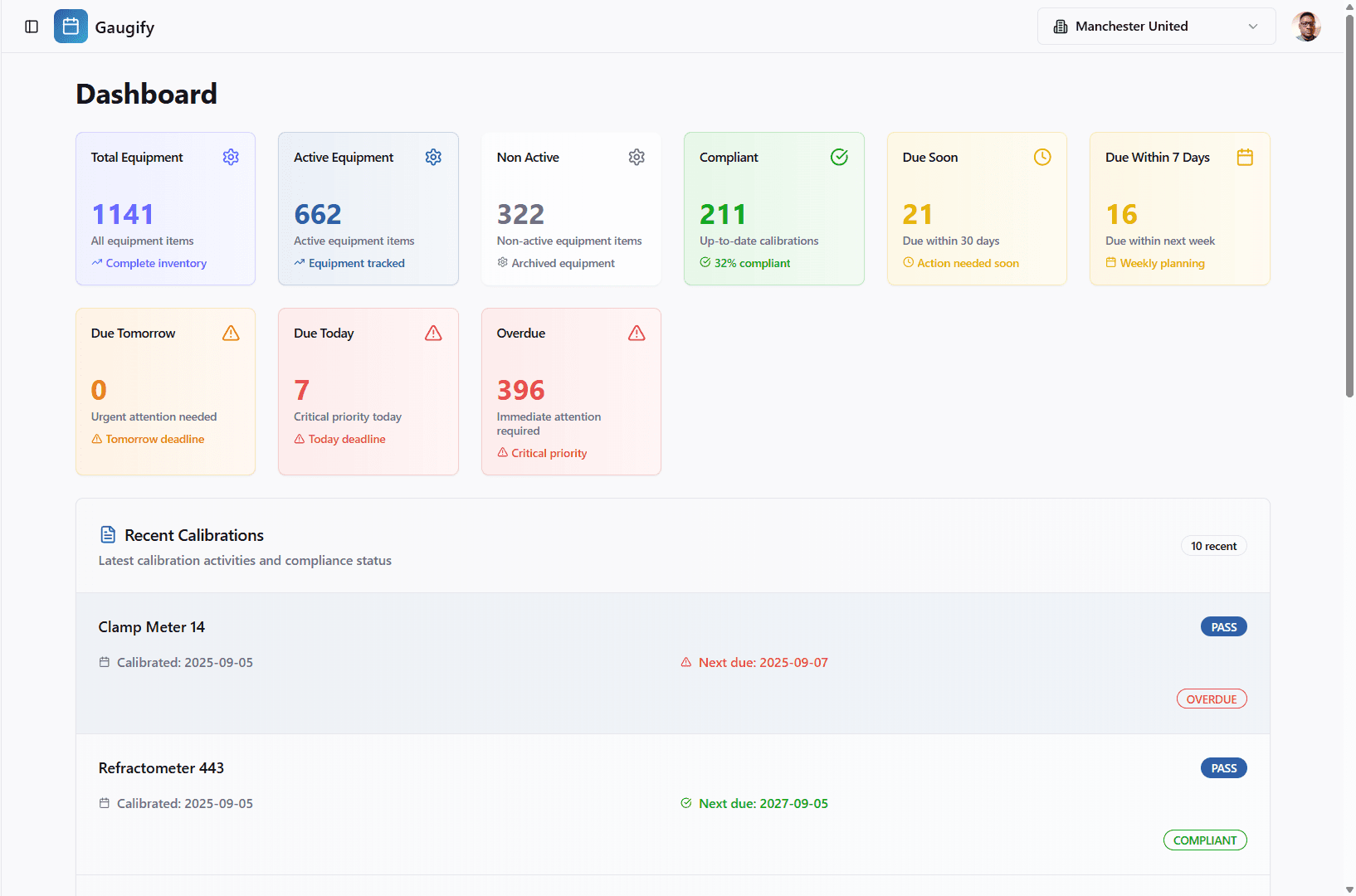
For organizations with multiple laser trackers across different facilities, centralized scheduling ensures consistent calibration practices and optimal resource utilization. Quality managers can view calibration status across their entire fleet through intuitive dashboards and reports.
As-Found and As-Left Data Management
Comprehensive calibration records are essential for demonstrating measurement traceability and identifying performance trends. Gaugify captures detailed as-found and as-left data for each laser tracker calibration, including:
Distance measurement errors at multiple test points
Angular measurement deviations across the coordinate range
Environmental conditions during calibration
Reference standard information and uncertainties
Adjustment details and final verification results
This detailed data enables powerful trend analysis to optimize calibration intervals and identify potential issues before they impact measurement quality.
Digital Certificate Generation
Gaugify automatically generates professional calibration certificates that meet international standards and customer requirements. Certificates include measurement uncertainty statements, traceability information, and comprehensive test results in formats suitable for quality audits and customer delivery.
Digital certificates are instantly accessible through the cloud platform, eliminating delays and ensuring records are never lost. Custom templates accommodate specific industry requirements and branding needs.
Compliance and Audit Support
Quality auditors increasingly focus on calibration system effectiveness rather than just paperwork compliance. Gaugify's compliance features provide audit-ready documentation and demonstrate systematic calibration management:
Complete calibration histories with full traceability chains
Automated compliance reporting for ISO 9001, AS9100, and ISO 17025
Exception reporting for overdue or failed calibrations
Statistical analysis of measurement system performance
Integration with Measurement Systems
Advanced organizations integrate calibration data directly with their measurement processes. Gaugify's API capabilities enable seamless integration with laser tracker software, automatically updating measurement uncertainty values based on current calibration status.
This integration ensures measurement results always reflect current instrument capabilities and provides automatic alerts when calibration expires during critical measurements.
Transform Your Laser Tracker Calibration Management
Effective laser tracker calibration requires more than just technical expertise—it demands systematic management processes that ensure consistency, compliance, and continuous improvement. Manual calibration tracking creates unnecessary risks and inefficiencies that modern software solutions can eliminate.
Gaugify provides the comprehensive calibration management platform that quality-focused organizations need to maintain their laser tracker fleets effectively. From automated scheduling and environmental monitoring integration to statistical analysis and audit-ready reporting, Gaugify handles the complexity while you focus on making accurate measurements.
Whether you're managing a single laser tracker or coordinating calibration across multiple facilities, Gaugify scales to meet your needs. The cloud-based platform provides instant access to calibration data, streamlined workflows, and the visibility needed for effective decision-making.
Don't let inadequate calibration management compromise your measurement quality. Start your free Gaugify trial today and discover how modern calibration management can transform your metrology operations. Experience automated scheduling, comprehensive record-keeping, and powerful analytics that make laser tracker calibration management effortless and reliable.
How to Calibrate Laser Trackers
Laser tracker calibration is a critical process for maintaining the accuracy and reliability of these sophisticated coordinate measuring instruments. With measurement uncertainties as low as ±15 micrometers + 0.6 µm/m, laser trackers demand rigorous calibration protocols to ensure they meet the stringent requirements of aerospace, automotive, and precision manufacturing applications. This comprehensive guide covers everything quality managers and metrologists need to know about calibrating laser trackers effectively.
Understanding Laser Trackers and Their Measurement Capabilities
Laser trackers are portable coordinate measuring machines that use laser interferometry and angular encoders to measure 3D coordinates of points in space. These instruments consist of a base unit containing the laser source, interferometer, and angular measurement system, paired with a spherically mounted retroreflector (SMR) that serves as the target.
Modern laser trackers like the Leica AT960, FARO Vantage, and API Radian series can measure distances up to 80 meters with remarkable precision. They measure three primary parameters:
Distance measurement: Using laser interferometry with typical uncertainties of ±0.5 µm + 0.3 µm/m
Horizontal angle: Measured by rotary encoders with uncertainties around ±15 µrad
Vertical angle: Similarly measured with comparable angular uncertainties
These measurements are converted to Cartesian coordinates (X, Y, Z) through mathematical transformation, making the tracker capable of measuring part dimensions, performing alignments, and guiding assembly operations with exceptional accuracy.
Why Laser Tracker Calibration Is Mission-Critical
The precision demands of industries using laser trackers make calibration absolutely essential. Consider an aerospace manufacturer inspecting a wing assembly with tolerances of ±0.1mm over a 20-meter span. Any drift in the tracker's measurement system could result in accepting out-of-tolerance parts, leading to costly rework or potential safety issues.
Several factors make regular laser tracker calibration crucial:
Environmental sensitivity: Temperature variations affect the laser wavelength and mechanical components
Mechanical wear: Moving parts like gimbal bearings and encoder systems degrade over time
Optical degradation: Laser power output and beam quality can drift
Electronic stability: Amplifier gain and offset parameters require periodic adjustment
Without proper calibration, measurement uncertainties can increase by 200-300% or more, rendering the instrument unsuitable for precision applications. Quality managers must establish robust calibration tracking systems to ensure laser trackers maintain their specified performance levels.
Comprehensive Laser Tracker Calibration Procedure
Performing effective laser tracker calibration requires specialized equipment, controlled environmental conditions, and meticulous attention to detail. Here's the step-by-step process used by accredited calibration laboratories:
Environmental Preparation
Temperature stability is paramount for accurate laser tracker calibration. The calibration environment must be maintained at 20°C ± 1°C with temperature gradients not exceeding 0.5°C per meter. Humidity should be controlled between 45-65% RH to prevent condensation and ensure stable air refractive index conditions.
Vibration isolation is equally important. The calibration setup should be isolated from external vibrations using pneumatic or passive isolation systems. Air currents that could affect the laser beam path must be minimized through proper HVAC design and temporary shields if necessary.
Reference Standards and Setup
The primary reference standard for laser tracker calibration is typically a calibrated length standard such as:
Step gauge: Precision steel bars with certified lengths, often 1m, 5m, and 10m nominal lengths
Ball bar: Carbon fiber or invar rods with precision spheres at known distances
Laser interferometer: Traceable to the definition of the meter through stabilized laser wavelength
For angular measurements, calibrated angle blocks or rotary tables with arc-second accuracy serve as reference standards. The measurement uncertainty of reference standards must be at least 3:1 better than the laser tracker's specified uncertainty.
Distance Measurement Calibration
The distance measurement calibration involves comparing the tracker's readings against certified reference lengths at multiple distances throughout the instrument's range:
Warm-up period: Allow the laser tracker to stabilize for minimum 30 minutes after power-on
Baseline measurement: Establish the zero position using the tracker's internal reference
Multi-distance verification: Measure certified artifacts at 2m, 5m, 10m, and maximum range distances
Environmental monitoring: Continuously record temperature, humidity, and atmospheric pressure
Repeatability assessment: Perform 10 repeated measurements at each test distance
Acceptance criteria typically require distance measurements to fall within ±(0.5 µm + 0.3 µm/m) of the certified reference values. Any deviations exceeding these limits indicate the need for internal adjustments or repair.
Angular Measurement Verification
Angular calibration involves positioning calibrated angle artifacts at known positions and comparing tracker readings:
Horizontal angle testing: Using a precision rotary table, verify measurements at 0°, 90°, 180°, and 270° positions
Vertical angle verification: Test elevation angles from -45° to +45° using calibrated angle blocks
Combined angle assessment: Verify angular accuracy throughout the complete spherical coordinate range
Angular measurements should typically agree with reference standards within ±15 microradians (approximately ±3 arc seconds) to meet manufacturer specifications.
Governing Standards for Laser Tracker Calibration
Several international standards provide guidance for laser tracker calibration procedures and requirements:
ASME B89.4.19-2021
This American standard specifically addresses the performance evaluation of laser-based spherical coordinate measurement systems. It defines test procedures for:
Range measurement accuracy and repeatability
Angular measurement uncertainty
Combined coordinate measurement uncertainty
Environmental compensation effectiveness
ISO 10360 Series
While primarily focused on coordinate measuring machines, ISO 10360-10 addresses laser trackers and similar large-scale measurement systems. This standard establishes acceptance and reverification tests for coordinate measuring accuracy.
VDI/VDE 2617-10
This German guideline provides detailed procedures for acceptance testing and periodic verification of laser trackers, including specific test artifacts and evaluation criteria.
Organizations maintaining ISO 17025 accreditation must ensure their laser tracker calibration procedures comply with these relevant standards and maintain full traceability to national measurement standards.
Optimal Calibration Intervals for Laser Tracker Calibration
Determining appropriate calibration intervals for laser trackers requires balancing measurement risk against calibration costs. Most manufacturers recommend annual calibration as a baseline, but several factors can influence this frequency:
Usage-Based Factors
Operating hours: Intensive use accelerates component wear and drift
Transportation frequency: Portable trackers subjected to frequent moves require more frequent calibration
Environmental extremes: Operation in harsh conditions may necessitate quarterly calibration
Application-Driven Requirements
Critical applications may demand more frequent calibration verification:
Aerospace manufacturing: Often requires 6-month calibration intervals
Automotive body-in-white: Monthly or even weekly checks for high-volume production
Research applications: May require pre-measurement verification for critical experiments
Risk-Based Calibration Scheduling
Modern calibration management approaches consider measurement risk and historical performance data. Trackers with stable calibration histories and non-critical applications might extend to 18-month intervals, while those showing drift patterns require more frequent attention.
A comprehensive calibration management system can analyze historical data to optimize calibration intervals based on actual instrument performance rather than arbitrary time periods.
Common Laser Tracker Calibration Mistakes and Prevention
Even experienced metrologists can encounter pitfalls during laser tracker calibration. Understanding these common mistakes helps ensure successful calibration outcomes:
Environmental Control Oversights
Mistake: Insufficient temperature stabilization time before beginning calibration measurements.
Prevention: Allow minimum 2-hour stabilization period after significant temperature changes. Monitor temperature continuously during calibration and reject measurements if temperature varies by more than 0.5°C during a measurement sequence.
Reference Standard Handling Errors
Mistake: Using reference standards beyond their calibration intervals or with insufficient measurement uncertainty ratios.
Prevention: Implement rigorous reference standard management procedures. Verify that all standards have current calibration certificates and maintain at least 4:1 uncertainty ratios where possible. Include reference standard uncertainties in measurement uncertainty budgets.
Atmospheric Compensation Deficiencies
Mistake: Relying on default atmospheric parameters rather than real-time environmental monitoring.
Prevention: Use calibrated temperature, humidity, and pressure sensors to provide real-time atmospheric compensation. Verify compensation accuracy by comparing distance measurements with and without environmental correction.
Inadequate Measurement Sampling
Mistake: Taking insufficient repeat measurements to properly assess repeatability and statistical uncertainty.
Prevention: Perform minimum 10 repeat measurements at each test point. Calculate standard deviations and use appropriate coverage factors for uncertainty calculations. Reject outliers using established statistical criteria.
Ready to eliminate these calibration management headaches? Start your free Gaugify trial and see how automated scheduling, environmental logging integration, and statistical analysis tools can streamline your laser tracker calibration process.
Streamlining Laser Tracker Calibration with Modern Software
Managing laser tracker calibration manually through spreadsheets and paper records creates unnecessary complexity and compliance risks. Modern calibration management systems like Gaugify provide comprehensive solutions specifically designed for high-precision measurement equipment.
Automated Calibration Scheduling
Gaugify's intelligent scheduling system tracks individual laser tracker calibration intervals based on manufacturer recommendations, regulatory requirements, and historical performance data. The system automatically generates work orders, assigns technicians, and sends advance notifications to prevent unexpected downtime.
For organizations with multiple laser trackers across different facilities, centralized scheduling ensures consistent calibration practices and optimal resource utilization. Quality managers can view calibration status across their entire fleet through intuitive dashboards and reports.
As-Found and As-Left Data Management
Comprehensive calibration records are essential for demonstrating measurement traceability and identifying performance trends. Gaugify captures detailed as-found and as-left data for each laser tracker calibration, including:
Distance measurement errors at multiple test points
Angular measurement deviations across the coordinate range
Environmental conditions during calibration
Reference standard information and uncertainties
Adjustment details and final verification results
This detailed data enables powerful trend analysis to optimize calibration intervals and identify potential issues before they impact measurement quality.
Digital Certificate Generation
Gaugify automatically generates professional calibration certificates that meet international standards and customer requirements. Certificates include measurement uncertainty statements, traceability information, and comprehensive test results in formats suitable for quality audits and customer delivery.
Digital certificates are instantly accessible through the cloud platform, eliminating delays and ensuring records are never lost. Custom templates accommodate specific industry requirements and branding needs.
Compliance and Audit Support
Quality auditors increasingly focus on calibration system effectiveness rather than just paperwork compliance. Gaugify's compliance features provide audit-ready documentation and demonstrate systematic calibration management:
Complete calibration histories with full traceability chains
Automated compliance reporting for ISO 9001, AS9100, and ISO 17025
Exception reporting for overdue or failed calibrations
Statistical analysis of measurement system performance
Integration with Measurement Systems
Advanced organizations integrate calibration data directly with their measurement processes. Gaugify's API capabilities enable seamless integration with laser tracker software, automatically updating measurement uncertainty values based on current calibration status.
This integration ensures measurement results always reflect current instrument capabilities and provides automatic alerts when calibration expires during critical measurements.
Transform Your Laser Tracker Calibration Management
Effective laser tracker calibration requires more than just technical expertise—it demands systematic management processes that ensure consistency, compliance, and continuous improvement. Manual calibration tracking creates unnecessary risks and inefficiencies that modern software solutions can eliminate.
Gaugify provides the comprehensive calibration management platform that quality-focused organizations need to maintain their laser tracker fleets effectively. From automated scheduling and environmental monitoring integration to statistical analysis and audit-ready reporting, Gaugify handles the complexity while you focus on making accurate measurements.
Whether you're managing a single laser tracker or coordinating calibration across multiple facilities, Gaugify scales to meet your needs. The cloud-based platform provides instant access to calibration data, streamlined workflows, and the visibility needed for effective decision-making.
Don't let inadequate calibration management compromise your measurement quality. Start your free Gaugify trial today and discover how modern calibration management can transform your metrology operations. Experience automated scheduling, comprehensive record-keeping, and powerful analytics that make laser tracker calibration management effortless and reliable.