
How to Calibrate Angle Blocks and Sine Bars
How to Calibrate Angle Blocks and Sine Bars
David Bentley
Quality Assurance Engineer
12 min read
How to Calibrate Angle Blocks and Sine Bars
Angle block sine bar calibration is essential for maintaining accuracy in precision angle measurements across manufacturing and inspection operations. These fundamental measuring instruments serve as the backbone for setting up workpieces, verifying angular dimensions, and calibrating other angle-measuring devices in machine shops, quality labs, and manufacturing facilities worldwide.
Whether you're working with 1-inch, 5-inch, or 10-inch sine bars, or precision angle blocks ranging from seconds to degrees, proper calibration ensures your angular measurements remain traceable and accurate. This comprehensive guide covers everything quality managers, shop floor supervisors, and lab technicians need to know about calibrating these critical measurement tools.
Understanding Angle Blocks and Sine Bars
Angle blocks are precision-ground steel or ceramic blocks manufactured to specific angular values, typically ranging from 1 second of arc to 45 degrees. Common sets include blocks with angles like 1", 3", 5", 9", 27", 41", and various degree increments. These blocks can be combined through wringing to create virtually any angle within their range, similar to how gage blocks create linear dimensions.
Sine bars are precision fixtures consisting of a hardened steel bar with two cylinders of equal diameter separated by a known distance—typically 5 inches (127mm) or 10 inches (254mm). When used with gage blocks to create a height differential, sine bars enable accurate angle measurement and setup based on trigonometric principles. The sine of the desired angle equals the gage block height divided by the sine bar length.
Both instruments measure angular dimensions with remarkable precision. High-grade angle blocks can achieve accuracies within ±1 second of arc, while sine bars combined with precision gage blocks can measure angles to within ±2 seconds of arc or better when properly calibrated and used.
Why Angle Block Sine Bar Calibration Is Critical
Angular measurement errors compound quickly in manufacturing processes. A deviation of just 30 seconds of arc over a 6-inch dimension results in a linear error of approximately 0.0015 inches—enough to cause part rejection in precision machining applications. Consider these real-world scenarios where calibration accuracy matters:
Aerospace Manufacturing: Turbine blade angles must be held within ±10 seconds of arc to maintain proper airflow characteristics
Automotive Applications: Camshaft lobe profiles require angular accuracy within ±30 seconds to ensure proper valve timing
Medical Device Production: Orthopedic implant surfaces need precise angular relationships within ±1 minute of arc for proper fit
Tool and Die Work: Progressive die angles must be accurate within ±15 seconds to prevent material flow issues
Environmental factors significantly impact angle block and sine bar accuracy. Temperature variations cause thermal expansion that affects both the angular surfaces and the reference cylinders. Mechanical wear from repeated wringing and handling gradually degrades surface flatness and cylindricity. Contamination from oils, coolants, and particles can create measurement errors of several seconds of arc.
Regular calibration catches these drift patterns before they impact production quality. Modern calibration management systems track performance trends and alert technicians when instruments approach their tolerance limits, preventing costly rework and rejected parts.
Step-by-Step Calibration Procedure for Angle Block Sine Bar Calibration
Proper calibration requires controlled environmental conditions, calibrated reference standards, and systematic measurement procedures. Here's the detailed process used in accredited calibration laboratories:
Environmental Requirements
Maintain the calibration area at 68°F ±2°F (20°C ±1°C) with relative humidity between 30-70%. Allow all instruments and standards to stabilize for at least 4 hours before beginning measurements. Vibration levels should not exceed 0.1g at frequencies above 10 Hz to prevent measurement interference.
Reference Standards Required
The following calibrated standards are essential for accurate angle block sine bar calibration:
Master angle blocks with uncertainty ratios of 4:1 or better relative to the instruments under calibration
Precision autocollimator with resolution of 0.1 seconds of arc or better
Optical polygon with 12, 24, or 72 sides for multiple angle verification
Certified gage block set (for sine bar calibration) with Grade 0.5 or better accuracy
Precision surface plate with Grade A flatness
Temperature monitoring equipment with ±0.1°C accuracy
Angle Block Calibration Procedure
Begin by cleaning all surfaces with lint-free cloths and appropriate solvents. Inspect for visible damage, including chips, scratches, or wear patterns that could affect accuracy.
Mount the autocollimator securely and perform a zero reference check using a calibrated mirror. Set up the angle block on the surface plate with its measuring surface perpendicular to the autocollimator's optical axis.
Take five readings at different positions across the angle block surface, rotating the block 120 degrees between measurements to average out any systematic errors. Record all measurements along with temperature and humidity conditions.
For each angle block, the measured value should fall within the manufacturer's specified tolerance, typically ±2 to ±5 seconds of arc depending on the grade. Premium blocks may specify ±1 second tolerance for critical applications.
Sine Bar Calibration Process
Sine bar calibration focuses on verifying the center-to-center distance between cylinders and the parallelism of the bar surface to the cylinder axis. Begin by measuring the nominal length using calibrated measuring equipment with uncertainty better than ±0.00005 inches.
Set up known angles using certified gage blocks and verify the sine bar's ability to reproduce these angles accurately. Test at minimum five angles distributed across the working range: 5°, 15°, 30°, 45°, and 60° are common test points.
For a 5-inch sine bar set to 30 degrees, the required gage block height is 5 × sin(30°) = 2.5000 inches. Measure the actual angle achieved using the autocollimator, comparing it to the calculated theoretical value.
The total angular error should not exceed ±2 seconds of arc for precision-grade sine bars. This translates to length accuracy within ±0.000025 inches for a 5-inch bar at 30 degrees.
Start your free Gaugify trial to digitally capture all calibration data, automatically calculate uncertainties, and generate professional certificates for your angle measurement instruments.
Relevant Calibration Standards
Several national and international standards govern angle block sine bar calibration procedures and requirements:
ISO Standards
ISO 3431: Specifies requirements for angle blocks, including dimensional tolerances, surface quality, and material specifications. This standard defines accuracy grades from 0 (highest precision) to 2 (standard workshop grade).
ISO/IEC 17025: Establishes general requirements for calibration laboratory competence, including measurement traceability, uncertainty calculations, and quality management systems. ISO 17025 compliance software helps laboratories maintain proper documentation and procedures.
ASME Standards
ASME B89.1.12M: Provides methods for verifying angle blocks and sine bars, including reference standards, environmental conditions, and acceptance criteria. This standard specifically addresses the use of autocollimators and optical polygons for angle measurement.
Federal Standards
Federal Standard 3 (FED-STD-3): Military specification for angle blocks used in defense applications, requiring enhanced accuracy and documentation. These standards often specify tighter tolerances than commercial grades.
Manufacturer Specifications
Leading manufacturers like Webber, Brown & Sharpe, Starrett, and Mitutoyo provide detailed specifications for their angle blocks and sine bars. These typically include:
Angular accuracy tolerances ranging from ±1" to ±5" of arc
Surface finish requirements (typically 4-8 microinches Ra)
Parallelism specifications for sine bar surfaces
Cylinder diameter tolerances and roundness requirements
Material specifications and heat treatment requirements
Calibration Intervals and Frequency Considerations
Determining optimal calibration intervals for angle blocks and sine bars requires balancing measurement risk against calibration costs. Industry practice typically follows these guidelines:
Standard Calibration Intervals
Angle Blocks: 12 months for daily-use workshop sets, 24 months for reference standards used primarily for calibration work, and 36 months for master standards in controlled laboratory environments.
Sine Bars: 12 months for production floor instruments, 18 months for inspection department tools, and 24 months for occasional-use reference instruments.
Factors Affecting Calibration Frequency
Several operational factors may require shorter intervals:
Usage Frequency: Daily handling and wringing cycles accelerate surface wear
Environmental Conditions: Temperature variations, humidity, and contamination exposure
Criticality of Application: Aerospace and medical applications often require 6-month intervals
Historical Performance: Instruments showing consistent drift may need more frequent calibration
Risk Assessment: Cost of measurement errors versus calibration expenses
Progressive interval adjustment based on calibration history provides the most cost-effective approach. Instruments consistently found within 50% of tolerance limits may qualify for extended intervals, while those approaching tolerance require shortened cycles.
Common Calibration Mistakes and Prevention Strategies
Avoiding these frequent errors ensures reliable angle block sine bar calibration results:
Temperature-Related Errors
Mistake: Insufficient thermal stabilization before measurement. Moving instruments from different temperature zones creates thermal gradients that affect accuracy for hours.
Prevention: Implement minimum 4-hour stabilization periods. Use temperature monitoring to verify equilibrium conditions. Consider thermal expansion coefficients when calculating corrections.
Surface Preparation Issues
Mistake: Inadequate cleaning leaving residual films or particles that affect wringing and measurement accuracy.
Prevention: Establish systematic cleaning procedures using appropriate solvents. Inspect surfaces under magnification for contamination. Verify proper wringing adhesion between blocks.
Reference Standard Problems
Mistake: Using reference standards with insufficient accuracy ratios or expired calibrations.
Prevention: Maintain 4:1 or 10:1 uncertainty ratios between standards and test instruments. Track reference standard calibration due dates and performance history.
Measurement Technique Errors
Mistake: Taking single measurements without considering repeatability or systematic errors.
Prevention: Implement statistical sampling with multiple measurements. Rotate instruments between readings to average systematic errors. Calculate measurement uncertainty properly.
Documentation Deficiencies
Mistake: Incomplete calibration records missing environmental conditions, standards used, or measurement uncertainty statements.
Prevention: Use standardized calibration forms or digital systems that prompt for all required data. Automated calibration management features prevent documentation gaps while ensuring consistent procedures.
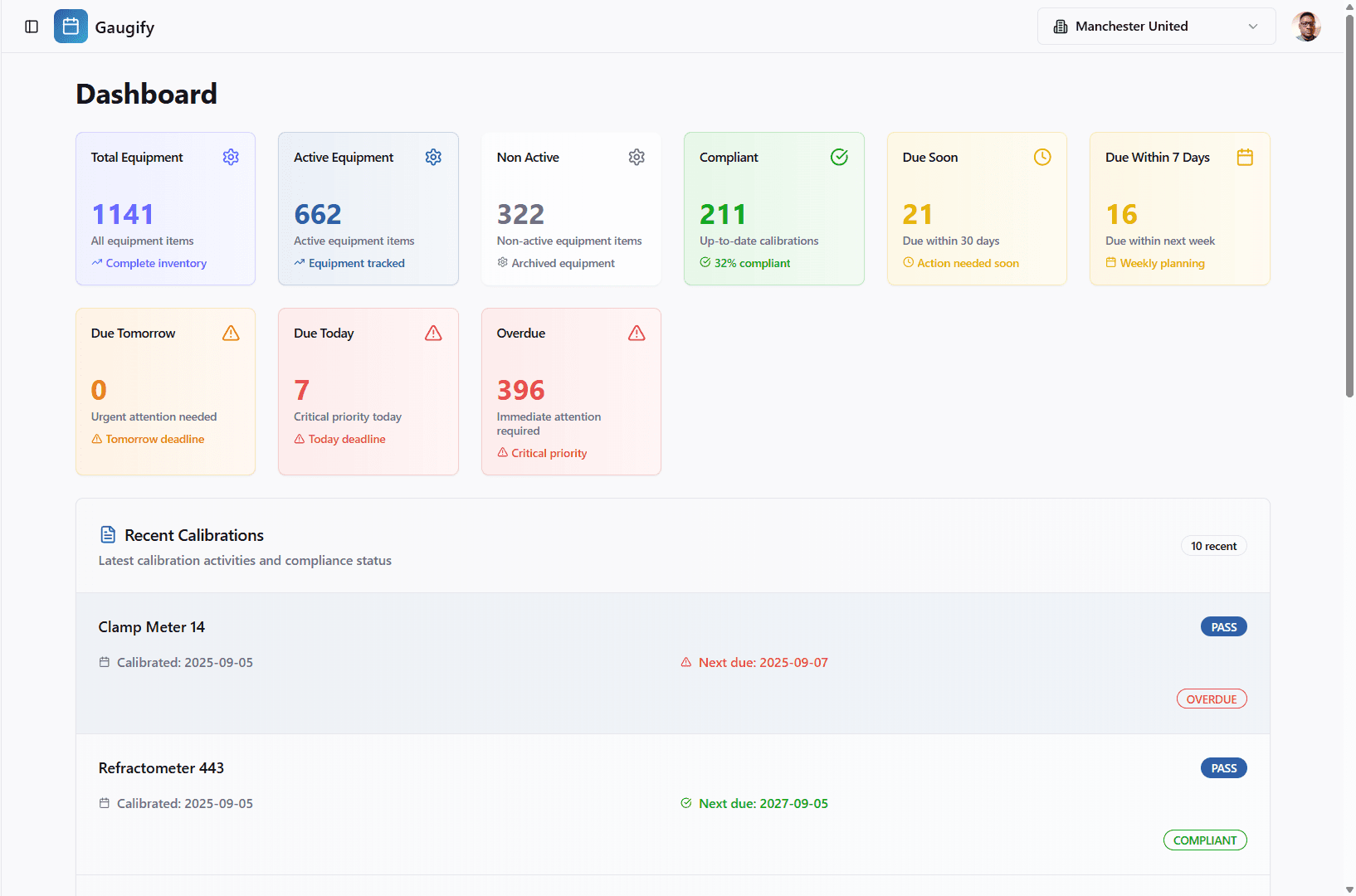
Tracking Angle Block and Sine Bar Calibrations with Gaugify
Modern calibration management requires sophisticated tracking capabilities that go beyond simple spreadsheets or paper records. Gaugify's cloud-based calibration management platform provides comprehensive solutions specifically designed for precision measurement instruments like angle blocks and sine bars.
Automated Scheduling and Reminders
Gaugify automatically tracks calibration due dates for each angle block and sine bar in your inventory. The system sends advance notifications to technicians and managers, preventing accidental use of expired instruments. Custom interval settings accommodate different usage patterns—from 6-month aerospace requirements to 24-month reference standard cycles.
The platform manages complex inventory scenarios where individual blocks within a set may have different calibration histories. For example, frequently used 30° and 45° blocks might require 12-month intervals while specialty angles calibrated annually.
As-Found and As-Left Data Management
Digital data capture eliminates transcription errors while providing instant access to calibration results. Technicians enter measurements directly into mobile devices or tablets, with automatic calculations for angles, uncertainties, and pass/fail determinations.
Trending analysis identifies instruments approaching tolerance limits before they fail calibration. For instance, if an angle block consistently measures +1.5 seconds of arc with ±3 second tolerance, Gaugify flags it for closer monitoring or shortened intervals.
Professional Certificate Generation
Automated certificate generation ensures consistent formatting and complete documentation. Each certificate includes:
Measurement uncertainty statements calculated per ISO/IEC 17025 requirements
Reference standards used with their calibration dates and uncertainties
Environmental conditions during calibration
As-found and as-left measurements for each angle tested
Digital signatures and approval workflows
Traceability statements linking to national standards
Integration with Quality Management Systems
Gaugify integrates seamlessly with existing quality management systems, automatically updating instrument status in production scheduling systems. When an angle block approaches its calibration due date, the system can automatically restrict its use in critical applications while allowing continued service in less demanding work.
Custom reporting capabilities support audit requirements from customers, registrars, and regulatory agencies. Generate comprehensive calibration reports showing compliance with industry standards, on-time performance metrics, and cost analysis for budget planning.
The platform's API enables real-time data exchange with ERP systems, maintenance management software, and statistical process control applications, creating a fully integrated metrology infrastructure.
Start Managing Your Angle Measurement Calibrations Today
Proper angle block sine bar calibration requires attention to detail, appropriate reference standards, and systematic procedures. However, managing the administrative aspects—scheduling, documentation, trending, and reporting—demands equally sophisticated tools.
Gaugify eliminates the complexity of calibration management while ensuring complete compliance with industry standards. Our platform handles everything from automated scheduling to professional certificate generation, freeing your technicians to focus on accurate measurements rather than paperwork.
Ready to streamline your calibration management? Start your free 30-day trial today and discover how Gaugify transforms calibration tracking from a necessary burden into a competitive advantage. No credit card required, and our support team will help you import your existing calibration records within minutes.
For a personalized demonstration of how Gaugify handles angle measurement instruments and other precision tools in your specific industry, schedule a live demo with our calibration management experts.
How to Calibrate Angle Blocks and Sine Bars
Angle block sine bar calibration is essential for maintaining accuracy in precision angle measurements across manufacturing and inspection operations. These fundamental measuring instruments serve as the backbone for setting up workpieces, verifying angular dimensions, and calibrating other angle-measuring devices in machine shops, quality labs, and manufacturing facilities worldwide.
Whether you're working with 1-inch, 5-inch, or 10-inch sine bars, or precision angle blocks ranging from seconds to degrees, proper calibration ensures your angular measurements remain traceable and accurate. This comprehensive guide covers everything quality managers, shop floor supervisors, and lab technicians need to know about calibrating these critical measurement tools.
Understanding Angle Blocks and Sine Bars
Angle blocks are precision-ground steel or ceramic blocks manufactured to specific angular values, typically ranging from 1 second of arc to 45 degrees. Common sets include blocks with angles like 1", 3", 5", 9", 27", 41", and various degree increments. These blocks can be combined through wringing to create virtually any angle within their range, similar to how gage blocks create linear dimensions.
Sine bars are precision fixtures consisting of a hardened steel bar with two cylinders of equal diameter separated by a known distance—typically 5 inches (127mm) or 10 inches (254mm). When used with gage blocks to create a height differential, sine bars enable accurate angle measurement and setup based on trigonometric principles. The sine of the desired angle equals the gage block height divided by the sine bar length.
Both instruments measure angular dimensions with remarkable precision. High-grade angle blocks can achieve accuracies within ±1 second of arc, while sine bars combined with precision gage blocks can measure angles to within ±2 seconds of arc or better when properly calibrated and used.
Why Angle Block Sine Bar Calibration Is Critical
Angular measurement errors compound quickly in manufacturing processes. A deviation of just 30 seconds of arc over a 6-inch dimension results in a linear error of approximately 0.0015 inches—enough to cause part rejection in precision machining applications. Consider these real-world scenarios where calibration accuracy matters:
Aerospace Manufacturing: Turbine blade angles must be held within ±10 seconds of arc to maintain proper airflow characteristics
Automotive Applications: Camshaft lobe profiles require angular accuracy within ±30 seconds to ensure proper valve timing
Medical Device Production: Orthopedic implant surfaces need precise angular relationships within ±1 minute of arc for proper fit
Tool and Die Work: Progressive die angles must be accurate within ±15 seconds to prevent material flow issues
Environmental factors significantly impact angle block and sine bar accuracy. Temperature variations cause thermal expansion that affects both the angular surfaces and the reference cylinders. Mechanical wear from repeated wringing and handling gradually degrades surface flatness and cylindricity. Contamination from oils, coolants, and particles can create measurement errors of several seconds of arc.
Regular calibration catches these drift patterns before they impact production quality. Modern calibration management systems track performance trends and alert technicians when instruments approach their tolerance limits, preventing costly rework and rejected parts.
Step-by-Step Calibration Procedure for Angle Block Sine Bar Calibration
Proper calibration requires controlled environmental conditions, calibrated reference standards, and systematic measurement procedures. Here's the detailed process used in accredited calibration laboratories:
Environmental Requirements
Maintain the calibration area at 68°F ±2°F (20°C ±1°C) with relative humidity between 30-70%. Allow all instruments and standards to stabilize for at least 4 hours before beginning measurements. Vibration levels should not exceed 0.1g at frequencies above 10 Hz to prevent measurement interference.
Reference Standards Required
The following calibrated standards are essential for accurate angle block sine bar calibration:
Master angle blocks with uncertainty ratios of 4:1 or better relative to the instruments under calibration
Precision autocollimator with resolution of 0.1 seconds of arc or better
Optical polygon with 12, 24, or 72 sides for multiple angle verification
Certified gage block set (for sine bar calibration) with Grade 0.5 or better accuracy
Precision surface plate with Grade A flatness
Temperature monitoring equipment with ±0.1°C accuracy
Angle Block Calibration Procedure
Begin by cleaning all surfaces with lint-free cloths and appropriate solvents. Inspect for visible damage, including chips, scratches, or wear patterns that could affect accuracy.
Mount the autocollimator securely and perform a zero reference check using a calibrated mirror. Set up the angle block on the surface plate with its measuring surface perpendicular to the autocollimator's optical axis.
Take five readings at different positions across the angle block surface, rotating the block 120 degrees between measurements to average out any systematic errors. Record all measurements along with temperature and humidity conditions.
For each angle block, the measured value should fall within the manufacturer's specified tolerance, typically ±2 to ±5 seconds of arc depending on the grade. Premium blocks may specify ±1 second tolerance for critical applications.
Sine Bar Calibration Process
Sine bar calibration focuses on verifying the center-to-center distance between cylinders and the parallelism of the bar surface to the cylinder axis. Begin by measuring the nominal length using calibrated measuring equipment with uncertainty better than ±0.00005 inches.
Set up known angles using certified gage blocks and verify the sine bar's ability to reproduce these angles accurately. Test at minimum five angles distributed across the working range: 5°, 15°, 30°, 45°, and 60° are common test points.
For a 5-inch sine bar set to 30 degrees, the required gage block height is 5 × sin(30°) = 2.5000 inches. Measure the actual angle achieved using the autocollimator, comparing it to the calculated theoretical value.
The total angular error should not exceed ±2 seconds of arc for precision-grade sine bars. This translates to length accuracy within ±0.000025 inches for a 5-inch bar at 30 degrees.
Start your free Gaugify trial to digitally capture all calibration data, automatically calculate uncertainties, and generate professional certificates for your angle measurement instruments.
Relevant Calibration Standards
Several national and international standards govern angle block sine bar calibration procedures and requirements:
ISO Standards
ISO 3431: Specifies requirements for angle blocks, including dimensional tolerances, surface quality, and material specifications. This standard defines accuracy grades from 0 (highest precision) to 2 (standard workshop grade).
ISO/IEC 17025: Establishes general requirements for calibration laboratory competence, including measurement traceability, uncertainty calculations, and quality management systems. ISO 17025 compliance software helps laboratories maintain proper documentation and procedures.
ASME Standards
ASME B89.1.12M: Provides methods for verifying angle blocks and sine bars, including reference standards, environmental conditions, and acceptance criteria. This standard specifically addresses the use of autocollimators and optical polygons for angle measurement.
Federal Standards
Federal Standard 3 (FED-STD-3): Military specification for angle blocks used in defense applications, requiring enhanced accuracy and documentation. These standards often specify tighter tolerances than commercial grades.
Manufacturer Specifications
Leading manufacturers like Webber, Brown & Sharpe, Starrett, and Mitutoyo provide detailed specifications for their angle blocks and sine bars. These typically include:
Angular accuracy tolerances ranging from ±1" to ±5" of arc
Surface finish requirements (typically 4-8 microinches Ra)
Parallelism specifications for sine bar surfaces
Cylinder diameter tolerances and roundness requirements
Material specifications and heat treatment requirements
Calibration Intervals and Frequency Considerations
Determining optimal calibration intervals for angle blocks and sine bars requires balancing measurement risk against calibration costs. Industry practice typically follows these guidelines:
Standard Calibration Intervals
Angle Blocks: 12 months for daily-use workshop sets, 24 months for reference standards used primarily for calibration work, and 36 months for master standards in controlled laboratory environments.
Sine Bars: 12 months for production floor instruments, 18 months for inspection department tools, and 24 months for occasional-use reference instruments.
Factors Affecting Calibration Frequency
Several operational factors may require shorter intervals:
Usage Frequency: Daily handling and wringing cycles accelerate surface wear
Environmental Conditions: Temperature variations, humidity, and contamination exposure
Criticality of Application: Aerospace and medical applications often require 6-month intervals
Historical Performance: Instruments showing consistent drift may need more frequent calibration
Risk Assessment: Cost of measurement errors versus calibration expenses
Progressive interval adjustment based on calibration history provides the most cost-effective approach. Instruments consistently found within 50% of tolerance limits may qualify for extended intervals, while those approaching tolerance require shortened cycles.
Common Calibration Mistakes and Prevention Strategies
Avoiding these frequent errors ensures reliable angle block sine bar calibration results:
Temperature-Related Errors
Mistake: Insufficient thermal stabilization before measurement. Moving instruments from different temperature zones creates thermal gradients that affect accuracy for hours.
Prevention: Implement minimum 4-hour stabilization periods. Use temperature monitoring to verify equilibrium conditions. Consider thermal expansion coefficients when calculating corrections.
Surface Preparation Issues
Mistake: Inadequate cleaning leaving residual films or particles that affect wringing and measurement accuracy.
Prevention: Establish systematic cleaning procedures using appropriate solvents. Inspect surfaces under magnification for contamination. Verify proper wringing adhesion between blocks.
Reference Standard Problems
Mistake: Using reference standards with insufficient accuracy ratios or expired calibrations.
Prevention: Maintain 4:1 or 10:1 uncertainty ratios between standards and test instruments. Track reference standard calibration due dates and performance history.
Measurement Technique Errors
Mistake: Taking single measurements without considering repeatability or systematic errors.
Prevention: Implement statistical sampling with multiple measurements. Rotate instruments between readings to average systematic errors. Calculate measurement uncertainty properly.
Documentation Deficiencies
Mistake: Incomplete calibration records missing environmental conditions, standards used, or measurement uncertainty statements.
Prevention: Use standardized calibration forms or digital systems that prompt for all required data. Automated calibration management features prevent documentation gaps while ensuring consistent procedures.
Tracking Angle Block and Sine Bar Calibrations with Gaugify
Modern calibration management requires sophisticated tracking capabilities that go beyond simple spreadsheets or paper records. Gaugify's cloud-based calibration management platform provides comprehensive solutions specifically designed for precision measurement instruments like angle blocks and sine bars.
Automated Scheduling and Reminders
Gaugify automatically tracks calibration due dates for each angle block and sine bar in your inventory. The system sends advance notifications to technicians and managers, preventing accidental use of expired instruments. Custom interval settings accommodate different usage patterns—from 6-month aerospace requirements to 24-month reference standard cycles.
The platform manages complex inventory scenarios where individual blocks within a set may have different calibration histories. For example, frequently used 30° and 45° blocks might require 12-month intervals while specialty angles calibrated annually.
As-Found and As-Left Data Management
Digital data capture eliminates transcription errors while providing instant access to calibration results. Technicians enter measurements directly into mobile devices or tablets, with automatic calculations for angles, uncertainties, and pass/fail determinations.
Trending analysis identifies instruments approaching tolerance limits before they fail calibration. For instance, if an angle block consistently measures +1.5 seconds of arc with ±3 second tolerance, Gaugify flags it for closer monitoring or shortened intervals.
Professional Certificate Generation
Automated certificate generation ensures consistent formatting and complete documentation. Each certificate includes:
Measurement uncertainty statements calculated per ISO/IEC 17025 requirements
Reference standards used with their calibration dates and uncertainties
Environmental conditions during calibration
As-found and as-left measurements for each angle tested
Digital signatures and approval workflows
Traceability statements linking to national standards
Integration with Quality Management Systems
Gaugify integrates seamlessly with existing quality management systems, automatically updating instrument status in production scheduling systems. When an angle block approaches its calibration due date, the system can automatically restrict its use in critical applications while allowing continued service in less demanding work.
Custom reporting capabilities support audit requirements from customers, registrars, and regulatory agencies. Generate comprehensive calibration reports showing compliance with industry standards, on-time performance metrics, and cost analysis for budget planning.
The platform's API enables real-time data exchange with ERP systems, maintenance management software, and statistical process control applications, creating a fully integrated metrology infrastructure.
Start Managing Your Angle Measurement Calibrations Today
Proper angle block sine bar calibration requires attention to detail, appropriate reference standards, and systematic procedures. However, managing the administrative aspects—scheduling, documentation, trending, and reporting—demands equally sophisticated tools.
Gaugify eliminates the complexity of calibration management while ensuring complete compliance with industry standards. Our platform handles everything from automated scheduling to professional certificate generation, freeing your technicians to focus on accurate measurements rather than paperwork.
Ready to streamline your calibration management? Start your free 30-day trial today and discover how Gaugify transforms calibration tracking from a necessary burden into a competitive advantage. No credit card required, and our support team will help you import your existing calibration records within minutes.
For a personalized demonstration of how Gaugify handles angle measurement instruments and other precision tools in your specific industry, schedule a live demo with our calibration management experts.