
How to Calibrate Autoclave and Sterilizers
How to Calibrate Autoclave and Sterilizers
David Bentley
Quality Assurance Engineer
12 min read
How to Calibrate Autoclave and Sterilizers
Proper autoclave calibration is essential for ensuring that your sterilization equipment operates within critical safety and efficacy parameters. Autoclaves and sterilizers are precision instruments that use pressurized steam to eliminate microorganisms from medical devices, laboratory equipment, and pharmaceutical products. When these instruments drift out of specification, the consequences can be severe—from compromised patient safety to failed regulatory audits and product recalls.
This comprehensive guide walks you through the complete autoclave calibration process, covering everything from preparation and procedures to documentation requirements and common pitfalls to avoid.
Understanding Autoclaves and Their Critical Measurements
Autoclaves are pressure vessels that sterilize equipment using saturated steam under pressure. They operate by combining three critical parameters: temperature, pressure, and time. The most common sterilization cycle operates at 121°C (250°F) at 15 PSI for 15-20 minutes, though specific requirements vary based on load type and sterilization standards.
Modern autoclaves measure and control multiple parameters simultaneously:
Temperature: Typically ranging from 100°C to 135°C, measured by RTDs or thermocouples
Pressure: Usually 0-30 PSI gauge pressure, monitored by pressure transducers
Time: Cycle duration and exposure time tracking
Steam quality: Some units monitor steam dryness and superheat
Load temperature: Internal probes verify actual sterilization temperatures
These measurements work together to ensure the sterilization process achieves the required sterility assurance level (SAL), typically 10^-6 for medical devices.
Why Autoclave Calibration Is Mission-Critical
Unlike many other instruments where calibration drift might cause quality issues, autoclave calibration directly impacts patient safety and regulatory compliance. Here's why autoclave calibration cannot be overlooked:
Patient Safety Impact: An autoclave reading 121°C when it's actually operating at 118°C may not achieve adequate sterilization. This 3°C difference could mean the difference between a 6-log reduction and a 4-log reduction in microbial load—potentially leaving viable pathogens on surgical instruments.
Regulatory Requirements: FDA 21 CFR Part 820, ISO 13485, and EU MDR all require validated sterilization processes. During a recent FDA inspection at a Class II medical device manufacturer, investigators identified autoclave temperature variations of ±4°C from setpoint, resulting in a 483 observation and required process validation studies.
Process Validation: Sterilization validation protocols like ISO 17665 require documented evidence that temperature and pressure sensors are calibrated and operating within specified tolerances before qualification testing begins.
Cost of Failure: A pharmaceutical company recently recalled $2.3 million worth of products after discovering their autoclave temperature sensor had drifted 5°C out of specification, potentially compromising sterility of aseptically processed products.
Step-by-Step Autoclave Calibration Procedure
Proper autoclave calibration requires precision, the right reference standards, and strict adherence to documented procedures. Here's the detailed process:
Pre-Calibration Preparation
Before beginning calibration, ensure environmental conditions are stable. The calibration area should maintain 20°C ±5°C with relative humidity below 80%. Allow the autoclave to reach thermal equilibrium—typically requiring 30-60 minutes of warm-up time after the last sterilization cycle.
Gather your reference standards:
Temperature standard: Calibrated RTD or thermocouple with accuracy of ±0.1°C, traceable to NIST
Pressure standard: Digital pressure gauge with 0.025% full-scale accuracy
Data logger: Multi-channel system for simultaneous temperature and pressure monitoring
Temperature Calibration Process
Temperature calibration typically involves both chamber and drain temperature sensors. Position your reference temperature probe at the geometric center of the chamber, ensuring it doesn't contact chamber walls or fixtures.
Run a standard sterilization cycle (121°C, 15 PSI) while simultaneously monitoring both the autoclave's temperature display and your reference standard. Record readings every 30 seconds during the sterilization phase when temperatures should be most stable.
Acceptance Criteria: Most facilities establish temperature accuracy requirements of ±1°C for sterilization applications, though some critical applications may require ±0.5°C. The key is consistency—temperature should remain within ±0.5°C of setpoint throughout the sterilization cycle.
Pressure Calibration Verification
Connect your reference pressure gauge to the autoclave's pressure port using appropriate fittings. Many autoclaves have dedicated calibration ports; if not, you may need to temporarily install a tee fitting in the pressure line.
Test at minimum three pressure points: 0 PSI (atmospheric), 15 PSI (standard sterilization pressure), and the maximum operating pressure (usually 25-30 PSI). Hold each pressure point for at least 2 minutes to ensure stability before recording readings.
Acceptance Criteria: Pressure accuracy typically requires ±0.5 PSI or ±2% of reading, whichever is greater. The pressure gauge should also demonstrate good repeatability when cycling between pressures.
Relevant Standards and Compliance Requirements
Several critical standards govern autoclave calibration procedures and requirements:
ISO 17665 (Sterilization of health care products) establishes requirements for moist heat sterilization processes, including calibration of temperature and pressure measuring systems. This standard requires that measuring instruments have documented calibration certificates and operate within validated tolerances.
AAMI ST8 (Hospital steam sterilizers) provides specific guidance for healthcare facilities, requiring temperature accuracy within ±2°C and pressure accuracy within ±10 kPa (±1.5 PSI) for routine monitoring.
USP <1211> (Sterilization and Sterility Assurance) outlines pharmaceutical industry requirements, emphasizing the need for calibrated instrumentation throughout sterilization validation and routine monitoring.
NIST SP 1800-23 provides cybersecurity guidance for medical devices, which increasingly applies to networked autoclave systems with digital calibration capabilities.
For laboratories operating under ISO 17025 accreditation, autoclave calibration must be performed using accredited calibration services or documented internal procedures with appropriate reference standards and uncertainty calculations.
Optimal Calibration Intervals and Influencing Factors
Determining the right calibration frequency for your autoclave requires balancing risk, regulatory requirements, and operational efficiency. Most facilities calibrate autoclaves annually, but several factors may warrant more frequent intervals:
Usage Intensity: Autoclaves running 8-10 cycles daily experience more thermal stress than units used occasionally. High-throughput facilities often calibrate quarterly or semi-annually. A busy hospital sterile processing department running 15+ cycles daily calibrates their primary autoclaves every 6 months after experiencing temperature sensor drift issues.
Critical Applications: Autoclaves used for sterile pharmaceutical manufacturing or implantable medical device processing may require monthly calibration verification, with full calibration every 6 months.
Regulatory Requirements: Some FDA-regulated facilities must calibrate before each validation study and at intervals specified in their quality systems. EU MDR requirements may necessitate more frequent calibration for Class III medical device manufacturers.
Historical Performance: Track your autoclave's calibration history. Units consistently passing calibration with minimal drift can often extend intervals, while units showing drift patterns may need more frequent attention.
Consider implementing a risk-based approach: perform simplified accuracy checks monthly using portable temperature/pressure indicators, with full calibration annually. This catches significant drift early while minimizing downtime.
Start Your Free Trial of Gaugify Today
Common Autoclave Calibration Mistakes and How to Avoid Them
Even experienced technicians can fall into calibration traps that compromise accuracy and compliance. Here are the most frequent mistakes and proven strategies to avoid them:
Inadequate Thermal Equilibration
The most common error is rushing the calibration process. Chamber temperatures can take 45-60 minutes to stabilize after the previous cycle, especially in large autoclaves. A medical device manufacturer discovered their "failing" temperature calibrations were actually due to insufficient equilibration time—their chamber was still cooling from the previous cycle.
Solution: Always wait for complete thermal equilibration. Monitor chamber temperature for at least 15 minutes of stability (±0.2°C variation) before beginning calibration measurements.
Improper Reference Probe Placement
Placing temperature probes near chamber walls, heating elements, or drain lines gives false readings due to thermal gradients. Even a few inches can make a 2-3°C difference in large chambers.
Solution: Position reference probes at the geometric center of the usable chamber volume, supported by non-metallic fixtures that don't conduct heat. Use the same locations consistently for trend analysis.
Ignoring Steam Quality
Wet steam or superheated steam affects sterilization efficacy, but many calibration procedures only verify temperature and pressure. A pharmaceutical facility discovered their autoclave was producing superheated steam (dry heat sterilization mode) while temperature and pressure readings appeared normal.
Solution: Include steam quality verification using appropriate test methods. Monitor for condensate formation and verify steam isn't superheated by more than 5-10°C above saturation temperature.
Documentation Gaps
Incomplete or missing calibration records create compliance nightmares. FDA inspectors frequently cite facilities for inadequate calibration documentation, even when the actual calibration was performed correctly.
Solution: Document everything—environmental conditions, reference standards used, raw data, calculations, and acceptance decisions. Include photos of test setup when possible.
Streamlining Autoclave Calibration Management with Modern Software
Managing autoclave calibration manually becomes increasingly complex as facilities grow and regulatory requirements tighten. Gaugify's calibration management software transforms how organizations track, schedule, and document their autoclave calibration programs.
Automated Scheduling and Reminders
Gaugify automatically calculates due dates based on your specific calibration intervals—whether that's quarterly for high-use units or annually for backup systems. The system sends email reminders 30, 14, and 7 days before calibration due dates, ensuring no autoclave goes past due.
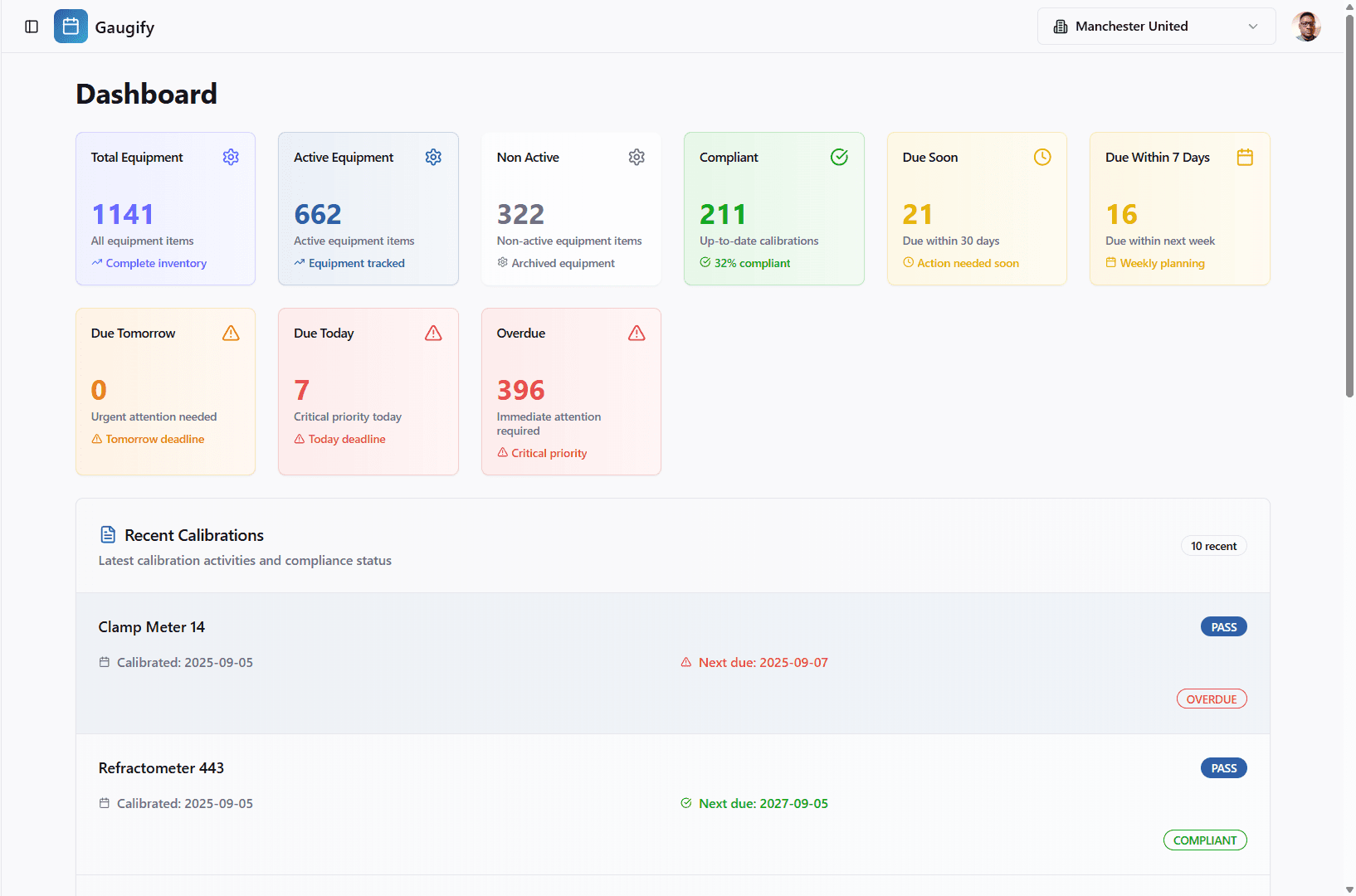
For facilities with multiple autoclaves, Gaugify's dashboard provides a real-time view of calibration status across your entire fleet. Quality managers can instantly identify which units need attention and plan calibration schedules to minimize operational disruption.
Digital Calibration Certificates and Data Management
Traditional paper-based calibration records create storage challenges and make trend analysis nearly impossible. Gaugify's digital platform stores all calibration data in searchable, secure cloud storage with automatic backups.
Upload calibration certificates directly from your calibration service provider or input data from internal calibrations. The system automatically extracts key information—calibration dates, next due dates, as-found and as-left values—and updates your calibration database.
As-Found/As-Left Trending and Analysis
Identifying autoclave drift patterns helps optimize calibration intervals and predict potential failures. Gaugify tracks as-found and as-left values for each calibration, generating trend charts that reveal drift rates over time.
For example, if your autoclave consistently shows +0.5°C drift after 12 months, you can adjust intervals or investigate root causes like aging sensors or control system issues. This data-driven approach improves reliability while potentially extending calibration intervals for stable units.
Compliance Reporting and Audit Readiness
Regulatory audits become significantly easier with Gaugify's compliance reporting features. Generate calibration status reports for all autoclaves, showing current calibration status, due dates, and compliance percentages.
The system maintains complete calibration histories, making it easy to demonstrate compliance over extended periods. During FDA inspections or ISO audits, you can quickly produce calibration records for any specific time period or piece of equipment.
Integration with Maintenance and Quality Systems
Autoclave calibration doesn't exist in isolation—it's part of a broader equipment maintenance and quality system. Gaugify integrates with maintenance management systems, automatically creating work orders when calibration identifies out-of-tolerance conditions.
The platform also supports multi-location organizations, providing centralized visibility across facilities while maintaining site-specific workflows and approval processes.
Cost-Benefit Analysis of Proper Autoclave Calibration
While calibration represents a direct cost, the return on investment becomes clear when considering the alternatives. A properly calibrated autoclave operating at 121°C ±0.5°C provides consistent, validated sterilization. An uncalibrated unit drifting to 118°C may require extended cycle times, waste energy, or worse—fail to achieve sterility.
Consider a mid-size medical device manufacturer with three production autoclaves:
Annual calibration cost: $2,400 (external service) or $1,200 (internal with proper equipment)
Avoided batch failures: Even one prevented batch loss of $15,000 justifies calibration costs
Regulatory compliance: Avoided 483 observations or warning letters (average remediation cost: $50,000-$200,000)
Process efficiency: Optimal sterilization cycles reduce energy consumption and improve throughput
The math is compelling—autoclave calibration pays for itself many times over through improved reliability, compliance, and operational efficiency.
Future Trends in Autoclave Calibration
Autoclave technology continues evolving, with implications for calibration approaches:
Wireless Sensors: New wireless temperature and pressure sensors enable real-time monitoring during sterilization cycles, providing continuous verification of calibration accuracy.
Predictive Maintenance: AI-powered systems analyze calibration trends and operational data to predict sensor drift and recommend optimal calibration intervals.
Digital Integration: Modern autoclaves with digital interfaces can export calibration data directly to management systems, reducing manual data entry and improving accuracy.
Remote Monitoring: Cloud-connected autoclaves enable remote calibration verification and troubleshooting, reducing downtime and service costs.
Take Control of Your Autoclave Calibration Program
Effective autoclave calibration management requires attention to detail, proper procedures, and robust documentation systems. While the technical aspects are straightforward, managing calibration schedules, tracking trends, and maintaining compliance across multiple units quickly becomes complex.
Gaugify's calibration management platform simplifies this complexity, providing automated scheduling, digital documentation, trend analysis, and compliance reporting in one integrated system. Whether you're managing three autoclaves or thirty, Gaugify ensures no equipment goes past due while providing the documentation you need for regulatory compliance.
Don't let manual calibration tracking put your sterilization program at risk. Modern facilities need modern solutions that scale with their operations while maintaining the highest standards of accuracy and compliance.
Start Your Free 30-Day Trial of Gaugify – No Credit Card Required
Experience firsthand how Gaugify transforms calibration management from a compliance burden into a strategic advantage. Set up your autoclave calibration program, import existing records, and see how automated scheduling and digital documentation improve your operational efficiency.
How to Calibrate Autoclave and Sterilizers
Proper autoclave calibration is essential for ensuring that your sterilization equipment operates within critical safety and efficacy parameters. Autoclaves and sterilizers are precision instruments that use pressurized steam to eliminate microorganisms from medical devices, laboratory equipment, and pharmaceutical products. When these instruments drift out of specification, the consequences can be severe—from compromised patient safety to failed regulatory audits and product recalls.
This comprehensive guide walks you through the complete autoclave calibration process, covering everything from preparation and procedures to documentation requirements and common pitfalls to avoid.
Understanding Autoclaves and Their Critical Measurements
Autoclaves are pressure vessels that sterilize equipment using saturated steam under pressure. They operate by combining three critical parameters: temperature, pressure, and time. The most common sterilization cycle operates at 121°C (250°F) at 15 PSI for 15-20 minutes, though specific requirements vary based on load type and sterilization standards.
Modern autoclaves measure and control multiple parameters simultaneously:
Temperature: Typically ranging from 100°C to 135°C, measured by RTDs or thermocouples
Pressure: Usually 0-30 PSI gauge pressure, monitored by pressure transducers
Time: Cycle duration and exposure time tracking
Steam quality: Some units monitor steam dryness and superheat
Load temperature: Internal probes verify actual sterilization temperatures
These measurements work together to ensure the sterilization process achieves the required sterility assurance level (SAL), typically 10^-6 for medical devices.
Why Autoclave Calibration Is Mission-Critical
Unlike many other instruments where calibration drift might cause quality issues, autoclave calibration directly impacts patient safety and regulatory compliance. Here's why autoclave calibration cannot be overlooked:
Patient Safety Impact: An autoclave reading 121°C when it's actually operating at 118°C may not achieve adequate sterilization. This 3°C difference could mean the difference between a 6-log reduction and a 4-log reduction in microbial load—potentially leaving viable pathogens on surgical instruments.
Regulatory Requirements: FDA 21 CFR Part 820, ISO 13485, and EU MDR all require validated sterilization processes. During a recent FDA inspection at a Class II medical device manufacturer, investigators identified autoclave temperature variations of ±4°C from setpoint, resulting in a 483 observation and required process validation studies.
Process Validation: Sterilization validation protocols like ISO 17665 require documented evidence that temperature and pressure sensors are calibrated and operating within specified tolerances before qualification testing begins.
Cost of Failure: A pharmaceutical company recently recalled $2.3 million worth of products after discovering their autoclave temperature sensor had drifted 5°C out of specification, potentially compromising sterility of aseptically processed products.
Step-by-Step Autoclave Calibration Procedure
Proper autoclave calibration requires precision, the right reference standards, and strict adherence to documented procedures. Here's the detailed process:
Pre-Calibration Preparation
Before beginning calibration, ensure environmental conditions are stable. The calibration area should maintain 20°C ±5°C with relative humidity below 80%. Allow the autoclave to reach thermal equilibrium—typically requiring 30-60 minutes of warm-up time after the last sterilization cycle.
Gather your reference standards:
Temperature standard: Calibrated RTD or thermocouple with accuracy of ±0.1°C, traceable to NIST
Pressure standard: Digital pressure gauge with 0.025% full-scale accuracy
Data logger: Multi-channel system for simultaneous temperature and pressure monitoring
Temperature Calibration Process
Temperature calibration typically involves both chamber and drain temperature sensors. Position your reference temperature probe at the geometric center of the chamber, ensuring it doesn't contact chamber walls or fixtures.
Run a standard sterilization cycle (121°C, 15 PSI) while simultaneously monitoring both the autoclave's temperature display and your reference standard. Record readings every 30 seconds during the sterilization phase when temperatures should be most stable.
Acceptance Criteria: Most facilities establish temperature accuracy requirements of ±1°C for sterilization applications, though some critical applications may require ±0.5°C. The key is consistency—temperature should remain within ±0.5°C of setpoint throughout the sterilization cycle.
Pressure Calibration Verification
Connect your reference pressure gauge to the autoclave's pressure port using appropriate fittings. Many autoclaves have dedicated calibration ports; if not, you may need to temporarily install a tee fitting in the pressure line.
Test at minimum three pressure points: 0 PSI (atmospheric), 15 PSI (standard sterilization pressure), and the maximum operating pressure (usually 25-30 PSI). Hold each pressure point for at least 2 minutes to ensure stability before recording readings.
Acceptance Criteria: Pressure accuracy typically requires ±0.5 PSI or ±2% of reading, whichever is greater. The pressure gauge should also demonstrate good repeatability when cycling between pressures.
Relevant Standards and Compliance Requirements
Several critical standards govern autoclave calibration procedures and requirements:
ISO 17665 (Sterilization of health care products) establishes requirements for moist heat sterilization processes, including calibration of temperature and pressure measuring systems. This standard requires that measuring instruments have documented calibration certificates and operate within validated tolerances.
AAMI ST8 (Hospital steam sterilizers) provides specific guidance for healthcare facilities, requiring temperature accuracy within ±2°C and pressure accuracy within ±10 kPa (±1.5 PSI) for routine monitoring.
USP <1211> (Sterilization and Sterility Assurance) outlines pharmaceutical industry requirements, emphasizing the need for calibrated instrumentation throughout sterilization validation and routine monitoring.
NIST SP 1800-23 provides cybersecurity guidance for medical devices, which increasingly applies to networked autoclave systems with digital calibration capabilities.
For laboratories operating under ISO 17025 accreditation, autoclave calibration must be performed using accredited calibration services or documented internal procedures with appropriate reference standards and uncertainty calculations.
Optimal Calibration Intervals and Influencing Factors
Determining the right calibration frequency for your autoclave requires balancing risk, regulatory requirements, and operational efficiency. Most facilities calibrate autoclaves annually, but several factors may warrant more frequent intervals:
Usage Intensity: Autoclaves running 8-10 cycles daily experience more thermal stress than units used occasionally. High-throughput facilities often calibrate quarterly or semi-annually. A busy hospital sterile processing department running 15+ cycles daily calibrates their primary autoclaves every 6 months after experiencing temperature sensor drift issues.
Critical Applications: Autoclaves used for sterile pharmaceutical manufacturing or implantable medical device processing may require monthly calibration verification, with full calibration every 6 months.
Regulatory Requirements: Some FDA-regulated facilities must calibrate before each validation study and at intervals specified in their quality systems. EU MDR requirements may necessitate more frequent calibration for Class III medical device manufacturers.
Historical Performance: Track your autoclave's calibration history. Units consistently passing calibration with minimal drift can often extend intervals, while units showing drift patterns may need more frequent attention.
Consider implementing a risk-based approach: perform simplified accuracy checks monthly using portable temperature/pressure indicators, with full calibration annually. This catches significant drift early while minimizing downtime.
Start Your Free Trial of Gaugify Today
Common Autoclave Calibration Mistakes and How to Avoid Them
Even experienced technicians can fall into calibration traps that compromise accuracy and compliance. Here are the most frequent mistakes and proven strategies to avoid them:
Inadequate Thermal Equilibration
The most common error is rushing the calibration process. Chamber temperatures can take 45-60 minutes to stabilize after the previous cycle, especially in large autoclaves. A medical device manufacturer discovered their "failing" temperature calibrations were actually due to insufficient equilibration time—their chamber was still cooling from the previous cycle.
Solution: Always wait for complete thermal equilibration. Monitor chamber temperature for at least 15 minutes of stability (±0.2°C variation) before beginning calibration measurements.
Improper Reference Probe Placement
Placing temperature probes near chamber walls, heating elements, or drain lines gives false readings due to thermal gradients. Even a few inches can make a 2-3°C difference in large chambers.
Solution: Position reference probes at the geometric center of the usable chamber volume, supported by non-metallic fixtures that don't conduct heat. Use the same locations consistently for trend analysis.
Ignoring Steam Quality
Wet steam or superheated steam affects sterilization efficacy, but many calibration procedures only verify temperature and pressure. A pharmaceutical facility discovered their autoclave was producing superheated steam (dry heat sterilization mode) while temperature and pressure readings appeared normal.
Solution: Include steam quality verification using appropriate test methods. Monitor for condensate formation and verify steam isn't superheated by more than 5-10°C above saturation temperature.
Documentation Gaps
Incomplete or missing calibration records create compliance nightmares. FDA inspectors frequently cite facilities for inadequate calibration documentation, even when the actual calibration was performed correctly.
Solution: Document everything—environmental conditions, reference standards used, raw data, calculations, and acceptance decisions. Include photos of test setup when possible.
Streamlining Autoclave Calibration Management with Modern Software
Managing autoclave calibration manually becomes increasingly complex as facilities grow and regulatory requirements tighten. Gaugify's calibration management software transforms how organizations track, schedule, and document their autoclave calibration programs.
Automated Scheduling and Reminders
Gaugify automatically calculates due dates based on your specific calibration intervals—whether that's quarterly for high-use units or annually for backup systems. The system sends email reminders 30, 14, and 7 days before calibration due dates, ensuring no autoclave goes past due.
For facilities with multiple autoclaves, Gaugify's dashboard provides a real-time view of calibration status across your entire fleet. Quality managers can instantly identify which units need attention and plan calibration schedules to minimize operational disruption.
Digital Calibration Certificates and Data Management
Traditional paper-based calibration records create storage challenges and make trend analysis nearly impossible. Gaugify's digital platform stores all calibration data in searchable, secure cloud storage with automatic backups.
Upload calibration certificates directly from your calibration service provider or input data from internal calibrations. The system automatically extracts key information—calibration dates, next due dates, as-found and as-left values—and updates your calibration database.
As-Found/As-Left Trending and Analysis
Identifying autoclave drift patterns helps optimize calibration intervals and predict potential failures. Gaugify tracks as-found and as-left values for each calibration, generating trend charts that reveal drift rates over time.
For example, if your autoclave consistently shows +0.5°C drift after 12 months, you can adjust intervals or investigate root causes like aging sensors or control system issues. This data-driven approach improves reliability while potentially extending calibration intervals for stable units.
Compliance Reporting and Audit Readiness
Regulatory audits become significantly easier with Gaugify's compliance reporting features. Generate calibration status reports for all autoclaves, showing current calibration status, due dates, and compliance percentages.
The system maintains complete calibration histories, making it easy to demonstrate compliance over extended periods. During FDA inspections or ISO audits, you can quickly produce calibration records for any specific time period or piece of equipment.
Integration with Maintenance and Quality Systems
Autoclave calibration doesn't exist in isolation—it's part of a broader equipment maintenance and quality system. Gaugify integrates with maintenance management systems, automatically creating work orders when calibration identifies out-of-tolerance conditions.
The platform also supports multi-location organizations, providing centralized visibility across facilities while maintaining site-specific workflows and approval processes.
Cost-Benefit Analysis of Proper Autoclave Calibration
While calibration represents a direct cost, the return on investment becomes clear when considering the alternatives. A properly calibrated autoclave operating at 121°C ±0.5°C provides consistent, validated sterilization. An uncalibrated unit drifting to 118°C may require extended cycle times, waste energy, or worse—fail to achieve sterility.
Consider a mid-size medical device manufacturer with three production autoclaves:
Annual calibration cost: $2,400 (external service) or $1,200 (internal with proper equipment)
Avoided batch failures: Even one prevented batch loss of $15,000 justifies calibration costs
Regulatory compliance: Avoided 483 observations or warning letters (average remediation cost: $50,000-$200,000)
Process efficiency: Optimal sterilization cycles reduce energy consumption and improve throughput
The math is compelling—autoclave calibration pays for itself many times over through improved reliability, compliance, and operational efficiency.
Future Trends in Autoclave Calibration
Autoclave technology continues evolving, with implications for calibration approaches:
Wireless Sensors: New wireless temperature and pressure sensors enable real-time monitoring during sterilization cycles, providing continuous verification of calibration accuracy.
Predictive Maintenance: AI-powered systems analyze calibration trends and operational data to predict sensor drift and recommend optimal calibration intervals.
Digital Integration: Modern autoclaves with digital interfaces can export calibration data directly to management systems, reducing manual data entry and improving accuracy.
Remote Monitoring: Cloud-connected autoclaves enable remote calibration verification and troubleshooting, reducing downtime and service costs.
Take Control of Your Autoclave Calibration Program
Effective autoclave calibration management requires attention to detail, proper procedures, and robust documentation systems. While the technical aspects are straightforward, managing calibration schedules, tracking trends, and maintaining compliance across multiple units quickly becomes complex.
Gaugify's calibration management platform simplifies this complexity, providing automated scheduling, digital documentation, trend analysis, and compliance reporting in one integrated system. Whether you're managing three autoclaves or thirty, Gaugify ensures no equipment goes past due while providing the documentation you need for regulatory compliance.
Don't let manual calibration tracking put your sterilization program at risk. Modern facilities need modern solutions that scale with their operations while maintaining the highest standards of accuracy and compliance.
Start Your Free 30-Day Trial of Gaugify – No Credit Card Required
Experience firsthand how Gaugify transforms calibration management from a compliance burden into a strategic advantage. Set up your autoclave calibration program, import existing records, and see how automated scheduling and digital documentation improve your operational efficiency.